This is our moment to start thinking differently, and it’s going to be our last chance.
Introducing In Our Nature, our #podcast on how protecting and restoring #nature can help us adapt to #climatechange. Follow us on YouTube, Spotify, or Apple Podcasts: https://t.co/GDkteYTyUk
We dive into both their experiences in our third episode, Science Is A Two-Way Street. Listen now on YouTube, Spotify, and Apple Podcasts: https://t.co/GDkteYTyUk
This episode is supported by @honeywell.
In a warming world, we need science to be accessible to all people – especially those dealing with the crisis firsthand. But we also have a lot we can learn about the #Earth from the people who live in deep connection with their #ecosystems. ✨
🫛Somnath Bontle, the headmaster of a local school in Bhojdari village, talks about how much knowledge tribal communities have about their ecosystems. It shows just how much these communities can contribute to ecology and climate science, if brought into the conversation.
Listen to the third episode, Science Is A Two-Way Street, now on YouTube, Spotify, and Apple Podcasts: https://t.co/GDkteYTyUk
This episode is supported by @honeywell.
Traditional knowledge is a precious source of wisdom about the natural world.
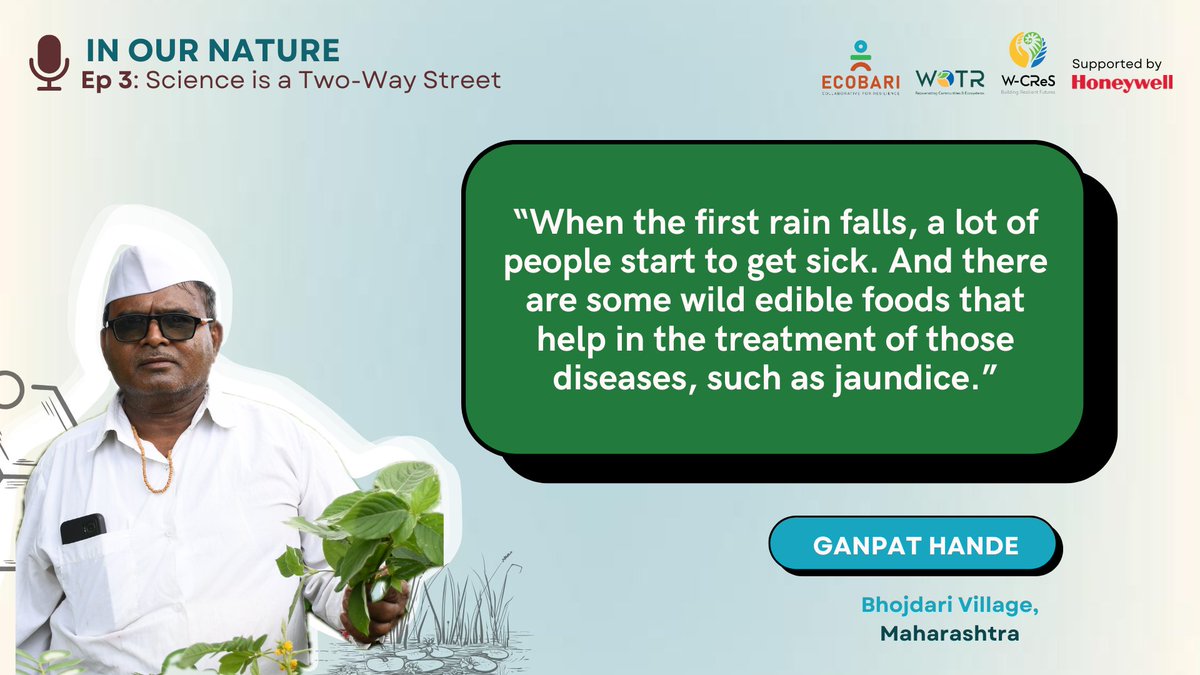
In @ECOBARI’s podcast, #InOurNature, #GanpatHande, the Policy Patil of Bhojdari village, talks about his deep interest in wild edible foods. He’s learned a lot about them from tribal communities.🌱
Ganpat’s story illustrates how communities can contribute to science on conservation and climate adaptation – from Inuit communities in the Arctic to farmers working with @CGIAR.
Learn more by listening to Science Is A Two-Way Street on YouTube, Spotify, and Apple Podcasts: https://t.co/GDkteYTyUk
This episode is supported by @honeywell.
#BhagwatGhagre of Kumbharwadi villages talks about how the realisation that multiple different villages share a single aquifer was a turning point in the way that his community manages water.
But this seemingly simple switch was backed by a detailed hydrogeological survey, a pair of 3D models, and a lot of discussions.
This shows how science can be a powerful tool to make the invisible visible, which is extremely relevant in the midst of the climate crisis.
⚡️ Climate change has got a lot to do with science ⚡️
Science is an incredible tool we use to figure out how the world works. In the era of climate change, it’s played a major role in helping us protect our planet and ourselves. But not everyone has access to science.
🌿Ganpat Hande of Bhojdari village shows us how much tribal communities know of their local landscapes, demonstrating the critical role they can play in conservation; and a special mention of @Keystone Foundation for how beautifully their work illustrates this!
We dive into their experiences + many lessons on ecosystem restoration, climate resilience, and human nature, in our second episode, #FoodForThought. Listen now on YouTube, Spotify, and Apple Podcasts: https://t.co/GDkteYTyUk
This episode is supported by @Honeywell. (4/4)
We are connected to our foods in so many ways, sometimes even more than we can imagine. In the second episode of ECOBARI’s podcast, #InOurNature, @Scientistinpink, and @ChefTZac discuss how much food can teach us about our relationship with nature. (1/4)
🍀 Zach shows how our emotional connection with food can be a powerful driving force to get us to act on climate change, because of how intimately the two are connected. (3/4)