Applying behavioural science to help make people happier, healthier, and wealthier with @irrationallabs. All views are personal. Retweets are not endorsements.
I am making the move to the place where skies are bluest.
If you are interested in behavioral economics, experiments, policy, and using behavioral design for good in big tech, find me over there with the same handle @EF110Econ .
And if you are someone I follow, please join me!
Climate change terminology does not influence willingness to take climate action
Our new paper (N=6,132, across 63 countries) suggests that focusing on subtle terminology in climate messaging is not an effective use of resources. https://t.co/iV8dloIonv
Led by @dgoldwert & @kim_doell
Why do we dislike inflation?
🚨New paper for @BrookingsInst revisits this long-standing question, already asked by @RobertJShiller in 1997, with current data and survey methods. Some key findings:🧵 1/10
https://t.co/V82VK8KF1G
We don't encourage order cancellation at Zomato, because it leads to a tremendous amount of food wastage.
Inspite of stringent policies, and and a no-refund policy for cancellations, more than 4 lakh perfectly good orders get canceled on Zomato, for various reasons by customers.
The top concern for us, the restaurant industry, and even the customers who cancel these orders, is to somehow save the food from going to waste.
Today, we are introducing a new feature (being scaled as we speak) – Food Rescue!
Canceled orders will now pop up for nearby customers, who can grab them at an unbeatable price, in their original untampered packaging, and receive them in just minutes.
If you are product manager at a large tech company, a researcher in this area, or just curious about how to reduce online harms. This talk is for you!
Register here: https://t.co/RGbajfDKsu
🎙️🖥️ I'm hosting a webinar on applying behavioral science to trust and safety to reduce harms online next Friday Nov 15th @ 9am PST.
I will review the latest experimental evidence as well as some @IrrationalLabs case studies in this area.
Join me! 🎙️ 🖥️
Link in replies.
📣 New paper: Using survey experiment pre-testing to support future pandemic response
📝 @Ben_Tappin & Luke B Hewitt analysed the cost-effectiveness of survey experiments to pre-test public health messages.
#CostEffectiveness#Research#Surveys
https://t.co/VDm9nsH7vn
Lots of talk about the reduction in the electric car grants. 6 months ago the OECD review of transport in Ireland said: 🧵
"Subsidies for private electric cars are an expensive and regressive way to reduce GHG emissions and have also shown low economic return"
Posting this again given some of the discussion around the announcement of the green licence plates and associated talk about the grant reduction harming ev sales.
Lots of talk on Irish econ Twitter about the reduction to the electric vehicle grant.
Some thoughts🧵
First off, why do policy change announcements like this not include evidence for the changes?
The press release made no mention of modelling, international evidence etc 1/n
The reason I say this is that subsidies can help, but they can also lose their additionality over time, especially as prices fall in the market.
We should have evidence based discussion about the impact of subsidies & the marginal impact that money can have elsewhere 3/3
Interesting to see some of the commentary on this.
Was manager of the behavioral economics team at SEAI back in 2019 who recommended this as a small way that could boost ev sales a little bit (evidence wasnt crystal clear but suggestive). Why wait so long to introduce this? 1/3
As sales of electric vehicles in Ireland have been falling year-on-year, the government announces new green registration plates for zero-emission vehicles...
#evs#electriccars
https://t.co/lqnP73nwex
See a lot of different takes that maybe the grant needs to increase again. Think there is a bit of a public evidence vacuum here.
What evidence did Eamon Ryan rely on to reduce it back in 2022? Has anything changed since then? An FOI could shed light on this decision 2/3
New episode — an interview with the scientists who created Debunkbot, an AI that reliably reduces belief in conspiracy theories via back-and-forth chat, no matter how far down the rabbit hole a person may be: https://t.co/COca6xKrnb (try it at https://t.co/pBRyMlzNHa)
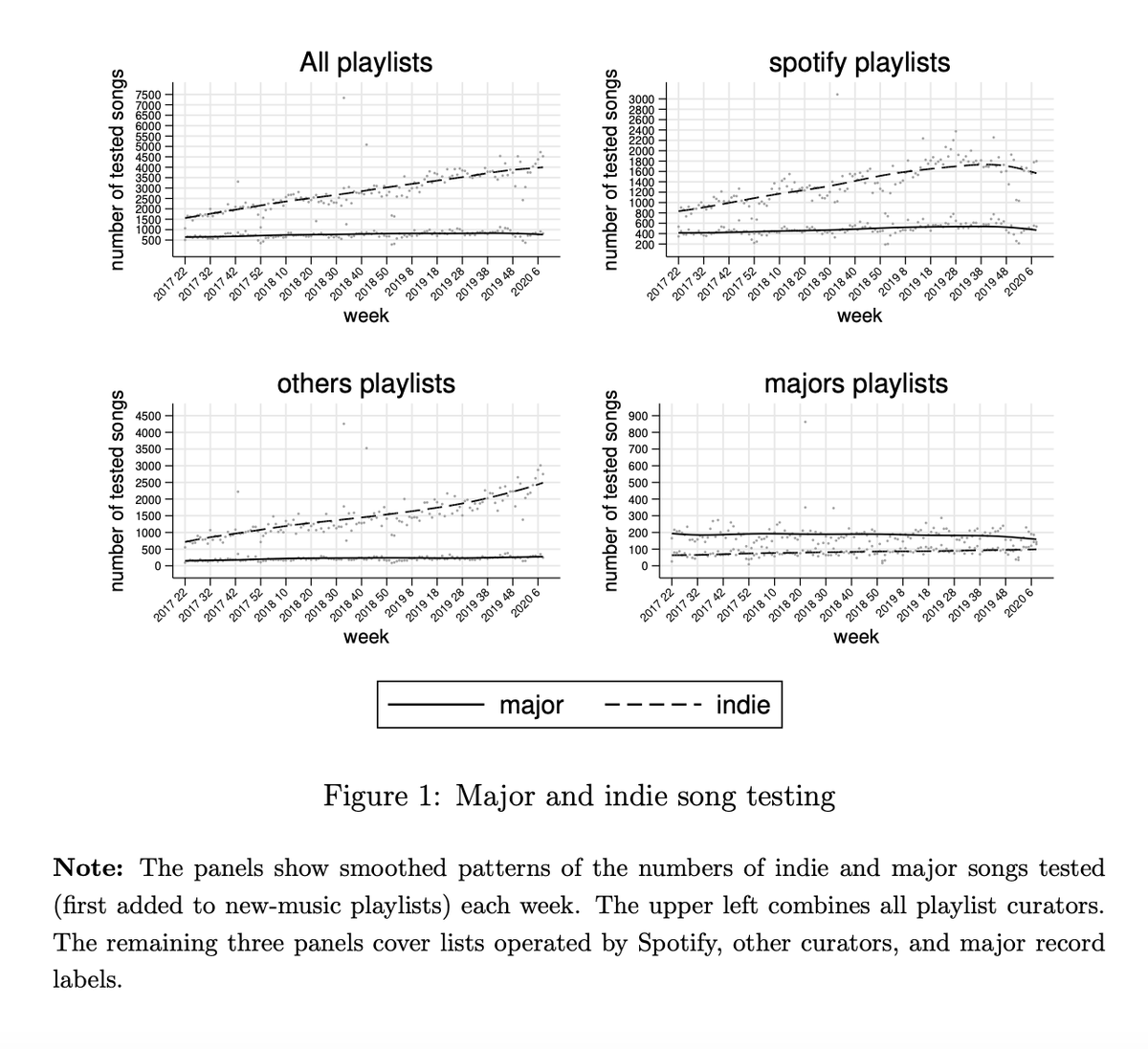
Fascinating paper on how Spotify uses playlists to maximize bargaining power with record labels. It's playlists:
- allow it to test and promote songs (especially "indie" songs)
- these indie songs are promoted heavily
- which explains declining royalty payments to major labels
Our new research finds huge cultural variation in perceptions of alignment with genAI!
People in Western countries are more skeptical & misaligned, Eastern countries are more aligned, optimistic & trusting (N = 6,362)
via @laura_k_globig & @steverathje2
https://t.co/LEwFFcuNPq
Just saw the first actual example of this in production in a 1,000+ people company, and it's amazing
They built an AI agent that:
1/ makes phone calls to everyone in the co every week, asking for a status update
2/ sends a report back with a summary of all the updates
3/ has a convo so the CEO can double click on any issue
Basically replaces the entire middle management layer of the business — no human needed to distill information up and down, with all the biases & politics & slowness involved in that. Just ICs, a CEO, and AI in the middle
Also means that as an IC you don't have to spend hours preparing for your big "meeting with the CEO." You can just ramble on, add as much info as you want, and trust that the agent will summarize and focus on what the CEO needs
We're adding the ability for Lindy to make phone calls, so this will soon come in a Lindy near you