The only UK charity for EGFR+ lung cancer advocacy, empowerment & support 💜 Our community offers hope & learning for those living with EGFR+. Get involved ⤵
Today marks 22 years since EGFR mutations were discovered in #lungcancer - a discovery that changed everything.
From first TKIs to osimertinib, adjuvant therapy and beyond. More people are living longer. Research into resistance is accelerating.
Still a long way to go - but 22 years of progress is worth marking. 💜
#LCSM
Osimertinib after definitive CRT in unresectable stage III EGFR-mutated NSCLC: safety outcomes from the phase III LAURA study - Lung Cancer https://t.co/AGh5wOcap1
Furmonertinib-based triplet therapy improves survival in EGFR-mutant NSCLC with leptomeningeal metastases: a large-scale multicenter retrospective study (FURMO-LM) - ESMO Open https://t.co/HIplkdak4A
🌟 Don't miss this insightful interview with @LeXiuning, who joined us at #ASCO26 to share updates from the phase 1 SOLARA trial!
➡️ Watch: https://t.co/n1YqL0nJTc
#NSCLC#EGFR#lcsm#ASCO2026
For people living with EGFR+ #lungcancer, one of the hardest questions is why treatment stops working.
New research from Southampton suggests tumour cells may revert to an earlier developmental state, like a tree that stops growing leaves and just keeps branching. When that happens, the cancer can become harder to treat.
Source: Bienkowska et al., Molecular Oncology, 2026. https://t.co/AiPHyE2zwW #LCSM
Happy to share our work on compound EGFR mutations in NSCLC @ClinicalLung
• Acquired resistance patterns: Ex19del/C797X, L858R/L718X
• De novo compound more common in L858R vs Ex19del
• G719X/L861Q may be sensitive to osi
https://t.co/vsXdLPxmxQ
#LCSM#Medtwitter
Details on safety of consolidation osimertinib after chemoradiation for EGFR mutant NSCLC from the phase III LAURA trial. Radiation pneumonitis seen in 48% with osi and 38% with placebo, mostly low grade, 87% continued osi, 93% without recurrence.
https://t.co/awsXgQUIsW
🫁 Early-stage EGFR+ NSCLC before adjuvant osimertinib.
International real-world study (n=1,043): 32% harbored EGFR mutations, yet only 29% received adjuvant therapy after resection.
5-year OS: 84% for EGFR-mutated vs 64% for EGFR wild-type disease. Lung and brain were the most common recurrence sites.
🚨 Highlights the value of early EGFR testing and the missed opportunities of the pre-osimertinib era.
📖 Lung Cancer
DOI 👉🏻 https://t.co/3w2vNwx3yf
#CánCare #NSCLC #EGFR #lcsm
‼️ Landmark #lungcancer research published today in Cell
Scientists at the Francis Crick Institute and UCL have discovered a 14-protein blood signature that predicts lung cancer more than 5 years before diagnosis, works in never-smokers, and could identify who benefits from prevention treatment.
People with high levels of these proteins were the ones who actually benefited from a drug to damp that inflammation down, cutting their lung cancer risk nearly in half.
This could finally give us something lung cancer has never had: a way to prevent it in the people most at risk.
https://t.co/SaZwBHnxvZ
#LCSM
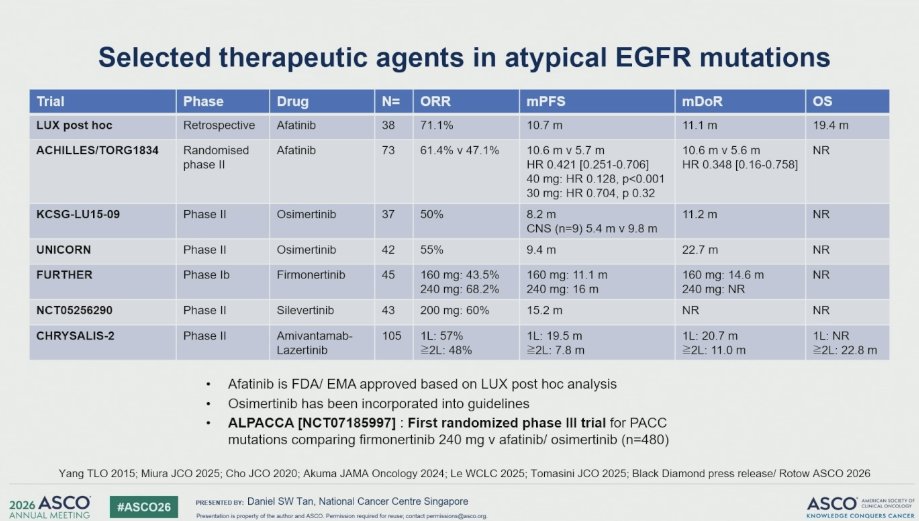
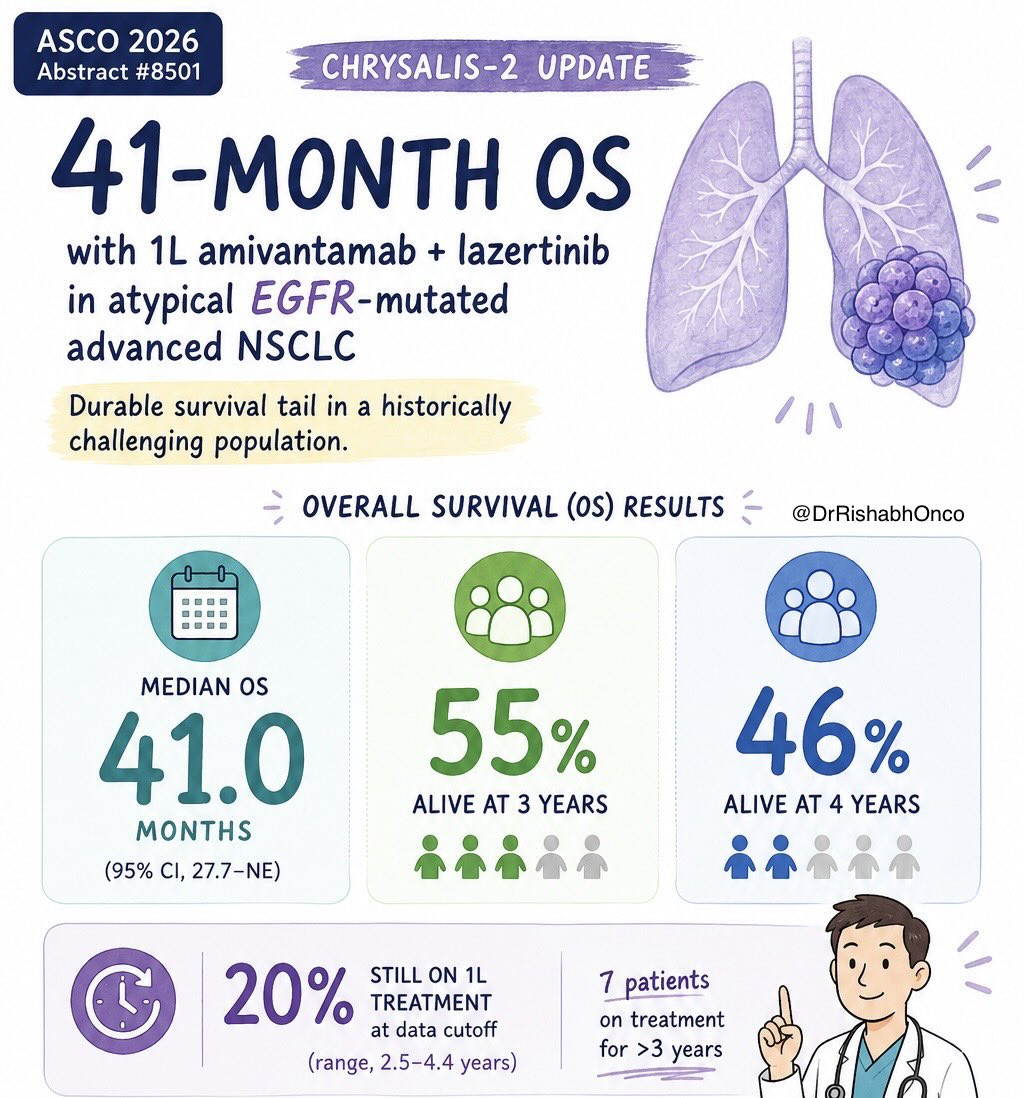
🆕 data from the CHRYSALIS-2 study, presented at #ASCO26, is v welcomed by EGFR+ UK. The results show promising survival outcomes for people with atypical EGFR mutations in advanced #lungcancer, incl G719X, L861Q & S768I.
In the study, people who received amivantamab plus lazertinib as their 1st treatment had a median overall survival of 41 months. 55% were alive at 3 yrs & 46% at 4 yrs.
This is an important result for a group that has had fewer targeted treatment options. #LCSM
Hope you all have a wonderful day. Thank you 🙏 so much for all your support in helping us to be there for more people in the UK with EGFR+ #lungcancer.
Join us today in Oxenhope where we take part in the Alex Wysocki Memorial Match vs @OxenhopeRecFC. A fantastic day of fun for a fantastic cause!
@EgfrUk 💚💜🧡
Phase III data at #ASCO26 shows sunvozertinib nearly doubled one-year progression-free survival vs chemo in EGFR exon 20 insertion #lungcancer: 46% vs 27%.
Our 2025 survey found 71% of our exon 20 community were on chemotherapy. The science is moving. The access pathways need to keep up. #LCSM #EGFRexon20
An update to @ASCO Living Guidelines for Stage IV #NSCLC WITH Driver Alterations includes New Treatment Options for Patients with certain #EGFR Mutations https://t.co/Hb9qBsptEX
@EGFRResisters@EgfrUk@EGFRmNSCLC#LCSM
Great opening to the lung cancer sessions at #ASCO26 opening with a focus on less common EGFR mutations - like exon20 by Dr John Heymach and EGFR uncommon mutations like G719X, 8768X, L86X, others FRC, Dr @JoelNealMD.
How meaningful is “practice-changing” data if patients still cannot access the drug?
Sunvozertinib has shown promising activity in EGFR exon20ins NSCLC, yet access remains the real endpoint that matters. A drug approval means little if, patients still cannot receive it.
Innovation is not just generating data, it is delivering therapies to the people who need them #ASCO26
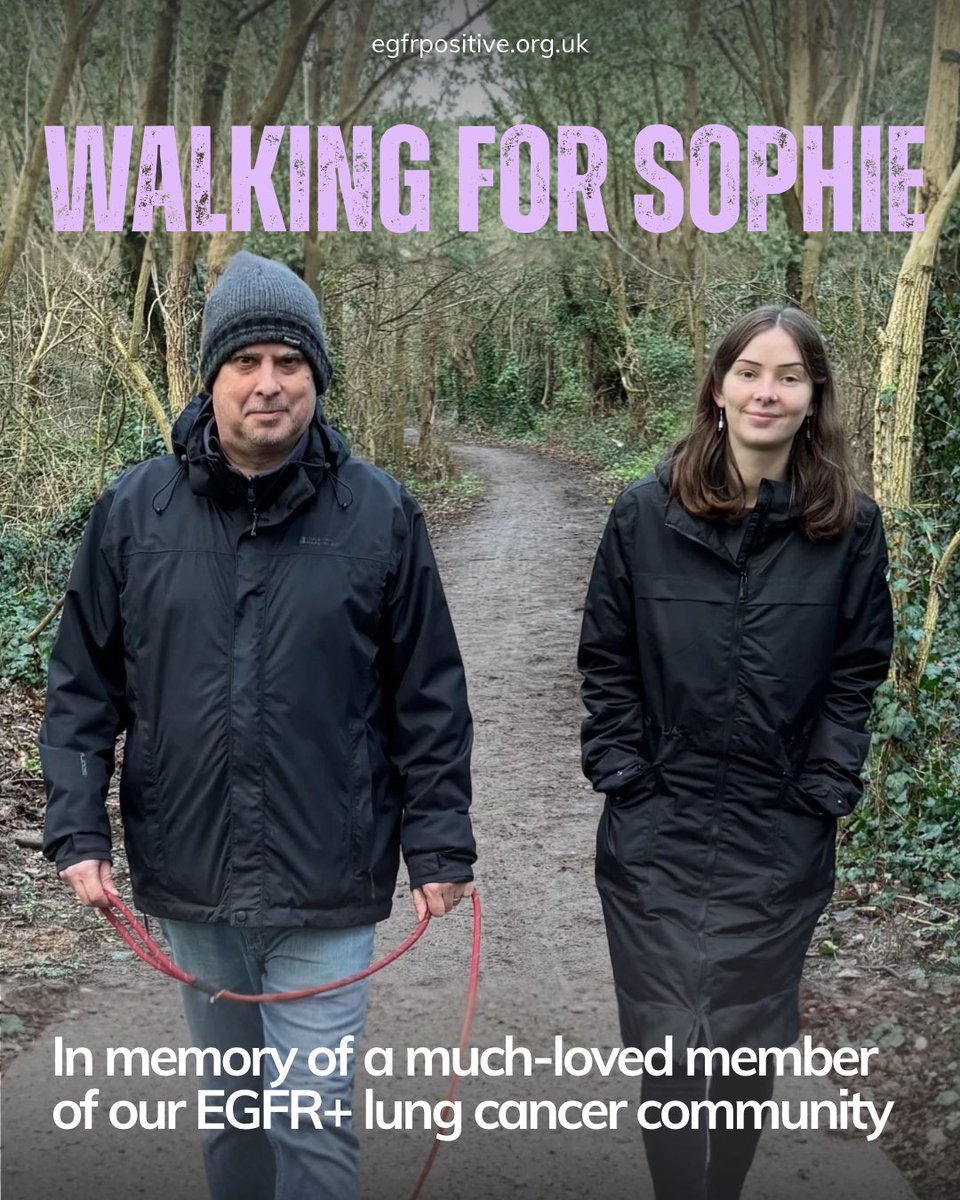
Martyn & Faye are walking 16 miles along the Downs Link in memory of their daughter & sister Sophie.
They will be raising funds and awareness for EGFR+ UK, helping us to better support more people living with EGFR+ #lungcancer.
https://t.co/W5PedLCfJL
Sophie was 24 when a crackle in her chest at night led her to her GP. She felt completely fine, still working, still caring for her beloved pets. Molly and Tilly and her dog Jasper.
She was a v loved member of our community, sharing what it felt like to live with stage 4 EGFR+ lung cancer through poetry, with a quiet thoughtfulness that stayed with everyone who read her words.
She died last year, aged 28, and is so missed. #LCSM
Our latest members’ survey found that 4 out of 5 people in our EGFR+ UK #lungcancer community are women.
Many are diagnosed in the middle of life, when they may be working, raising families, caring for others, and managing many responsibilities.
👉 https://t.co/x9HNUesxS8
#LCSM
#ASCO26 🫁
Could atypical EGFR-mutated NSCLC finally be seeing durable long-term survival?
Updated CHRYSALIS-2 data with frontline amivantamab + lazertinib suggests the answer may be yes.
📌 Study population
Previously untreated atypical EGFR-mutated advanced NSCLC
(Ex20ins excluded)
📌 Key efficacy results
🔹 Median OS: 41.0 months
🔹 3-year OS: 55%
🔹 4-year OS: 46%
📌 Durability signal
🔹 20% remained on treatment at data cutoff
🔹 Some patients continued therapy beyond 4 years
📌 Why this matters
Atypical EGFR mutations historically have worse outcomes than classical EGFR exon19/L858R disease.
Seeing nearly 3.5 years median OS in this population is clinically meaningful.
📌 Safety
No new long-term safety signals identified.
A small phase I/Ib cohort, yes.
But the survival tail here is difficult to ignore.
📖 Full abstract in comment ⬇️
#LungCancer #NSCLC #EGFR #TargetedTherapy @ASCO@myesmo@esmo_open@OncoAlert@larvol