The New Diplomacy of Artificial Intelligence
There was something quietly historic about the scene in Évian-les-Bains.
Around the G7 table sat the leaders of the world’s most powerful democracies. Beside them were executives from OpenAI, Anthropic, Google DeepMind, Mistral AI and other companies building systems that may define the next economic and strategic era.
They were not treated as ordinary business guests, but as actors of state-level importance.
For most of modern history, geopolitical power belonged to governments because they controlled armies, borders, currencies and critical infrastructure. Artificial intelligence is beginning to alter that equation.
A small number of private companies now control technologies capable of shaping national security, scientific discovery, financial markets, cybersecurity and public information. Their models are becoming infrastructure on which governments and societies increasingly depend.
Presidents and prime ministers still hold democratic authority. AI laboratories increasingly hold the technical capability.
This creates a new and uncomfortable interdependence.
Governments need the expertise and computing power of private AI companies. Those companies need energy, markets, public contracts, legal protection and political legitimacy.
Yet the balance is uneven.
The most advanced systems remain proprietary. Regulators struggle to assess them independently, while internal decisions are rarely transparent and strategic priorities remain shaped by commercial competition.
This is why Sam Altman’s reported warning to G7 leaders was so striking:
“Do not cede your responsibilities to AI labs like mine.”
The greatest risk may not be that technology companies replace governments. It may be that governments gradually lose the ability to act without them.
A state may write the law, but the company may control the model.
A regulator may impose a standard, but the laboratory may hold the expertise needed to judge whether it works.
When the same companies develop the technology, assess its risks, advise governments and help design the rules, oversight begins to resemble delegation.
Cooperation is essential.
AI governance will require common standards, international testing frameworks and coordination among democracies.
But cooperation must not become dependency, and technical expertise must not replace democratic accountability.
The G7 may one day be remembered as the beginning of a new diplomatic order: one in which governments negotiate not only with other governments, but with private laboratories whose technologies increasingly shape power itself.
The question is no longer simply who will control artificial intelligence.
It is:
Who will control those who control it?
#ArtificialIntelligence #AIGovernance #Geopolitics #G7 #Democracy #TechnologyPolicy
Mistral AI may be Europe's most important AI company.
Not because it will beat OpenAI tomorrow.
But because it seems to understand something many policymakers still don't:
Europe's future in AI is not consumer chatbots.
It's industrial AI.
Engineering.
Manufacturing.
Energy.
Aerospace.
Physics-based simulation.
The acquisition of Emmi AI signals a strategic shift toward AI-native industry rather than chasing bigger and bigger LLMs.
The challenge?
Europe still faces:
• Lower investment levels
• Slower infrastructure deployment
• Regulatory complexity
• Fragmented AI strategy
Mistral's success or failure will be more than a startup story.
It may become a test of whether Europe can still build global technology leaders.
The next 24 months will be critical.
#AI #MistralAI #ArtificialIntelligence #Europe #DeepTech #IndustrialAI #PhysicsAI #MachineLearning #Innovation #OpenSourceAI
@MistralAI
The next major breakthrough in humanoid robotics may not be a better robot. It may be a better safety architecture.
Nvidia has introduced Halos for Robotics, a system designed to make autonomous machines safer when operating alongside humans.
The announcement is significant because the real obstacle facing humanoid robots is no longer simply intelligence.
It is trust.
A robot can recognize objects, plan movements and execute increasingly complex tasks. But once it enters a warehouse, a factory, a hospital or eventually a home, every software error can become a physical event.
A mistaken chatbot generates the wrong answer.
A mistaken humanoid can injure someone, damage equipment or disrupt a critical operation.
This is why Nvidia’s strategy matters.
Rather than building the robot itself, the company is developing the layer beneath the robot: processors, software, sensors, simulation, inspection and safety validation.
In other words, Nvidia appears to be positioning itself not as the manufacturer of the winning humanoid, but as the infrastructure provider for the entire industry.
That may prove far more valuable.
Its first customer, Agility Robotics, plans to integrate Halos into humanoids operating in environments connected to companies such as Amazon and Toyota. These industrial settings are likely to be the first real testing ground for large-scale human–robot collaboration.
But the challenge is much deeper than preventing collisions.
A safe humanoid must continuously understand:
— what it is allowed to touch;
— how much force it can apply;
— how humans around it may move;
— when its perception is unreliable;
— when it must stop rather than improvise.
And there is another issue that deserves more attention: cybersecurity.
Once robots become connected, autonomous and physically capable, a cyberattack is no longer limited to stolen data. It can become a physical threat.
A compromised humanoid could manipulate objects, disrupt production or endanger people. Safety and cybersecurity can no longer be treated as separate disciplines.
This is where the debate should begin.
Will one unified safety architecture accelerate trust and industrial adoption?
Or will dependence on a small number of technology platforms create systemic vulnerabilities across thousands of robots?
The humanoid revolution will not be decided by the most impressive demonstration video.
It will be decided by reliability, resilience and the ability to fail safely.
Before asking whether robots can work beside us, perhaps we should ask a more important question:
Who decides what a robot is allowed to do when the real world does not match its training?
#HumanoidRobots #Robotics #Nvidia #PhysicalAI #ArtificialIntelligence #Cybersecurity #Automation #IndustrialAI #FutureOfWork
The Physical Monuments of AI Anxiety
Opposition to data centers in the U.S. isn’t just a localized NIMBY issue. According to a new Milltown Partners poll, a mere 8% of opponents actually live near one.
Instead, these windowless warehouses have become the physical lightning rod for a broader collective anxiety over an AI-driven future. While opinions on their utility are fractured, 49% of Americans now support a temporary construction ban.
This isn't a Luddite rejection of progress; it’s a demand to pull the emergency brake until critical questions are answered: Who pays for the massive energy bill? What is the environmental cost? And who actually benefits?
As tech leaders warn of job losses and startups introduce autonomous robots to run these facilities, a bipartisan populist backlash is brewing. Americans are growing wary of funding a future they fear will leave them behind.
#AI #DataCenters #TechEconomy #ArtificialIntelligence #SiliconValley #TechNews
@elonmusk@Google@xai
Nvidia says it may have largely solved the data center water challenge. A major breakthrough — but not yet a complete solution.
At London Climate Week, Nvidia presented a new generation of AI infrastructure capable of being cooled by liquid circulating at approximately 113°F, or 45°C.
Because the coolant can operate at a much higher temperature than traditional systems, data centers could significantly reduce — and in some cases eliminate — the need for mechanical chillers that consume large amounts of energy and water.
The system uses a closed-loop mixture of water and propylene glycol to remove heat directly from the processors.
From a technical perspective, this could be a major step forward.
It may help:
• reduce water consumption linked to cooling;
• lower the energy required for air conditioning and chillers;
• increase computing density inside data centers;
• improve opportunities for heat recovery and reuse.
But we should be careful not to draw conclusions too quickly.
Reducing water consumption per unit of computing power does not necessarily mean reducing the industry’s total environmental footprint.
Existing data centers will take years to upgrade. Electricity generation can itself consume significant amounts of water. Most importantly, every efficiency gain can accelerate the construction of new infrastructure and increase overall demand for AI computing.
This is the central paradox of modern AI:
The more efficient computing becomes, the cheaper it becomes. And the cheaper it becomes, the more we use it.
Nvidia’s announcement is therefore an important industrial breakthrough, but it should not become a license for unlimited expansion.
The real measure of progress will not simply be how many liters of water are saved per server. It will be whether the industry can simultaneously improve:
energy efficiency, water usage, heat recovery, and the amount of useful intelligence produced per joule consumed.
The future of AI will not depend only on more powerful chips.
It will depend on our ability to produce more intelligence with fewer resources.
#ArtificialIntelligence #Nvidia #DataCenters #LiquidCooling #SustainableAI #GreenComputing #EnergyEfficiency #Water #Infrastructure #LowJouleAI
@netanyahu מנקודת מבט פרגמטית, ומעל הכל, עובדתית, כיצד נוכל למנוע מאיראן להשיג נשק גרעיני אם ארצות הברית תעזוב אותנו לדאוג לעצמנו? האם לא כדאי לנו לשגר תקיפות מנע בעוצמה גבוהה מאוד, אולי אפילו ברמה גרעינית טקטית?
#iran#israel
Proposed by a Claude AI guru, these tips are always available and geared towards helping users like us.
Spend a day mastering Claude here: https://t.co/Rss3Wi25Xm
_
→ Level 1 - 24 min: The basics.
Claude For Dummies: https://t.co/0XezTm2wNq
Claude Certified: https://t.co/7MgWF1X7xe
Stupid simple Claude: https://t.co/UwU6u2Fd3F
_
→ Level 2 - 1 hour: Real workflows.
Claude Cowork: https://t.co/0uifFAR7WK
Claude for teams: https://t.co/kSGQ1bdywd
Claude Design: https://t.co/WvRm4lnS2l
Cowork + Projects: https://t.co/V7VvKlMMHe
Claude for slides: https://t.co/s8oOXTMo0j
Claude Skills: https://t.co/Q4CzxyANsG
_
→ Level 3 - 3.5 hours: The pro moves.
Claude to sound like you: https://t.co/eBIno6iva8
Stop hitting Claude limits: https://t.co/3UhF9COToa
Stop Prompting: https://t.co/8RHlVm8RvB
Claude replaced me: https://t.co/kemUERu11o
Stop sounding like AI: https://t.co/NYiJxRS2XR
Excel with Claude: https://t.co/kTcam1IZR5
_
→ Level 4 - 8 hours: Expert mode.
Claude Code: https://t.co/3w6eecoUIC
Claude Connectors: https://t.co/HG1hU4Fbws
Don't use Claude at work: https://t.co/YjHhu6GL3z
#AI #elearning #Claude #Skills
@SpencerGuard@netanyahu We Israelis thank you for setting the record straight. Our children are in the military, and beyond our legitimate anxieties, we must confront the lies and hatred of deeply anti-Semitic and anti-Israeli groups and countries. Thank you from the bottom of our hearts.
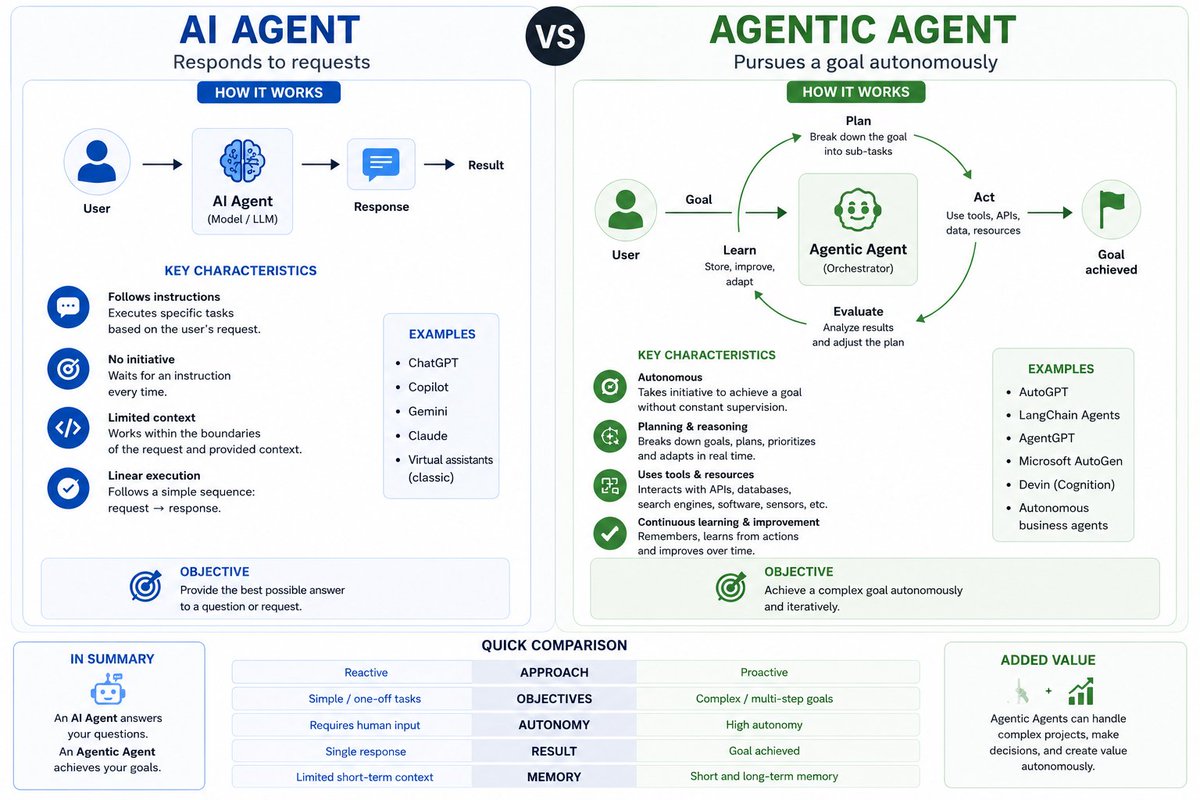
AI Agent vs Agentic agent
Most people use the terms "AI Agent" and "Agentic Agent" interchangeably.
They are not the same thing.
An AI Agent primarily responds to requests. It follows instructions, processes information, and delivers answers.
An Agentic Agent starts with an objective rather than a question. It can plan, break down tasks, use tools, evaluate results, adapt its strategy, and continue working until the goal is achieved.
The shift is profound:
We are moving from AI as an assistant to AI as an autonomous executor.
This evolution could transform cybersecurity, research, engineering, healthcare, finance, software development, and virtually every knowledge-based profession.
The real question is no longer:
"What can AI answer?"
But rather:
"What can AI accomplish on its own?"
The future of AI may not be defined by intelligence alone, but by autonomy.
#AI #AgenticAI #AIAgents #ArtificialIntelligence #Automation #FutureOfWork #Innovation #LLM #AutonomousSystems #LowJouleAI
@elonmusk@NVIDIAAIInfra
This AI chip concept is fascinating, but it highlights a growing misconception in the industry.
The future of AI is probably NOT a giant processor combining every accelerator imaginable (GPU, TPU, FPGA, NPU, LPU, etc.) into a single monster chip.
The bottleneck is no longer compute.
It's energy, heat, cooling, and infrastructure.
The next breakthrough may come from intelligent orchestration, chiplets, photonic interconnects, adaptive accelerators, and dramatically better efficiency.
The key metric of the next decade may not be FLOPS.
It may be Intelligence per Watt.
More intelligence. Less energy.
#AI #ArtificialIntelligence #Semiconductors #GPU #NPU #TPU #Datacenter #EnergyEfficiency #LowJouleAI #FutureOfAI
Grok Build CLI just got an update with v0.2.58! 🚀
Changelog v0.2.58
Bug Fixes:
• Terminal command output files are now capped at 5 GB during execution and truncated to 64 MB after the process exits.
• Interjection messages now display the actual user text instead of a generic header.
• The legacy `agent` command is now kept in sync with `grok` after running `grok update`.
• Headless (`grok -p`) runs now wait for background tasks and subagents to finish before exiting.
@knafo_sarah
La Personne Humaine à l’Ère de l’IA – Une Réflexion Théologique
En 2026, l’IA n’est plus un simple outil : elle devient une co-créatrice qui remodèle le travail, la vérité et même la guerre. Mais la Genèse nous le rappelle : l’homme est créé à l’image de Dieu, avec une dignité inaliénable.
L’IA simule l’intelligence mais n’a ni âme, ni conscience, ni finalité éternelle. Les risques majeurs incluent la déshumanisation par le dataïsme, la perte d’agentivité via l’automatisation, les deepfakes, et la fusion transhumaniste qui menace notre identité créée.
L’encyclique *Magnifica Humanitas* du Pape Léon XIV avertit : la technologie doit servir l’homme, jamais l’asservir. La solution ? Une formation thomiste, une régulation éthique fondée sur la loi naturelle, une résistance spirituelle par la prière et la communauté réelle, ainsi qu’un discernement quotidien.
Baptisons la technologie. Priorisons la subsidiarité. Protégeons l’âme. L’histoire s’achève par le retour du Christ – et non par une singularité technologique.
Magnifica Humanitas nous appelle à une maîtrise responsable au service du Royaume.
Qu’en pensez-vous ? Comment protéger la dignité humaine à l’ère de l’IA ?
#MagnificaHumanitas #EthiqueIA #DigniteHumaine #FoiEtTechnologie #DoctrineSociale #LeonXIV #EvangelisationNumerique
The Human Person in the AI Age – A Theological Reflection
In 2026, AI isn't just a tool—it's a co-creator reshaping work, truth, and war. But Genesis reminds us: humans are made in God's image with inalienable dignity.
AI simulates intelligence but lacks soul, conscience, and eternal purpose. Key risks include dehumanization through dataism, loss of agency via automation, deepfakes, and transhumanist fusion that threatens our created identity.
Pope Leo XIV's *Magnifica Humanitas* warns: Technology must serve man, never enslave him. The solution? Thomistic formation, ethical regulation based on natural law, spiritual resistance through prayer and real community, plus daily discernment.
Baptize technology. Prioritize subsidiarity. Protect the soul. History ends with Christ's return—not technological singularity.
Magnifica Humanitas calls us to responsible mastery in service of the Kingdom.
What do you think? How do we safeguard human dignity in the AI era?
#MagnificaHumanitas #AIethics #HumanDignity #FaithAndTech #CatholicSocialTeaching #LeoXIV #DigitalEvangelization
@netanyahu אני רוצה להאמין לך, אדוני ראש הממשלה.
כי אנחנו באמת מרגישים ששוב הוטמענו בידי אמריקאים חסרי הכוח לסיים את מלאכת ההשמדה והחיסול של הטרוריסטים.
איראן לא רק תמשיך להעשיר אורניום, אלא, חשוב מכך, תשיג נשק גרעיני מתפקד במלואו ומוכן לשימוש בזכות חבריה הפקיסטניים או הצפון קוריאנים...
כל זה בשביל זה!!!?
חיילינו נהרגו לחינם, אזרחינו נטבחו לשווא, המדינה שלנו מושפלת ומתבזבזת בבוץ העולמי – הכל לשווא!!.. הנשיא האמריקאי בגד בישראל, בגד בעם היהודי, ובגד בך באופן אישי, אדוני ראש הממשלה!
זה לא מדיניות, זה פרסה עלובה, בדיחה חולנית בטעם רע!
אנחנו עבדים של אמריקה, שרואה בנו בשר תותחים, קורבנות מתכלים, בובות על חוטים!
אתה באמת תיתן לאיראן לצאת גיבורה מהתיאטרון האבסורדי הזה?
נמשיך פשוט לשבת בחיבוק ידיים עד שהם ישמידו אותנו בפצצה גרעינית איראנית?
שאלות בלי סוף, ותשובות אין