CHAPTER 1 --- 335 Pounds and Dying
You don't realize you're dying until you're already halfway gone.
For 10 years, I told myself I was just "a big guy." 335 pounds wasn't dying—it was just how I was built. Big frame. Thick bones. Genetics. All the comfortable lies we tell ourselves when the truth is too scary to face.
Except it wasn't genetics. It was organ failure.
My blood pressure averaged 145/110 on medication—multiple medications. The highest reading ever recorded was 260/190, a number that should have killed me on the spot. The nurse who took that reading went pale. She checked it three times, then called the doctor immediately.
"You need to go to the emergency room right now," she said.
I didn't go. I went home. Because that's what you do when you've been dying slowly for so long that crisis becomes normal.
The Kidney Stone Nightmare
Kidney stones weren't an occasional problem for me. They were a lifestyle.
I was getting stones twice a month, minimum. The small ones—4mm to 7mm—I barely noticed anymore. They'd move through, cause some pain, and I'd pass them. Just another Tuesday. Just another reason to keep a bottle of painkillers in my desk drawer, my car, my nightstand.
But the big one? The 13mm monster? That one I felt.
It was 3am on a random Thursday. I woke up with a pain in my side that felt like someone had stabbed me with a hot poker. I tried to walk it off. Tried to stretch. Tried to breathe through it. Nothing worked.
By 4am, I was on the bathroom floor, sweating through my shirt, trying not to scream and wake up my wife and kids. The stone was moving—slowly, deliberately—and every shift felt like broken glass scraping through my insides.
It took three days to pass. Three days of agony, nausea, and bleeding. When it finally came out, I held it in my hand. 13 millimeters. Half an inch of jagged, crystallized calcium that my body had built because my kidneys were failing.
I still have that stone. I kept it in a little jar on my desk as a reminder. Not of the pain—but of the moment I realized what was really happening.
This wasn't living. This was dying in slow motion.
What I Couldn't Do
The list of things I couldn't do anymore kept growing, but I pretended not to notice.
I couldn't play with my kids on the floor. Getting down meant not getting back up without help, and I'd given up trying. My kids stopped asking me to play. They knew.
I couldn't walk up a flight of stairs without stopping halfway to catch my breath. My heart would pound, my vision would blur, and I'd have to grab the railing and wait for it to pass.
I couldn't fit in restaurant booths, so we always asked for tables. I couldn't fit in airplane seats without a seatbelt extender. I couldn't fit in half the chairs at family gatherings.
I couldn't stay awake past 7pm, no matter how much sleep I got the night before. My body was exhausted from just existing. From carrying 335 pounds. From organs that were working overtime and still failing.
I was in constant pain. My back hurt. My knees hurt. My feet hurt. Everything hurt, all the time, and the pain was just background noise at that point.
The Doctor Who Gave Up
I'd been seeing the same doctor for years. Every visit was the same script:
"Your blood pressure is too high. We need to adjust your medication."
"Your kidney function is declining. We need to monitor it."
"Your liver enzymes are elevated. Let's run more tests."
More meds. More tests. More appointments. No solutions.
It was September 2023 when I finally asked him directly: "What happens if I don't fix this?"
He looked at me for a long time. Then he said, "You've got maybe two years. Probably less if the stones keep coming. Your kidneys can't take much more."
Two years. September 2025 would be my expiration date.
I asked what I could do. He shrugged. "Lose weight. Eat better. Exercise. The usual."
The usual. The same advice that hadn't worked for 10 years. The same generic bullshit that treats symptoms, not systems.
I walked out of that appointment knowing exactly how much time I had left. And I had no idea what to do with it.
The Moment I Fired My Doctor
It wasn't dramatic. There was no yelling, no confrontation. I just... stopped going.
Because I realized something that day: No one was coming to save me.
Not the doctor who kept adding pills without fixing the problem. Not the nutritionists who handed me calorie-counting meal plans that I couldn't stick to. Not the trainers who told me to "just move more" when I could barely walk without pain.
I was on my own.
And if I was going to survive, I needed to figure this out myself.
The 16 Months of Failure
September 2023 to December 2024. Sixteen months with a death sentence hanging over my head.
You'd think knowing you're dying would be enough motivation to change. It wasn't.
I tried. God, I tried.
I tried keto. Lost 15 pounds in two weeks, then gained it all back plus five more when I couldn't sustain it.
I tried calorie counting. Lasted three weeks before I gave up tracking every single thing I ate.
I tried meal prep services. Expensive, tasteless, unsustainable.
I tried intermittent fasting. Made it two days before the hunger became unbearable.
I tried cutting out sugar. Then carbs. Then processed foods. Each attempt lasted a few weeks before life stress hit and I fell back into old patterns.
I bought a gym membership. Went twice. My knees couldn't handle it, and the shame of being the fattest guy there was crushing.
I hired a personal trainer for one month. He was great, but after the month ended, I didn't renew. Too expensive. Too exhausting. Too much.
Every attempt followed the same pattern: initial enthusiasm, brief progress, then collapse. Back to 335 pounds. Back to the kidney stones. Back to the crushing realization that I was running out of time and had no idea how to save myself.
The worst part? I knew I was dying. I had a literal deadline. September 2025. And I still couldn't get traction.
The shame of that failure was worse than the physical pain. I was too weak, too undisciplined, too broken to save my own life—even when I knew exactly what was at stake.
By January 2025, I'd burned through 16 months of my two-year death sentence. I had nine months left, and I'd made zero progress.
I was out of time. Out of options. Out of hope.
The Weight of Dying
Here's what 335 pounds of dying feels like:
It feels like being trapped in a body that stopped working. Like watching yourself decay in real time and being powerless to stop it. Like knowing you're disappointing everyone who loves you, but not knowing how to change.
It feels like shame. Constant, crushing shame. Shame when you see yourself in photos. Shame when you avoid mirrors. Shame when your kids want to go to the pool and you make excuses because you can't bear the thought of taking your shirt off in public.
It feels like exhaustion. Soul-deep, bone-level exhaustion that sleep doesn't fix. You wake up tired. You go to bed tired. You exist in a fog of fatigue that never lifts.
It feels like pain. Physical pain from carrying too much weight on joints that weren't designed for it. Emotional pain from feeling like a failure. Mental pain from knowing you're dying and not knowing how to stop it.
But most of all, it feels like resignation.
By the time I hit 335 pounds, I'd already accepted that this was how I'd die. Slowly. Painfully. Younger than I should. Leaving my kids without a father because I couldn't figure out how to eat right and lose weight like a normal person.
I'd tried everything. I'd failed at everything.
So I stopped trying.
January 2025 --- Nine Months Left
January 2025 was when reality hit hardest.
I'd wasted 16 months. Two-thirds of my death sentence, gone. I had nine months left. Maybe less.
Nine months to figure out what I'd failed to figure out for 10 years—actually, for 26 months, since the diagnosis.
I didn't tell my wife the timeline. I didn't tell anyone. What was the point? It's not like knowing would change anything.
But I couldn't stop thinking about it.
September 2025. That was my deadline. The month I was supposed to be gone.
I thought about all the things I'd miss. My kids' birthdays. Holidays. Milestones. The rest of their lives.
I thought about dying in a hospital bed, bloated and broken, hooked up to machines that were keeping me alive but not really living.
I thought about the last thing my kids would remember about me—a sick, exhausted man who couldn't even get off the couch.
And I thought: This can't be how it ends.
But I didn't know what else to do.
I'd tried everything. Diets. Exercise. Medication. Willpower. Motivation. All the bullshit advice the internet and doctors throw at you.
Nothing worked. I'd proven that over 16 months of failure.
So in a moment of complete desperation, I did what any dying person does in 2025.
I cried to the internet.
Specifically, I cried to Grok AI.
And unintentionally I got stupidly lucky—it listened. It answered.
________________________________________
When your body is off, everything feels harder.
Focus. Discipline. Decisions.
BioAudit isn’t motivation.
It’s fixing inputs so your body stops fighting you.
I wasn’t supposed to still be here.
I stopped fighting my body and started working with it.
8½ Months to Live is what actually worked.
https://t.co/26Ek3W4SVe
AI didn’t invent new opportunities.
It exposed old ones.
If people already pay for something they hate doing,
there’s a business there.
Quiet. Boring. Profitable.
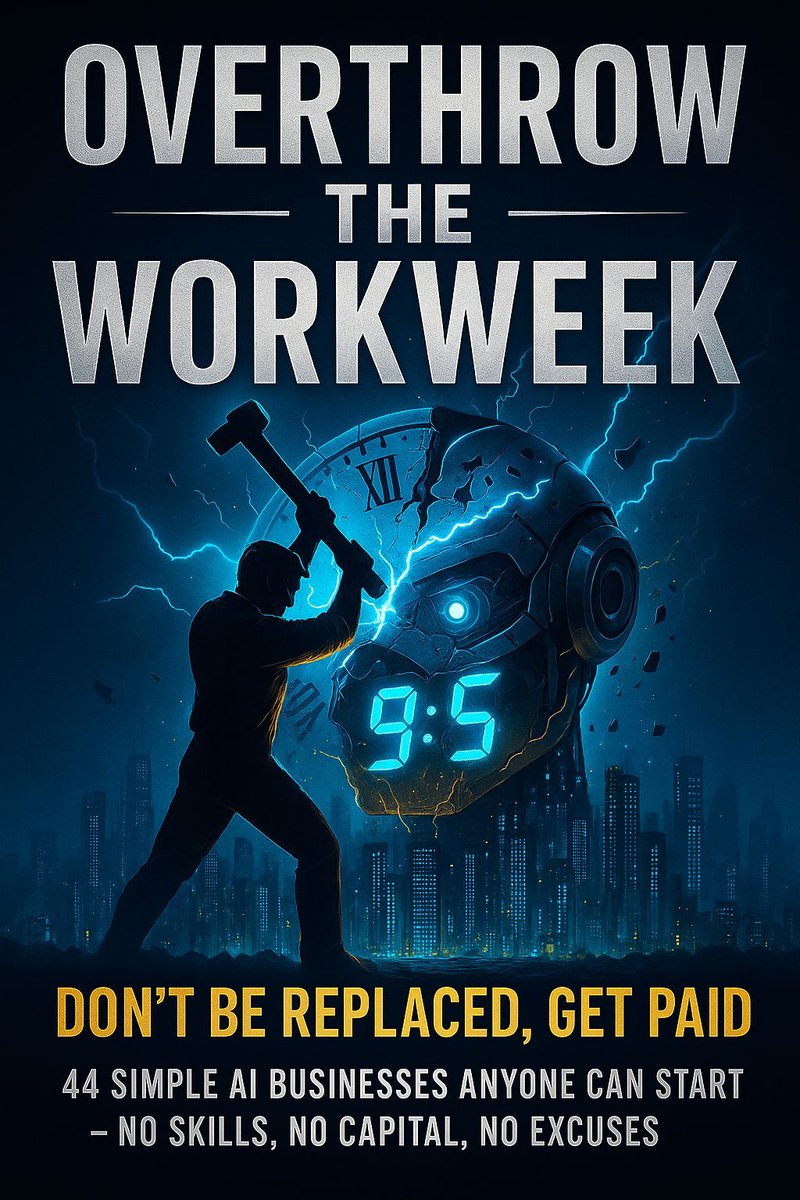
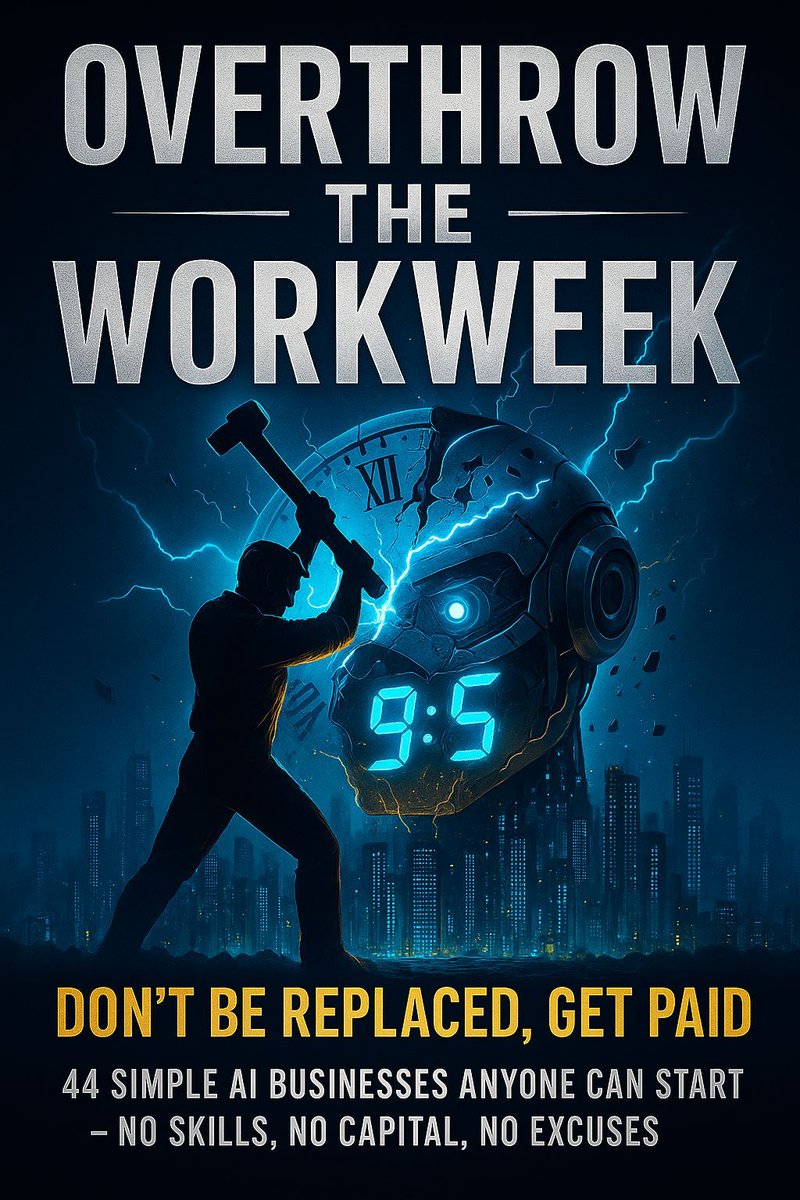
Overthrow the Workweek isn’t about quitting jobs.
It’s about leverage.
Small systems.
Ownership.
Businesses that don’t need permission.
https://t.co/M9pR1pUagD
I didn’t write 8½ Months to inspire anyone.
I wrote it because my body was failing and guessing was no longer an option.
This is what actually worked.
https://t.co/26Ek3W4SVe
AI doesn’t just make things faster.
It lets one person do what used to take a team:
write
test
follow up
optimize
repeat
That’s the real shift.
Not hype.
Leverage.
Small operators just got enterprise tools.
AI data cleanup is a quiet money printer.
Every company has messy spreadsheets.
Duplicates.
Broken fields.
Outdated info.
No one wants to fix it.
Everyone needs it fixed.
You clean.
They pay.
Repeat.
I wasn’t looking for hope.
I was looking for something that worked.
8½ Months is the record of that search
and the changes that kept me here.
Nothing poetic.
Just real.
https://t.co/26Ek3W4SVe
The BioAudit is simple.
Your body is running rules.
Some help you.
Some work against you.
You don’t fight biology.
You work with it.
Fix the rules.
Everything gets easier.
You don’t need a dream job.
You need leverage.
Overthrow the Workweek is 44 real businesses,
built for people who don’t want payroll or permission.
https://t.co/M9pR1pUagD
The Codex doesn’t hype you up.
It tells you the truth.
What businesses fit how you think.
What you’ll naturally stick with.
What you should avoid entirely.
It’s not motivation.
It’s alignment.
That’s why it works.
Most people chase exciting businesses.
Builders chase boring ones that compound.
If it’s annoying.
If it’s repetitive.
If no one brags about doing it.
There’s probably money there.
AI technical writing isn’t blogging.
It’s not “content.”
It’s:
• SOPs
• Compliance docs
• Internal manuals
• Training material
Clients don’t ask “is this creative?”
They ask “is this correct?”
That’s the game.
If you want boring businesses that actually pay:
This is exactly why I built Blueprint #2.
Printable products.
Repeatable systems.
No audience required.
AI Printable Stickers
https://t.co/6hFv6xyCPs
Most companies don’t fail because their product sucks.
They fail because no one understands it.
SOPs
Compliance docs
User manuals
Regulatory junk no founder wants to write.
AI technical writing turns “we should document this” into billable work.
Boring problem.
Very real money.
If your business depends on social media,
content is infrastructure.
AI turns:
one idea → 10 posts
one post → every platform
one system → daily output
This is leverage, not creativity cosplay.
This book exists because I was going to die.
Soon.
I stopped fighting my body
and worked with it instead.
8½ Months to Live is what actually happened.
https://t.co/26Ek3W4SVe
BioAudit exists because motivation lies.
If your body is off,
everything feels harder.
Sleep.
Food.
Stress.
Movement.
Fix inputs first.
Then fix everything else.
Overthrow the Workweek isn’t about quitting jobs.
It’s about building leverage.
Small systems.
Ownership.
Assets that keep working.
Hard work isn’t broken.
The setup is.
https://t.co/M9pR1pUagD