New analysis shows sex‑specific differences in outcomes after minimally invasive ascending aortic surgery.
Women experienced higher perioperative stroke rates and longer ICU stays, though survival remained comparable to men.
Read the full study: https://t.co/HYUljCsbIe
When thousands gather, risk perception becomes as important as risk itself.
This review identifies factors influencing risk perception and evaluates communication strategies across digital, physical, and in‑person modalities.
Read more in the collection: https://t.co/FH1A3iSTqc
A fascinating and rare presentation: bilateral CPAFs with an aortopulmonary fistula causing heart‑failure symptoms.
This report highlights the importance of multidisciplinary evaluation in complex cardiovascular anomalies.
Explore this unique case: https://t.co/3O2HepibWy
🫁 Risk factors for impaired oxygenation after CPB
New retrospective study (2022–2024, n=202) identifies:
🔹High BMI
🔹Hypertension
🔹Elevated Respiratory Index (RI)
💡RI may be a practical addition to pre‑op screening.
Read more: https://t.co/sG1hjeeow4
🧠Think beyond atherosclerosis.
This case highlights how DSA flow stagnation and CTA in oblique‑sagittal views were crucial for diagnosis after MRI/US failed to identify the source.
Read more: https://t.co/UexDiuu7an
Muscle health plays a big role for older adults facing lung cancer surgery🫁
Patients with lower muscle mass had more postoperative complications.
This highlights the importance of strength, nutrition, and pre‑surgery preparation.
Learn more: https://t.co/VxFfHfYI2U
#FlashbackFriday
Pulmonary rehabilitation before and after lung cancer surgery may significantly improve outcomes.
This study’s matched‑case analysis found meaningful improvements in LOS, PPCs, and QoL.
https://t.co/O33z80MM39
EMS supervisors play a critical role in preventing workplace violence.
This Delphi study provides consensus‑based guidelines to support leadership in risk assessment, standardized training, and ongoing intervention evaluation.
Read the full text here: https://t.co/oO7yaOehjx
Liver transplantation has a rebalanced but fragile hemostatic system.🩺
This study maps how FV, FVIII & FXIII shift across surgical phases, offering insight into when patients may be most vulnerable to bleeding or thrombosis.
Read the full text: https://t.co/W42hM3SnnM
Did you know a fluid pocket in the lung can perfectly mimic a tumour on an X‑ray? 🫁💡
This “phantom tumour” often appears in people with heart failure and clears rapidly with medication.
Read the case report here: https://t.co/eG2ewogSOv
How do hospital teams feel during disaster simulations?
This study found three unique staff response profiles, from enthusiastic emergency clinicians to less experienced teams reporting negative emotions.
These insights can shape future trainings: https://t.co/wmkBOmz23v
Elderly patients face high risk after major abdominal surgery but prehabilitation may shift outcomes.
A new study reports fewer severe complications, shorter LOS, & striking benefits in patients ≥80 yrs after a multimodal home‑based program.
Read more! https://t.co/3tQgUGRaYo
How well do our “routine” coagulation tests reflect what actually happens during CPB?🫀
This prospective study shows a major FXII drop that aPTT/ROTEM barely detect, raising questions about how we interpret post‑bypass labs.
🔗https://t.co/khZGsWOJdM
📢 New research on aortic valve replacement strategies
In 148 patients with severe symptomatic AS, both TAVR and SAVR improved echo parameters, but EOA stood out as a stronger marker of SAVR success.
Explore the full findings: https://t.co/2jYMspq6l7
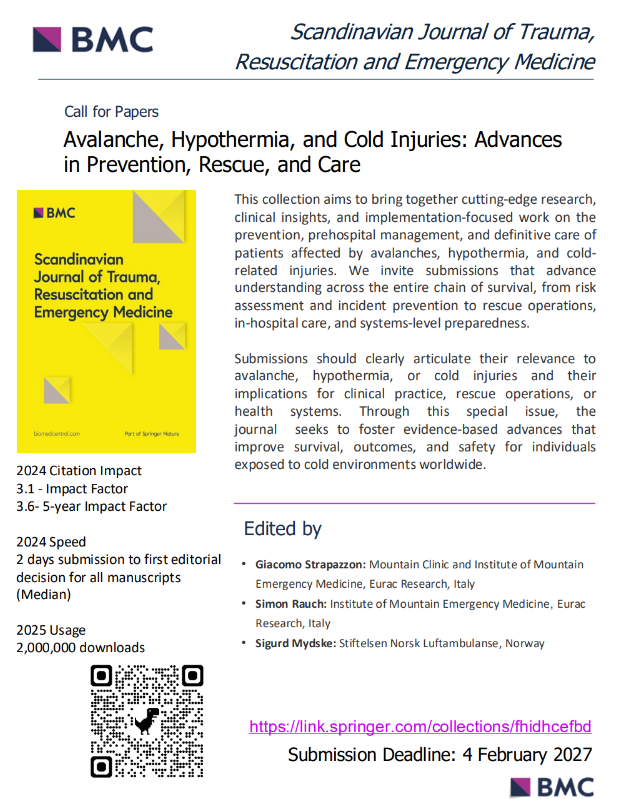
Submit your research to the collection "Avalanche, Hypothermia, and Cold Injuries: Advances in Prevention, Rescue, and Care"❄️
Highlighting prevention, prehospital care, and treatment of avalanche and cold‑related injuries.
Learn more and submit here: https://t.co/b8DLpaYSjx
Students considering EM residency showed higher comfort with creating simulations after participating in a “flipped sim-room” curriculum🏥🚑
Active learning → stronger engagement → better preparation
Educational Advances in Emergency Medicine: https://t.co/Of9rnh3RIY
Deadline EXTENDED to 11 August 2026🚨
Submit to International Journal of Emergency Medicine's collection: "Use of AI in Medical Education: Embracing Responsible Innovation"
Learn more about this innovative collection here: https://t.co/6kdTuBdKye
Deadline EXTENDED to 19 August 2026🚨
Submit to International Journal of Emergency Medicine's collection now! "Violence in the Emergency Department: Responding to a Global Crisis"
Learn more about sharing your research here: https://t.co/NeOLb42W44
New study explores delirium in critically ill #COVID19 patients requiring prolonged IMV ± ECMO.
Delirium occurred in 53.9% of cases, with higher rates in IMV‑only patients.
Findings highlight the role of sedation practices and ICU stay duration.
🔗https://t.co/6QgoUyD00V