What the British did in Kenya, a thread 🧵, source: Britain's Gulag : The Brutal End of Empire in Kenya by Caroline Elkins..
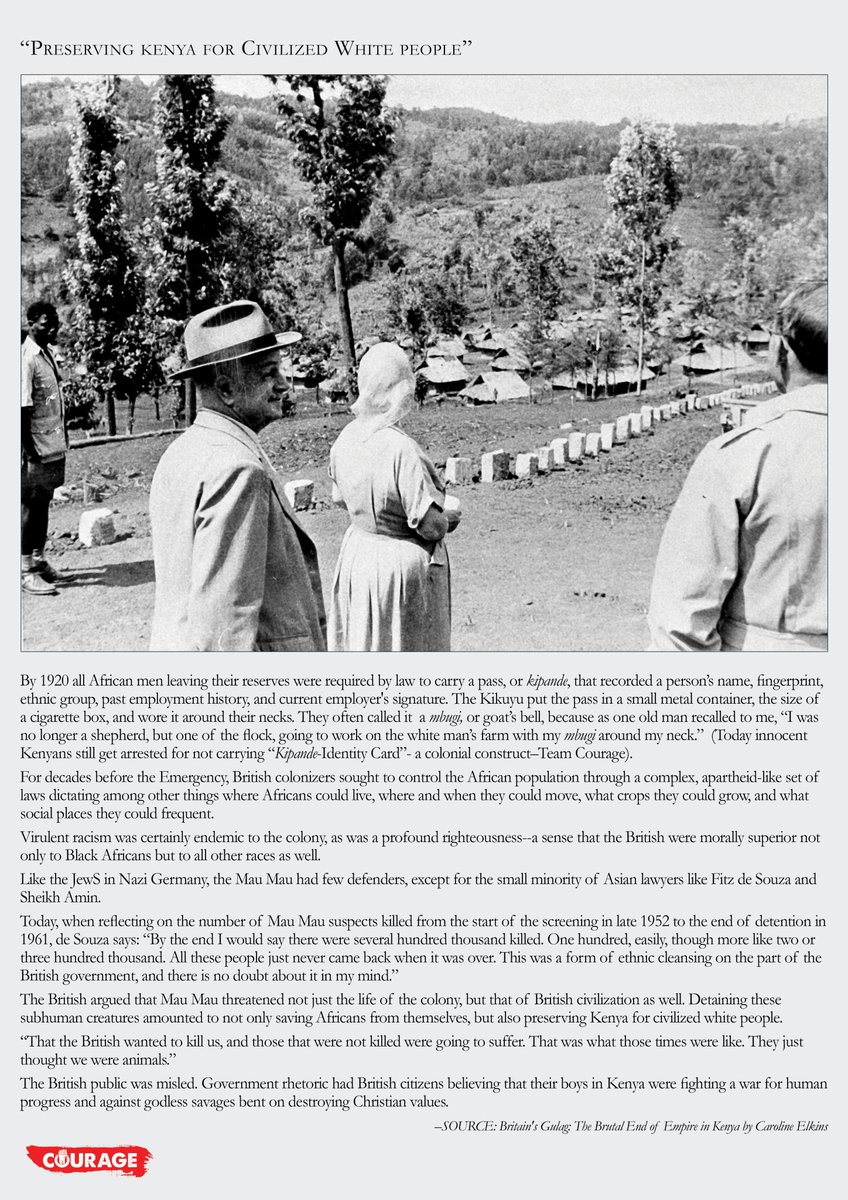
"PRESERVING KENYA FOR CIVILIZED WHITE PEOPLE"
First, the colonial government established African reserves, which were defined rural areas, eventually with official boundaries, much like the homelands in South Africa or the Native American reserves in the United States, where each African ethnic group in the colony was expected to live separately. The Kikuyu had their own reserves in the Central Province district of Kiambu, Fort Hall, and Nyeri, the Maasai resided mostly in the colony’s Southern Province, the Luo lived in Nyanza Province, and so forth. This practice of divide and rule was also a cornerstone of the colonial government’s labor policy. With insufficient land in their reserves, many Africans had little choice but to migrate to the European farms in search of work, and survival.
But confining the African s was not enough to force them all into wage economy. As an additional tactic of control, the British colonial government taxed them. The second colonial regulation called for a hut tax and poll tax, together amounting to nearly twenty-five shillings, the equivalent of almost two months of African wages at the going local rate.
By 1920 all African men leaving their reserves were required by law to carry a pass, or kipande, that recorded a person’s name, fingerprint, ethnic group, past employment history, and current employer's signature. The Kikuyu put the pass in a small metal container, the size of a cigarette box, and wore it around their necks. They often called it a mbugi, or goat’s bell, because as one old man recalled to me, “I was no longer a shepherd, but one of the flock, going to work on the white man’s farm with my mbugi around my neck. The kipande became one of the most detested symbols of British colonial power, though the Africans had little recourse but to carry their identity cards at all times; failure to produce it on demand brought a hefty fine, imprisonment, or both. #SemaUkweli #RoyalVisitKenya
Age when their business launched?
Jeff Bezos: 30
Oprah Winfrey: 32
Reed Hastings, Netflix: 36
Doris Fisher, Gap: 37
Vera Wang: 40
Eric Yuan, Zoom: 41
Sam Walton, Walmart: 44
Adi Dassler, Adidas: 48
Bernie Marcus, Home Depot: 50
Charles Flint, IBM: 61
Here are their stories 🧵👇
As Kenyans 🇰🇪 we cordially accept this title of the capital of Africa. We ask the African Union to move with speed and officially recognize the same.🤭🤭