Paper 4: search for continuous wave signals: https://t.co/eCiX3EUmsY
Paper 5: implications for massive black holes, dark matter and the early Universe: https://t.co/a51xE0WBLF
Paper 6: limits on ultralight Dark Matter: https://t.co/LiQIvfR2Iz
We are founding members of the International Pulsar Timing Array (@IPTA_GW, https://t.co/zoWJ3lBXOi), a consortium of consortia, in which we collaborate to cross-check our results and make plans for future improvemens of our work.
And here are the links:
Paper 1: data: https://t.co/cOvmmhhSgj
Paper 2: noise modelling: https://t.co/OrtLZAHQuT
Paper 3: search for gravitational wave signals: https://t.co/zls10ilaZh
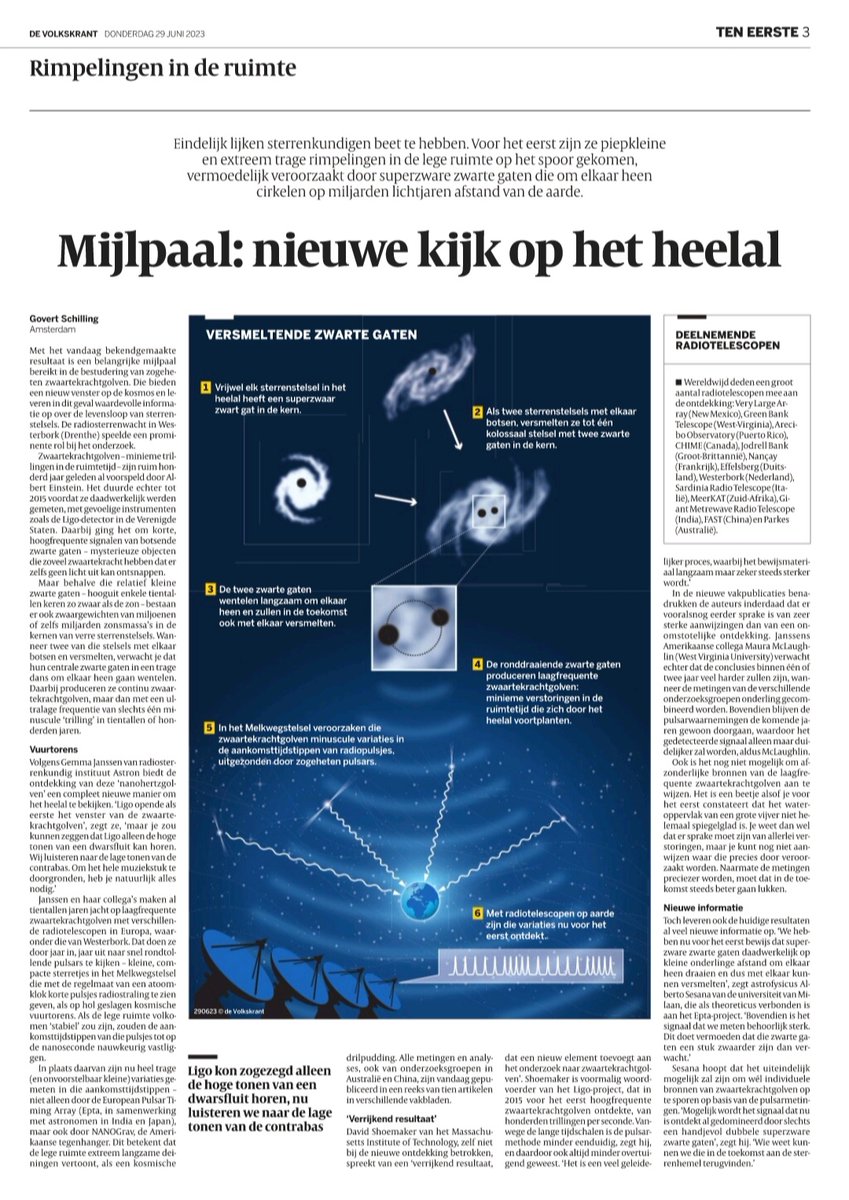
@CSIRO_ATNF@ARC_OzGRav@NANOGrav These waves are expected to come from pairs of supermassive black holes found in the centres of merging galaxies. These results are a crucial milestone in opening a new, astrophysically-rich window in the gravitational wave spectrum.
@EPTAGW, an international collaboration of European astronomers, together with Indian and Japanese colleagues from the Indian Pulsar Timing Array @InPTA_GW, have published the results of more than 25
years of observations from six of the World's most sensitive radio telescopes.
We found evidence for ultra-low-frequency gravitational waves, with other collaborations @CSIRO_ATNF@ARC_OzGRav@NANOGRAV and CPTA
independently reporting on similar results.
We teamed up with @EPTAGW and combined our data with theirs for our latest venture!
Keep an eye out on this space on 29th June as we coordinate the release of our exciting science results with @nanograv, @CSIRO_ATNF and @ARC_OzGRav and @CPTA
EPTA and InPTA are releasing their latest results on Thursday 29 June, in coordination with other PTAs around the world @InPta@ARC_OzGRav@CSIRO_ATNF@NANOGrav