Nothing kills you faster than chronic worry.
Here’s what that stress is really doing to your body.
Constantly worrying about things outside your control doesn’t just affect your peace of mind—it can seriously harm your physical health.
Persistent anxiety keeps your body’s stress-response system on high alert, leading to chronic stress that wears down vital systems over time.
This prolonged activation weakens the immune system, increasing your vulnerability to illness, while also contributing to cardiovascular problems like high blood pressure and elevated risk of heart disease.
The toll doesn't stop there. Chronic stress floods the body with hormones like cortisol, which can disrupt digestion, trigger headaches, and cause ongoing muscle tension. Mentally, this strain often pushes people toward unhealthy coping habits such as overeating, smoking, or substance use—behaviors that further erode physical well-being. Learning to let go of what you can’t control isn't just emotional advice—it’s a prescription for better health.
Source: American Psychological Association. (2023). Stress effects on the body.
☀️ NOV 11, 2025 – Science says: 10 min OUTDOOR LIGHT in the first hour after waking
→ +37% dopamine receptor density
→ -28% cortisol all day
→ Free. Instant.
→ Try tomorrow
→ reply 1–10 energy boost!
#EQLIBRA#MorningScience
The human body isn't biologically programmed to be awake past midnight, according to scientists behind the “Mind After Midnight” hypothesis, who warn that staying up into the early hours can change how our brains function in ways that may increase risk-taking, depression, and even self-harm.
The idea is based on growing evidence that our minds operate differently at night, especially when we’re sleep-deprived. Past midnight, we’re more drawn to negative thoughts, more likely to act on harmful impulses, and less able to think rationally or resist cravings.
Researchers believe this shift is linked to our circadian rhythm—the internal body clock that controls our sleep-wake cycle and influences mood, focus, and motivation.
In the daytime, the brain is primed for alertness and logical thinking. But at night, especially after midnight, our biology shifts gears. From an evolutionary perspective, this makes sense: humans evolved to be active in the daylight and rest when it’s dark, when predators were a greater threat.
At night, our attention to danger is heightened, but in the modern world, that can backfire, causing anxiety, hopelessness, or impulsive behavior.
The hypothesis offers real-world examples: a person who can resist drugs during the day but gives in at night, or a student with insomnia who begins to spiral into depression when no one is around to help. Suicide rates are significantly higher between midnight and 6 a.m., and night-time drug overdoses are also more common. Scientists say we should treat post-midnight wakefulness as a potential mental health risk, not just an inconvenient schedule.
Every weekend, millions shift their sleep like crossing time zones.
It’s called social jetlag — and it silently wrecks mood, metabolism, and focus.
But new research shows: weekend catch-up sleep might not be all bad.
🧵#EQLIBRA
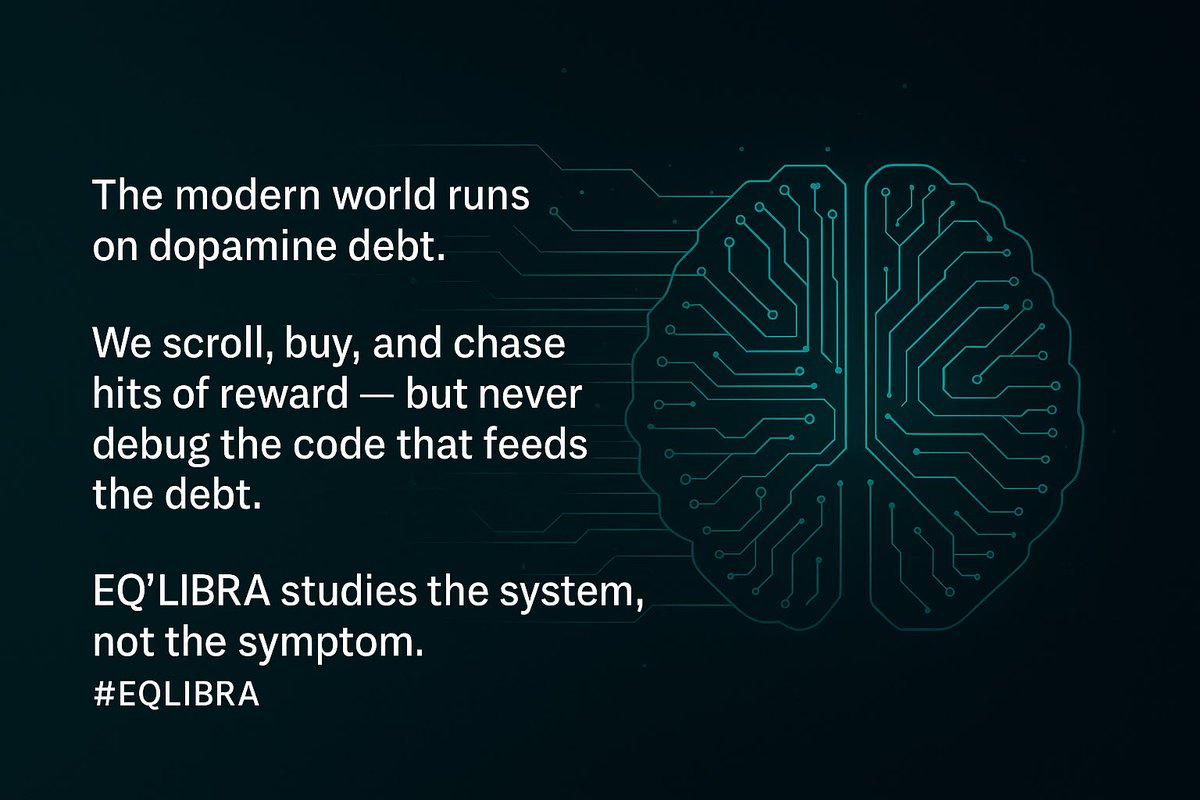
The modern world runs on dopamine debt.
We scroll, buy, and chase hits of reward — but never debug the code that feeds the debt.
EQ’LIBRA studies the system, not the symptom.
#EQLIBRA
Humanity doesn’t need more motivation.
It needs operating instructions.
Forget dopamine hacks — learn the system itself.
Updating the human OS starts now.
#EQLIBRA