Monitoring Social Change in Europe 🇪🇺 since 2002 | The European Social Survey European Research Infrastructure Consortium (ESS ERIC) is a biennial survey.
Bobby Duffy (@policyatkings 🇬🇧) will deliver the 2026 Sir Roger Jowell Memorial Lecture in London and online from 6pm on Thursday 10 September.
This year’s lecture in memory of our co-founder will focus on generational divisions and how to overcome them.
https://t.co/I5nfbClFZn
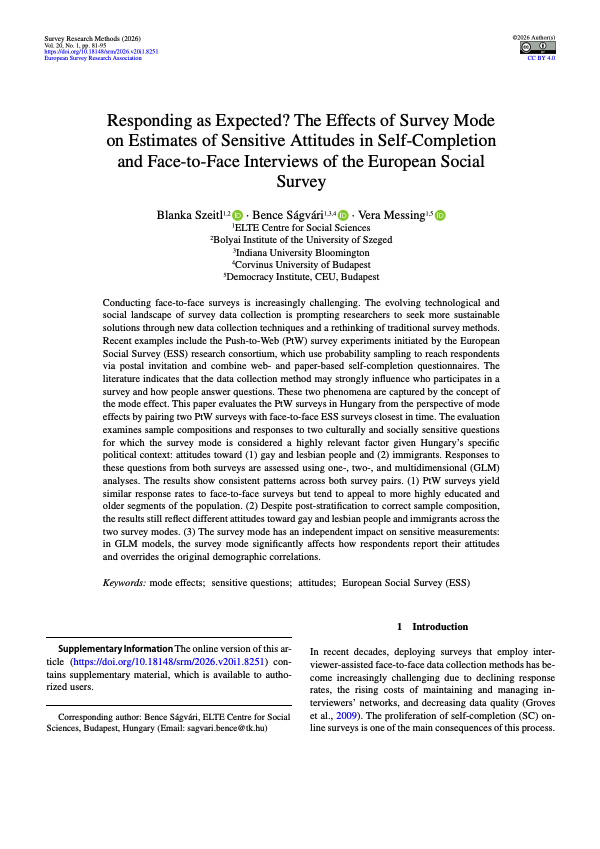
Research that compared responses in self-completion questionnaires and in-person interviews has been published by Survey Research Methods.
Blanka Szeitl, Bence Ságvári and Vera Messing (@css_budapest 🇭🇺) assessed mode effects for two sensitive questions.
https://t.co/uEKmBeoikn
Find out more about our self-completion panel survey at a webinar being held from 2-3.30pm (CEST) on Tuesday 22 September.
It will provide an overview of the panel design and methodology, and explain how you can access and analyse ESS-CRONOS-3 data.
https://t.co/5CVxyVwCPz
A special issue of Methods, Data, Analyses (MDA) on video interviewing in surveys is now available.
Published earlier this month, it includes 11 papers on video interviewing, including three that feature analysis of video interviews in our survey.
https://t.co/NncjlYE6hF
This year’s Sir Roger Jowell Memorial Lecture will be delivered by Bobby Duffy (@policyatkings 🇬🇧) from 6-7.30pm (BST) on Thursday 10 September.
Duffy will argue that we need to move beyond stereotypes and focus on more rigorous generational analysis.
https://t.co/I5nfbCmdOV
Analysis of our data was conducted for research published by the Journal of Happiness Studies (@SpringerNature).
Sandra Bohmann and Fabian Kalleitner (@LMU_Muenchen 🇩🇪 ) investigated whether perceived unfair inequality has a negative effect on wellbeing.
https://t.co/6uljOfDC2S
Analysis of data from the first five waves of our self-completion panel survey (ESS-CRONOS-3) can now benefit from longitudinal weighting.
The new longitudinal weight should be used for all analysis if two or more of the first five waves are combined.
https://t.co/0yYhjL0iHH
New research published in Scientific Reports (@NaturePortfolio) on inequalities included analysis of our data (2002-24).
Olaf von dem Knesebeck and Daniel Lüdecke (@UKEHamburg 🇩🇪) examined educational inequalities in disability among older respondents.
https://t.co/1SGdYS9bpv
A webinar being held from 2-3.30pm (CEST) on Tuesday 22 September will focus on our self-completion panel survey (ESS-CRONOS-3).
The event will provide an overview of the methodology, and show how to access and analyse the data collected in 11 countries.
https://t.co/5CVxyVxaF7
An academic article that considered the link between depressive symptoms and populism was based on analysis of our data.
The authors assessed data from Round 11 (2023/24) of our survey and data collected via our self-completion panel survey (CRONOS-2).
https://t.co/7BSom2Nm4q
Analysis of our data on gender discrimination in the workplace was referenced in this @a_publica article.
Dani Marinova and Gabriela de Carvalho (@UABBarcelona 🇪🇸) found that women were far more likely to experience discrimination than male respondents.
https://t.co/IFOXcuqs0u
New research into the social inequalities of cardiovascular health issues has been published by Discover Public Health (@SpringerNature).
The authors investigated respondents reporting heart and circulation problems in Round 11 (2023/24) of our survey.
https://t.co/fgMq32JP5R
A new @HorizonEU project, ESS-Innovate, will help to consolidate, modernise and future-proof our survey.
The project aims to increase the number of participating countries and will introduce AI and LLM-led tools to support data collection and operations.
https://t.co/ckPbh4Vi0N
A call for papers is now open for a Survey Research Methods special issue on self-completion data collection.
"We welcome contributions that provide methodological insight and practical evidence..."
The deadline for submissions is 31 October 2026.
https://t.co/uOUQA0wczX
👋 Hoy en Agenda Pública
🇩🇪 Alemania sigue sin estrategia industrial
@PeterBofinger, profesor de Economía en la Universidad de Würzburg, sostiene que las reformas de Friedrich Merz no bastan para reactivar una economía estancada.
📎 https://t.co/UnQduBkYXp
🌎 Albares: Iberoamérica como prioridad estratégica
@jmalbares, ministro de Asuntos Exteriores, Unión Europea y Cooperación, defiende que América Latina es el principal socio natural de Europa y apuesta por reforzar los vínculos con la región a través de la Cumbre Iberoamericana, Mercosur y una renovada agenda multilateral. 📎 https://t.co/H8XfNLQfz5
🗳️ ¿Por qué ganó Reyes Maroto?
@DomenecD, investigador sénior del CIDOB, analiza cómo la organización territorial y el respaldo del aparato socialista resultaron decisivos en las primarias del PSOE de Madrid. La baja participación reforzó el peso de las agrupaciones más movilizadas.
📎 https://t.co/crYDSbJIQv
👨👩👧 ¿Ha servido el permiso de paternidad para reducir la discriminación laboral?
Dani Marinova, profesora Serra Húnter de Ciencia Política en la Universitat Autònoma de Barcelona, y Gabriela de Carvalho, investigadora posdoctoral del Instituto de Gobierno y Políticas Públicas (IGOP-UAB), muestran que la ampliación del permiso de paternidad no ha reducido la discriminación contra las madres y, además, ha comenzado a trasladar parte de esa penalización también a los padres.
📎 https://t.co/onkH4cg3xx
Our formal relationship with the Japanese General Social Survey 🇯🇵 has been extended until 2030.
As part of the agreement, we will continue to replicate questions, allowing for comparisons between Europe and Japan, and share methodological information.
https://t.co/s3RVYNAU5r
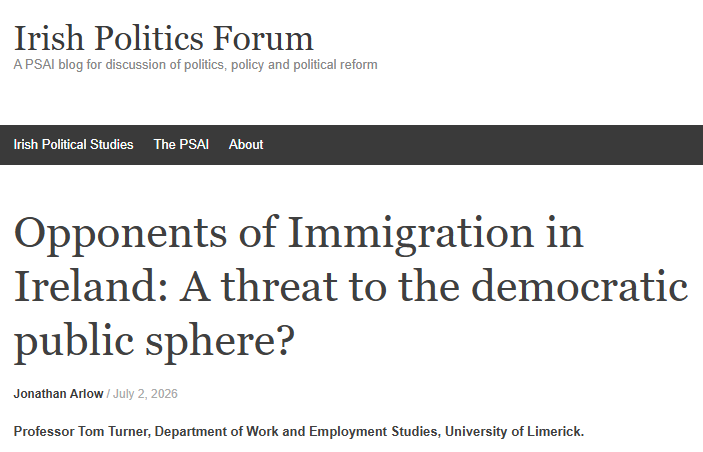
Using two pooled rounds of the European Social Survey in 2012 and 2020 Professor Tom Turner explores whether opposition to #immigration spills over into weaker attachment to #democracy. #ESS#ESSIE https://t.co/89K7GMuWeq
Longitudinal weights are now available for the first five waves of our self-completion panel survey (ESS-CRONOS-3).
The new longitudinal weights should be used for all analysis if data from two or more of the first five waves are combined.
https://t.co/3Wt6jQSOrK
I am sharing this now for international colleagues interested in the study of youth and non-progressive politics.
Researching Conservative Youth Politics. A Reflexive Approach to Methodological and Ethical Challenges
In open access at @Contention_J
https://t.co/Wc1SbQRkIO
New research published by the Journal of Contemporary European Studies (@tandfonline) includes analysis of our data.
Academics led by José Luis Gómez-Barroso (@UNED 🇪🇸) examined the profile of Eurosceptic respondents using three rounds of our survey.
https://t.co/KMmUNi6jK5