SITUATION DETECTED: Researchers at MIT show that GPT-6 Astra can natively read and write neural network weights through pure reasoning - no gradients, no training loops - calling it Weight-Space Programming.
wow. another one
Mathematician Benedikt Jahnel said that, if a human had solved a problem like this, it could plausibly have been Fields Medal level work 👀
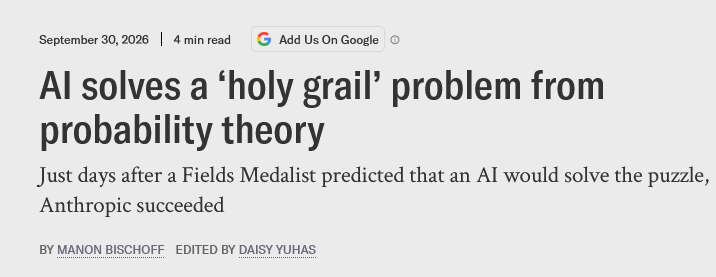
AI just solved a decades old “holy grail” problem in probability theory that resisted elite mathematicians for decades
Anthropic says its AI generated a proof resolving a famous conjecture in percolation theory, the mathematics of how random local connections suddenly form large scale connected structures.
The big open question concerned dimensions 3 through 10. Mathematicians already knew the relevant phase transition was continuous in 1D, 2D, and dimensions 11+, but the middle range had remained unresolved. The new AI generated proof shows that the transition is continuous there too, filling the decades old gap.
2022 Fields Medalist Hugo Duminil-Copin had tried and failed to solve the conjecture, then wrote in late August that it was only a matter of time before AI beat humans to it.
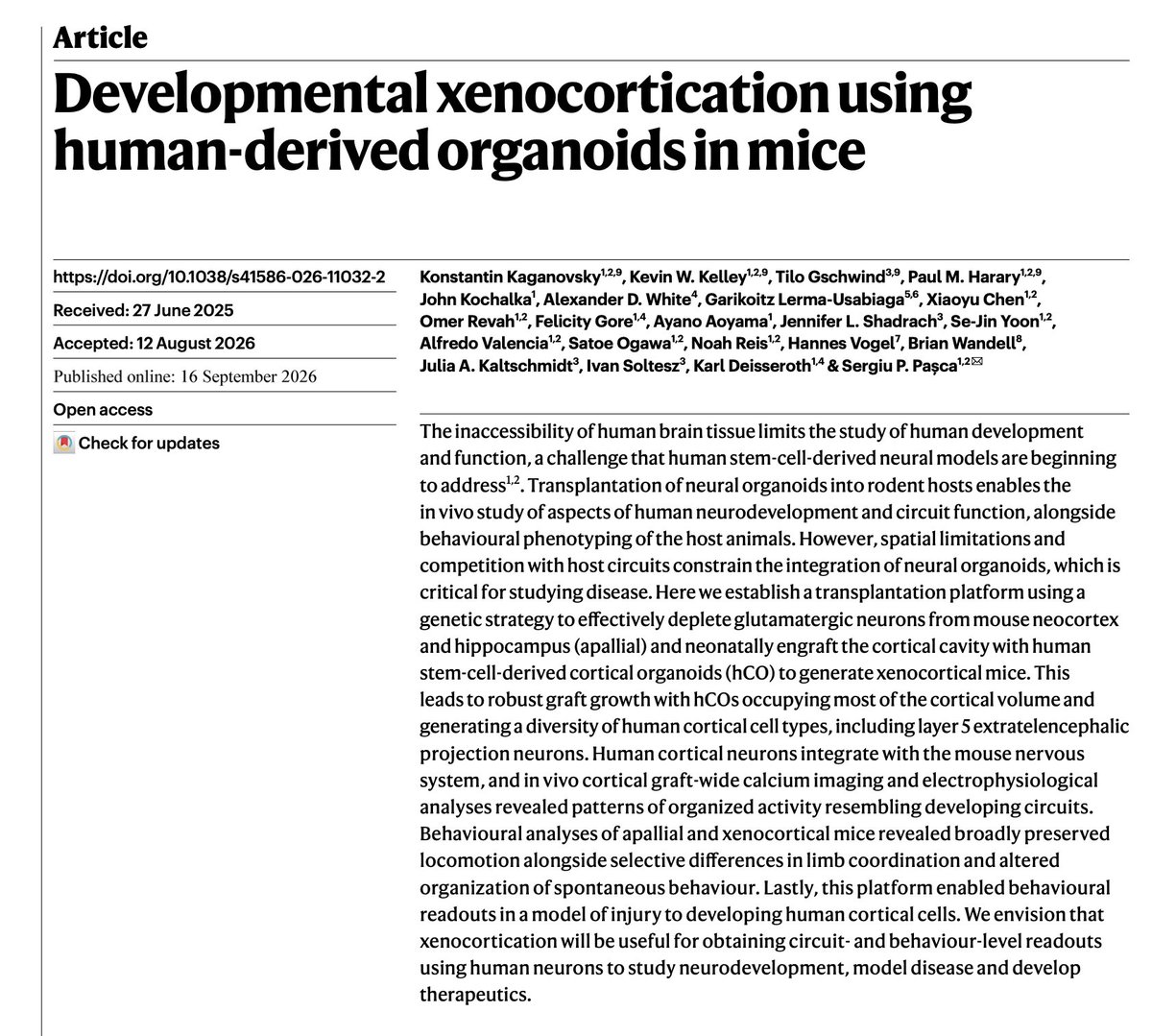
An extraordinary @Nature paper has just landed from the lab of @Sergiu_P_Pasca at @Stanford - led by Konstantin Kaganovsky. They have found a way to create "xenocortical mice" which have ~92% of their cortex occupied by a cortical organoid derived from human stem cells. This human-derived cortical graft integrates deeply with the host nervous system, supporting organised neural activity and behaviour.
This study is a milestone in synthetic biology and chimera research. It has the potential to generate multiple medical breakthroughs by providing an enhanced biological model of human brain tissue that allows behavioural as well as neural and genetic assays.
The Stanford team have been exceptionally thorough and proactive in addressing ethical concerns that comes from this frontier work. But their pioneering work nonetheless raises many open questions: are the xenocortical mice conscious? Do they have any human-like properties of consciousness or cognition?
@NitaFarahany and I will be addressing some of these questions in a forthcoming commentary - where we'll also offer an ethically-informed roadmap to guide this important research as it progresses. In this context, "pacing the frontier" really does make sense 😉
Read the Stanford @nature paper here, and buckle up. It's wild. https://t.co/Ky9HFb9nYI
Many drugs work by binding to a specific target in the body and blocking or changing what it does. An important first step in the drug development process is designing a molecule that can bind tightly to its target. Traditionally, that's meant weeks or months of expert work per target, sifting through a large number of candidates to identify the few that work.
We wanted to test if Claude could successfully design novel protein binders from scratch (also called de novo design). With a protein design prompt written by a human expert, Claude autonomously designed protein binders against 14 out of 15 targets.
We then worked with Adaptyv Bio and Twist Bioscience, who independently built and tested the proteins Claude designed.