7,000 Signatures and a News Update
More than 7,000 people have signed our petition, as the campaign continues to grow.
Thank you to everyone who has signed, shared, and donated. Your support means a lot!
A second article has been published, with the US-based Christian publication Charisma. This follows earlier publicity in The Christian Post.
Our purpose is clear: to ensure that safeguarding concerns are heard, understood, and addressed with transparency, integrity, and accountability.
Our commitment is to survivors, to fairness, and to the belief that real change begins with truth.
Read the latest story: https://t.co/JM6Gf6jJ2n
Petition link: https://t.co/fElBkwih3w
5,000 Signatures and Making Headlines!
What an extraordinary few days.
The petition has now reached 5,000 signatures, with people from the UK and beyond adding their names to a growing call for accountability.
To everyone who has signed, shared, donated, and encouraged others to engage with the campaign: thank you.
The Christian Post has also covered the petition, bringing wider attention to the call for the resignation of the Archbishop of Canterbury.
At its heart are fundamental questions about safeguarding, due diligence, leadership, and the treatment of survivors and whistleblowers within the Church.
5,000 people have joined the conversation. Let’s keep that momentum growing.
Sign and share the petition: https://t.co/fElBkwih3w
Read the Christian Post article:
https://t.co/xkbwsz4q3K
3,000 signatures and rising.
Since we shared the petition this weekend, we have reached more than 3,000 signatures!
Thank you to everyone who has signed, shared, spoken out, and helped amplify the importance of safeguarding.
Our petition is calling for the resignation of the Archbishop of Canterbury.
Recent events have raised serious questions about judgement, due diligence, accountability, and whether survivor voices are being heard, including those affected by abuse, terrorism, and institutional failure.
Every signature adds another voice.
If you have not yet signed, or would be willing to share the petition with others, any support would be greatly appreciated:
https://t.co/fElBkwiOT4
Thank you to everyone continuing to stand with survivors and support the call for change.
@AleemMaqbool@AndrewGraystone@cathynewman@donna_birrell@GuardintheFlock@HseofSurvivors@kayaburgess@MadsDavies@NatSecSoc@Rgt71Robert@Richard_Scorer@seaofcomplicity@steveswannBBC
Our campaign calling for the Archbishop of Canterbury's resignation has been updated.
The latest controversy is deeply troubling, not simply because of the decision itself but because of what it says about judgement, due diligence, and whether survivor voices are truly being heard.
On Friday 11th September 2026, the 25th anniversary of the 9/11 terrorist attacks, the Archbishop presented the Hubert Walter Award for Reconciliation and Interfaith Cooperation to Hafiz Muhammad Tahir Mehmood Ashrafi.
Ashrafi had previously attracted controversy over remarks concerning Osama bin Laden. In 2007, he said that bin Laden “must be given the lofty title of Islam, Saifullah,” meaning “Sword of God.” His representatives dispute suggestions that the remarks amounted to an endorsement of bin Laden.
The decision to present the award prompted strong criticism. Travis Frain OBE, a survivor of the Westminster Bridge terrorist attack, described it as a “grave misjudgement by the Church.” The National Secular Society called it “an insult to the victims of 9/11 and their families.”
Six days later, Lambeth Palace withdrew the award.
This goes beyond one poor decision. It raises a much more serious question: what consideration was given to survivors?
Those who have experienced abuse, terrorism, and institutional failure should not have to keep fighting to make their voices heard by those that claim to care about reconciliation, safeguarding, and justice.
Our campaign began because of serious safeguarding concerns. This latest episode only deepens the questions surrounding judgement and accountability at the highest level of the Church of England.
Meaningful accountability must follow, echoing the call for the Archbishop of Canterbury to resign.
Read and support the campaign here: https://t.co/Pvo6bIN95o
@AleemMaqbool@AndrewGraystone@cathynewman@donna_birrell@GuardintheFlock@HseofSurvivors@kayaburgess@MadsDavies@NatSecSoc@Rgt71Robert@Richard_Scorer@seaofcomplicity@steveswannBBC
Here is our recently published Letters to the Editors @ChurchTimes
Unanswered questions about safeguarding
From Emma Ash and the Revd Robert Thompson
Madam, — Your report (News, 8 May) on the independent audit of the National Safeguarding Team (NST) raises an urgent and uncomfortable question: Why is a report published by the Church of England in May 2026 dated 2025? And why, in a matter as urgent as safeguarding, has the Church apparently waited at least five months, perhaps longer, before placing it in the public domain?
This is not a minor administrative delay. The audit makes 66 recommendations. It is of profound concern that bishops, trustees, and senior office-holders may have access to safeguarding audits for months before survivors, parish safeguarding officers, clergy, and the wider public are allowed to read them.
That is especially troubling when some of those in senior governance positions may themselves have faced safeguarding concerns, complaints, or Clergy Discipline Measure processes. The Church cannot claim to be transparent while allowing those with institutional power to read, retain, and manage the timing of reports before those most affected by safeguarding failure are told what they contain. Nor is this an isolated concern. The diocese of London indicated that its audit results would be published at the end of the year (2025). The diocese of Chester said that its report would be published early in the New Year (2026). It is simply not good enough for safeguarding audits to disappear into institutional silence for months.
Delay is not neutral. In safeguarding, delay carries risk; it corrodes trust; and it tells those already harmed by institutional failure that the Church still does not understand the moral urgency of safeguarding.
The Archbishops’ Council and NST should now publish a clear timeline for the NST audit: when it was completed, when it was received, who decided the publication date, and why it was not released sooner.
EMMA ASH Address supplied (Tewkesbury, Gloucestershire)
ROBERT THOMPSON Address supplied (London NW6)
@donna_birrell@kayaburgess@MadsDavies@seaofcomplicity@AndrewGraystone@GuardintheFlock@cathynewman@AleemMaqbool@Rgt71Robert@Richard_Scorer@steveswannBBC@GabriellaSwerl
So proud of the team @PassionPix - we just won a @BAFTA for this! And proudest of all of the John Smyth survivors who told their story with such power and composure ♥️ Privileged to help them achieve accountability.
@iansmith34 4.10 states that the Diocesan Bishop holds ultimate accountability for diocesan-wide safeguarding.
4.46 notes that the Head of Safeguarding holds absolute responsibility within the diocese for the delivery of operational matters relating to safeguarding.
Having just read Part 1 of the newly released London Safeguarding Audit (published in 2025; released today), the quotes that stood out about the Diocese of London and its safeguarding culture are deeply concerning.
The report speaks of unclear roles, under-resourcing, burnout, relational divisions, hierarchical culture, and safeguarding frameworks that are not sufficiently robust or clearly defined. At the same time, survivors describe mistrust in the system, processes that did not feel trauma-informed, and a lack of consistent follow-up care. The audit also found that the overwhelming majority of survey respondents believed the Church prioritises its reputation over safeguarding people.
An audit has highlighted what many already knew: survivors are still not coming forward to report church abuse because the current system does not feel safe enough to trust.
This cannot simply end with recommendations and internal reviews.
An independent inquiry into the Diocese of London is needed, but so too is new legislation to ensure accountability and transparency is achieved via independent security.
@donna_birrell@kayaburgess@MadsDavies@seaofcomplicity@AndrewGraystone@GuardintheFlock@cathynewman@AleemMaqbool@Rgt71Robert@Richard_Scorer@steveswannBBC@GabriellaSwerl
https://t.co/fiO52nl9g6
I joined the Diocesan Safeguarding Team in 2022 as a Safeguarding Adviser and valued my role.
My departure in 2025 was not by mutual agreement; I did not wish to leave my post. I ultimately left following an ACAS-mediated process, which was pursued as a last resort due to the escalating legal costs I was incurring.
During my employment, I raised formal safeguarding concerns through appropriate internal channels. These included discrepancies in workload allocation, concerns regarding the welfare of a clergyperson who was not receiving adequate support, and my own experiences of victimisation.
The clergyperson concerned has since confirmed to me directly that he was receiving no support, contrary to assurances given at the time.
Rather than addressing these concerns through constructive problem-solving or systemic improvement, the organisational response focused on managing and containing the issue, including the marginalisation of those raising concerns.
Following my hospitalisation, I was offered no meaningful pastoral or managerial support. Despite my ongoing employment, professional responsibilities, and vulnerability, my line manager and the Head of Safeguarding refused to communicate with me.
My Occupational Health report explicitly identified a toxic working environment and systemic culture as contributing factors to my ill health.
Contrary to statements made by the Diocese, at no point did the Diocese work alongside, liaise with, or speak to NHS practitioners involved in my care.
By contrast, NHS staff were exemplary, and I am deeply grateful for the professionalism, care, and support they provided in helping to rebuild my health and wellbeing.
As matters progressed, the working environment became unsafe. Members of the safeguarding team refused to engage with me or respond to emails, including correspondence relating to live safeguarding cases. Emails concerning active safeguarding matters were left unanswered.
On my departure, there was no handover of my cases, and no arrangements were put in place to ensure continuity of safeguarding oversight.
This created unacceptable safeguarding risk and represents a serious failure of safeguarding governance and duty of care, both to service users and to me as a safeguarding professional.
I reject the assertion that concerns were adequately addressed or that appropriate support was offered or provided. I have raised these matters with the Charity Commission, where they remain under review.
@Rgt71Robert@TheOutsider40 @BishopNewcastle @cathynewman@ChurchTimes@ChtyCommission
Twenty years ago, a colleague in ancient philosophy asked me if I'd be willing to read Greek with an undergrad in the summer. I agreed. We had a great time reading Aristotle, which he hadn't read in Greek before. NOW ...
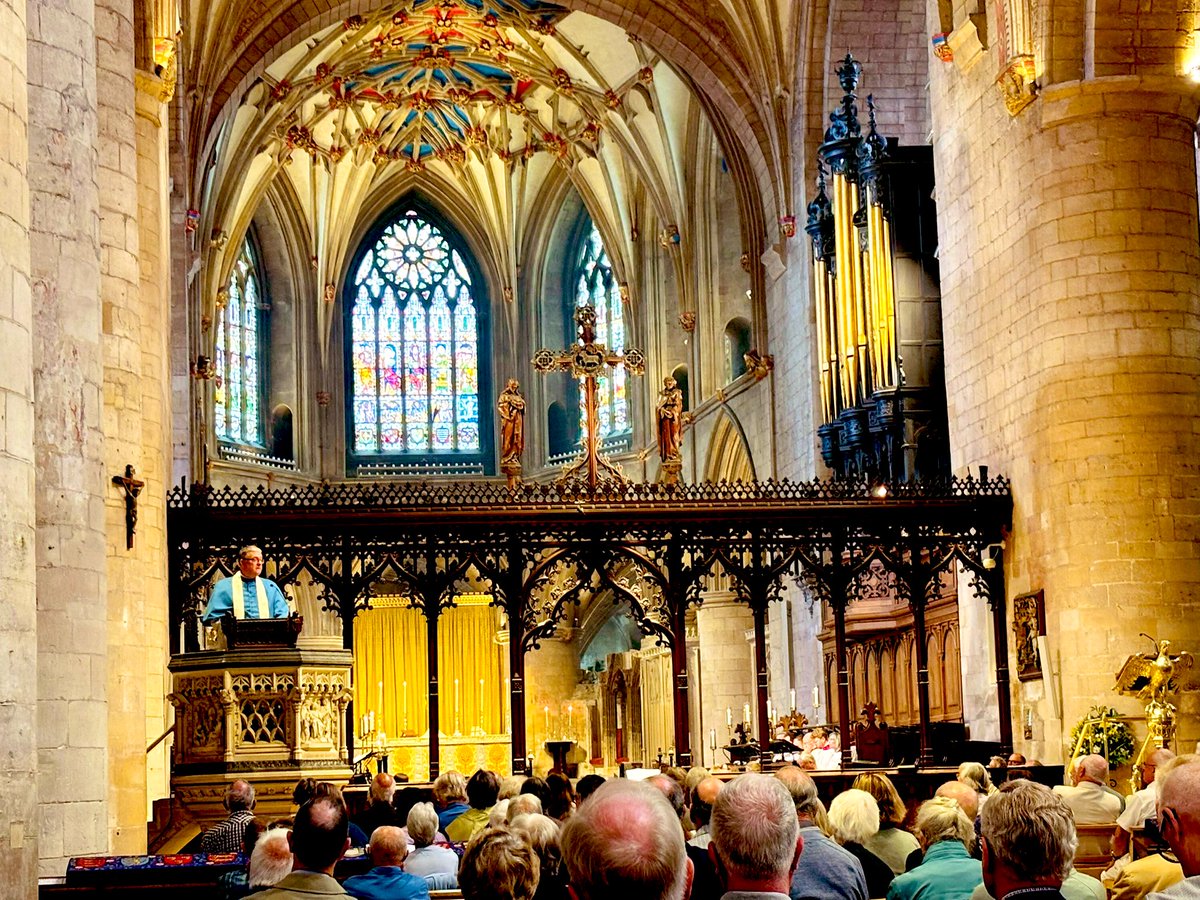
Wonderful to be at today’s Musica Deo Sacra 2025 Festival @TewkesAbbey. The sermon by @DeanofLincoln offered powerful reflections on the transatlantic slave trade & the Beatitudes, bringing to mind Clarkson, Equiano, and Wilberforce. #MDS2025#ThankYou@Nickduffdavies
3-months studying Ancient Greek, The Republic, Book 7, with @CatherineProj finishes next week! My translations are all done! We’ve had some phenomenal conversations on metaphysics & I’m thankful for this time & group researching Plato. #Philosophy#Classics#AncientGreek#Plato