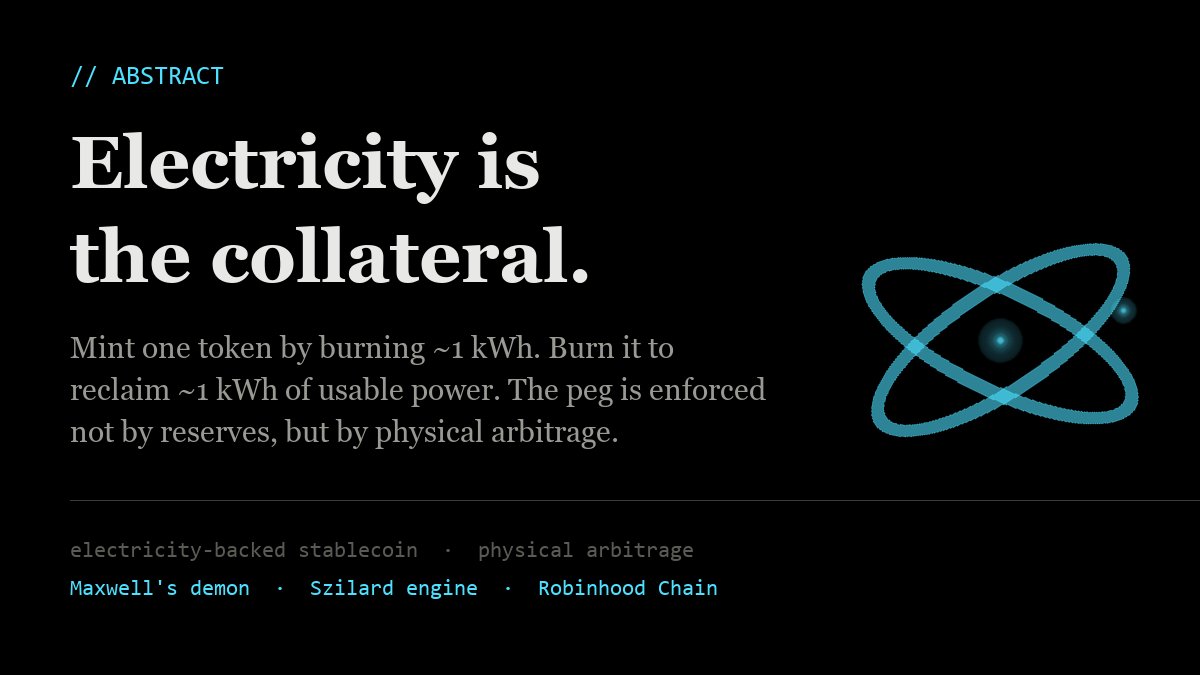
Mint with 1 kWh, burn for 1 kWh. Electricity as collateral, information as the wire. Theory only — Landauer, Theoretical support comes from @Livermore_Lab .
Electricity is not the reserve. It is the peg.
Fiat stablecoins park trust in one company’s bank account. Algorithmic ones hand the price to oracles and rehypothecation, then depeg to zero when markets break. E-Stablecoin takes a third path: not the dollar, one kilowatt-hour.
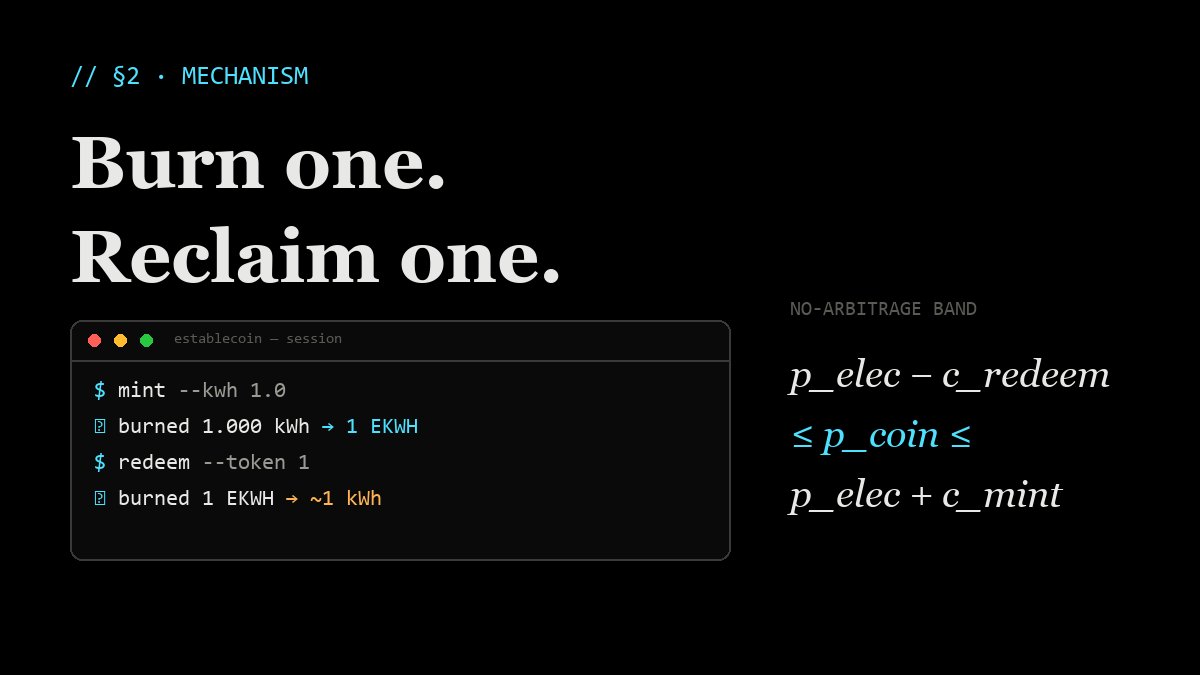
Mint 1 EKWH by burning ~1 kWh. Burn 1 EKWH to reclaim ~1 kWh locally. The definition is fixed:
E-Stablecoin ≡ 1 kWh
The peg is not an institution. It is physical arbitrage. If the coin trades above local power plus mint cost, burn kilowatt-hours, mint, and sell — price falls. If it trades below power minus redeem cost, buy and redeem — price rises. The no-arbitrage band is:
p_elec − c_redeem ≤ p_coin ≤ p_elec + c_mint
Electricity has stayed broadly stable for five decades, unlike compute and storage, which Moore’s law crushed. It is homogeneous, used worldwide, and producible in a decentralized way — already a ~$3 trillion annual market under computation itself. Bitcoin burns energy once. This path is built so the energy can be redeemed. That is the watershed.
The theory is not a slogan. Maxwell’s demon, the Szilard engine, Landauer’s principle: information and energy exchange at a real, calculable rate. The second law is explicit — E_out ≤ E_in. You cannot redeem more than was burned to mint.
On Robinhood Chain (chainId 4663): on-chain ledger, off-chain physical settlement. The token does not move remote electrons. It encodes a right — consume one kilowatt-hour here, regenerate one elsewhere. Both ends need real generation and consumption equipment. The chain cannot do that step for you.
CA:
0x2F55B7520d54810BD6218Dd6c4585f4Be2409687
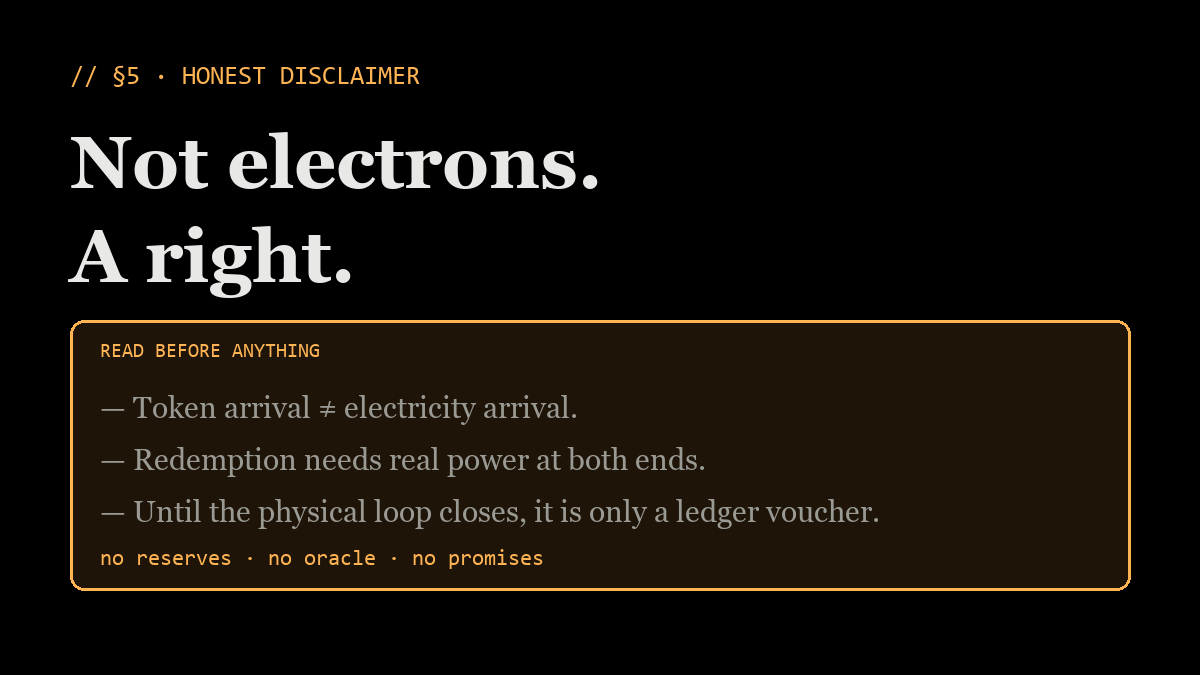
Concept from Murialdo & Belof, Lawrence Livermore National Laboratory (2023). This adaptation is an independent, unreviewed proposal. Until the physical loop closes, a token is a ledger voucher.
Green power has a double-counting problem, not a marketing problem.
The same megawatt-hour can show up in a PPA, a renewable certificate, a corporate claim, and a local subsidy. A shared, append-only registry does not make the electron cleaner. It makes the claim checkable. If two parties cannot both retire the same serial number, the attribute starts to mean something.
Do not put the breaker on a blockchain. Put the receipt there.
Dispatch, protection, and frequency control belong in the control room. What belongs on-chain is the record after the fact: interval meter data, certificate serial numbers, and the rule that triggered a payment. Confusing those two jobs is how energy-blockchain pilots become slide decks.
Power-sector reform is often short of something other than another megawatt: a trust and settlement layer that can keep up with the electron.
Wind, solar, storage, chargers, and flexible load have turned the grid into a high-frequency, multi-party, small-ticket market. Green certificates, ancillary services, demand response, and behind-the-meter sales are still mostly monthly reconciliation, manual matching, and central ledgers. The data exists. Title and price do not move at the speed of the power.
Blockchain is useful here in narrow ways. It should not replace dispatch. It should do three things control rooms are not built for:
1. Trace green power and environmental attributes. Which plant, which interval, which certificate—and whether it was counted twice. An on-chain record is harder to rewrite after the fact than a spreadsheet claim.
2. Automate small settlements. Distributed solar, customer storage, and interruptible load inside a virtual power plant can be paid by the minute or by the event. A smart contract can encode “responded, therefore paid” and shorten the reconciliation cycle.
3. Align records across parties. Generation, the grid, retailers, users, and regulators can share one tamper-evident log, so disputes start with the data rather than with competing versions of it.
The boundary matters. Real-time balance, protection, and security constraints stay in the power-system control layer. A chain should not, and cannot, operate breakers. Public-chain throughput and energy use need their own assessment; power markets fit permissioned or consortium chains better, and identity, interconnection, and money remain under electricity and financial rules.
The point of putting power on a blockchain is not a token. It is that every flexible kilowatt-hour can show its origin, measure its contribution, and settle. Capacity can keep growing. If metering, title, and settlement stay on the last generation’s rails, flexibility will not turn into revenue—or into reliable supply.
https://t.co/cYC6keJ58Z
92 GW / 1.5 GW is about 61 nuclear plants. The US has about 94 operating reactors. He is not describing an incremental add. He is describing a second nuclear fleet, and none of those plants are licensed for 2027.
The crunch is not “no electrons exist.” It is firm power at the site, on time. Gas turbines and transformers are sold out for years. A 1.5 GW nuclear plant does not help a cluster that needs power in 2027.
⚡️EX-GOOGLE CEO WARNS OF POWER SHORTAGE
Former Google CEO Eric Schmidt says AI is driving a massive electricity crunch:
“We’re running out of electricity… we need 92 gigawatts more power. The average nuclear plant is 1.5 gigawatts, you see the problem.”
⚡️EX-GOOGLE CEO WARNS OF POWER SHORTAGE
Former Google CEO Eric Schmidt says AI is driving a massive electricity crunch:
“We’re running out of electricity… we need 92 gigawatts more power. The average nuclear plant is 1.5 gigawatts, you see the problem.”
LPS is the right frame. Chips are no longer the long pole. A 4.25 GW site still needs turbines, transformers and an interconnect that actually energizes between 2028 and 2030. Securing the land does not secure the electrons.
Electricity is not the reserve. It is the peg.
Fiat stablecoins park trust in one company’s bank account. Algorithmic ones hand the price to oracles and rehypothecation, then depeg to zero when markets break. E-Stablecoin takes a third path: not the dollar, one kilowatt-hour.
Mint 1 EKWH by burning ~1 kWh. Burn 1 EKWH to reclaim ~1 kWh locally. The definition is fixed:
E-Stablecoin ≡ 1 kWh
The peg is not an institution. It is physical arbitrage. If the coin trades above local power plus mint cost, burn kilowatt-hours, mint, and sell — price falls. If it trades below power minus redeem cost, buy and redeem — price rises. The no-arbitrage band is:
p_elec − c_redeem ≤ p_coin ≤ p_elec + c_mint
Electricity has stayed broadly stable for five decades, unlike compute and storage, which Moore’s law crushed. It is homogeneous, used worldwide, and producible in a decentralized way — already a ~$3 trillion annual market under computation itself. Bitcoin burns energy once. This path is built so the energy can be redeemed. That is the watershed.
The theory is not a slogan. Maxwell’s demon, the Szilard engine, Landauer’s principle: information and energy exchange at a real, calculable rate. The second law is explicit — E_out ≤ E_in. You cannot redeem more than was burned to mint.
On Robinhood Chain (chainId 4663): on-chain ledger, off-chain physical settlement. The token does not move remote electrons. It encodes a right — consume one kilowatt-hour here, regenerate one elsewhere. Both ends need real generation and consumption equipment. The chain cannot do that step for you.
CA:
0x2F55B7520d54810BD6218Dd6c4585f4Be2409687
Concept from Murialdo & Belof, Lawrence Livermore National Laboratory (2023). This adaptation is an independent, unreviewed proposal. Until the physical loop closes, a token is a ledger voucher.
The thing you must understand: a token does not carry electrons. It carries a right — "burn one here, regenerate one elsewhere." Both ends need real generation and real consumption.
Landauer: erasing one bit costs at least k_B·T·ln2. Szilard: one bit of information can extract at most k_B·T·ln2 of work. Information is physical. That's the foundation.
Why can a token "equal" a kilowatt-hour?
Because information and energy really do exchange — Maxwell's demon (1867), the Szilard engine (1929), Landauer's principle (1961).
The peg closes itself. Coin trades above the price of electricity → arbitrageurs mint and sell. Below → they buy and redeem. Physical arbitrage, not a price oracle.