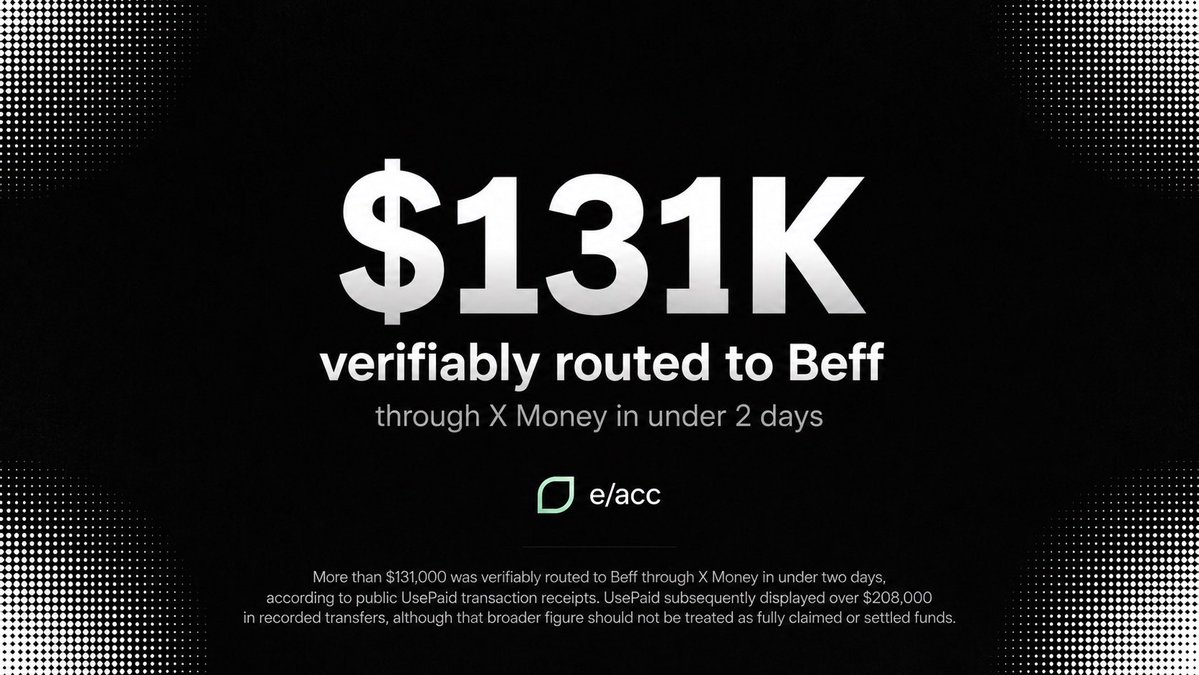
More than $131,000 was verifiably routed to Beff through X Money in under two days, according to public UsePaid transaction receipts.
UsePaid subsequently displayed over $208,000 in recorded transfers.
Although that broader figure should not be treated as fully claimed or settled funds.
Point-form recap of the space discussing / brainstorming @Kardashev_AI - ICYMI:
-Turning e/acc into a formal institution. The organizers want to move beyond memes, posting, and informal group chats into scientific papers, philosophy, policy proposals, and sustained influence. They said the nonprofit had been under discussion for over a year.
-Leadership and initial setup. Beff/Gill would serve as chairman and help with fundraising while continuing to run Extropic. Maxwell, described as having worked with neuroscientist Karl Friston, would run the institute. A domain was purchased, but incorporation, legal structure, staffing, and budgets were still being worked out.
-An unexpected financial windfall accelerated the announcement. Beff described unsolicited money arriving through X Money amid crypto/meme activity, reaching roughly $100,000 by late in the conversation. He said he had not launched or owned the associated token and intended to put the proceeds toward the nonprofit. Initial spending would cover legal fees, computers, basic AI usage, and a short period of operations before larger fundraising.
-Creating a counterweight to effective altruism and AI-restriction advocacy. Participants argued that AI-risk organizations have far more funding and coordination than e/acc. They anticipated further funding from AI-company wealth and potential IPOs, and wanted an institution capable of responding with research and policy arguments. Those funding forecasts were speculative.
-Researching intelligence across biological and artificial systems. Proposed work included thermodynamics, information theory, neuroscience, and alternative computing—especially understanding how intelligence emerges in different physical substrates, rather than focusing exclusively on conventional digital AI.
-Exploring hybrid biological–silicon intelligence. One proposed experiment was to connect cultured-neuron computing systems from Cortical Labs with Extropic’s thermodynamic computing hardware. The aim would be to demonstrate a combined biological and artificial intelligence system. This was an exploratory idea, not an announced working prototype.
-Developing a deeper intellectual foundation for e/acc. They discussed complex adaptive systems, active inference, economics, and how ideas spread and influence behavior. The ambition was to develop a substantial school of thought, with advancing civilization’s energy use and technological capabilities—the Kardashev-scale framing—as a guiding objective.
-Protecting access to AI and compute. A recurring policy theme was the freedom to own computing hardware, train models, use open weights, and run inference independently. Speakers proposed a “First Amendment for synthetic thought” and a “Second Amendment for compute” as advocacy concepts.
-Opposing concentrated control and regulatory capture. Participants worried that a few large AI labs could use regulation to exclude competitors and restrict independent AI use. They argued that centralized control, censorship, and authoritarian outcomes deserved greater attention in AI-risk discussions.
-Studying markets as a mechanism for AI alignment. Speakers suggested that customer demand, competition, reputation, and liability could encourage useful, reliable models. They criticized safety certification that, in their view, could become procedural theater or shield companies from responsibility.
-Connecting autonomous AI with crypto. They speculated about AI agents earning money and paying independent hosts for compute through cryptocurrency. Related ideas included community-funded model training, shared ownership of models, and distributing model revenue to contributors.
-Debating nonprofit structure and independence. The group discussed research and lobbying entities, potentially using both 501(c)(3) and 501(c)(4) structures. A DAO was floated, but the conversation leaned toward a simpler nonprofit structure. They also emphasized avoiding dependence on one dominant donor.
-Reaching people outside the tech/Twitter audience. Ana and Shaw stressed that research alone would not be enough. Suggestions included AI-assisted journalist research and outreach, accessible explanations, cultural content, events, and concrete stories about benefits such as better healthcare, more family time, and greater prosperity.
-Making optimism credible and actionable. An extended discussion connected pessimistic narratives with “learned helplessness.” Participants argued for a specific, believable picture of a better future that motivates people to act, while acknowledging that broad prosperity and managing job disruption require actual solutions.
-Choosing research with tangible public benefits. A participant with lobbying experience suggested focusing on problems that policymakers and ordinary people already care about, particularly healthcare. Maxwell also discussed distinguishing recoverable crises from self-reinforcing catastrophes, using demographic decline as an example.
-Next steps and community participation. The organizers planned to formalize the organization, raise additional funds, publish materials explaining its direction, and invite researchers, policy specialists, communicators, and supporters to contribute. No detailed launch schedule or finalized research roadmap was presented.
-Other conversation and closing banter. Side topics included Extropic’s progress, AI documentaries and podcasts, crypto-community dynamics, memories of early e/acc Spaces, San Francisco culture, and restaurant automation. The late discussion about a massive nonprofit data center was joking rather than a concrete commitment.
Point-form recap of the space discussing / brainstorming @Kardashev_AI - ICYMI:
-Turning e/acc into a formal institution. The organizers want to move beyond memes, posting, and informal group chats into scientific papers, philosophy, policy proposals, and sustained influence. They said the nonprofit had been under discussion for over a year.
-Leadership and initial setup. Beff/Gill would serve as chairman and help with fundraising while continuing to run Extropic. Maxwell, described as having worked with neuroscientist Karl Friston, would run the institute. A domain was purchased, but incorporation, legal structure, staffing, and budgets were still being worked out.
-An unexpected financial windfall accelerated the announcement. Beff described unsolicited money arriving through X Money amid crypto/meme activity, reaching roughly $100,000 by late in the conversation. He said he had not launched or owned the associated token and intended to put the proceeds toward the nonprofit. Initial spending would cover legal fees, computers, basic AI usage, and a short period of operations before larger fundraising.
-Creating a counterweight to effective altruism and AI-restriction advocacy. Participants argued that AI-risk organizations have far more funding and coordination than e/acc. They anticipated further funding from AI-company wealth and potential IPOs, and wanted an institution capable of responding with research and policy arguments. Those funding forecasts were speculative.
-Researching intelligence across biological and artificial systems. Proposed work included thermodynamics, information theory, neuroscience, and alternative computing—especially understanding how intelligence emerges in different physical substrates, rather than focusing exclusively on conventional digital AI.
-Exploring hybrid biological–silicon intelligence. One proposed experiment was to connect cultured-neuron computing systems from Cortical Labs with Extropic’s thermodynamic computing hardware. The aim would be to demonstrate a combined biological and artificial intelligence system. This was an exploratory idea, not an announced working prototype.
-Developing a deeper intellectual foundation for e/acc. They discussed complex adaptive systems, active inference, economics, and how ideas spread and influence behavior. The ambition was to develop a substantial school of thought, with advancing civilization’s energy use and technological capabilities—the Kardashev-scale framing—as a guiding objective.
-Protecting access to AI and compute. A recurring policy theme was the freedom to own computing hardware, train models, use open weights, and run inference independently. Speakers proposed a “First Amendment for synthetic thought” and a “Second Amendment for compute” as advocacy concepts.
-Opposing concentrated control and regulatory capture. Participants worried that a few large AI labs could use regulation to exclude competitors and restrict independent AI use. They argued that centralized control, censorship, and authoritarian outcomes deserved greater attention in AI-risk discussions.
-Studying markets as a mechanism for AI alignment. Speakers suggested that customer demand, competition, reputation, and liability could encourage useful, reliable models. They criticized safety certification that, in their view, could become procedural theater or shield companies from responsibility.
-Connecting autonomous AI with crypto. They speculated about AI agents earning money and paying independent hosts for compute through cryptocurrency. Related ideas included community-funded model training, shared ownership of models, and distributing model revenue to contributors.
-Debating nonprofit structure and independence. The group discussed research and lobbying entities, potentially using both 501(c)(3) and 501(c)(4) structures. A DAO was floated, but the conversation leaned toward a simpler nonprofit structure. They also emphasized avoiding dependence on one dominant donor.
-Reaching people outside the tech/Twitter audience. Ana and Shaw stressed that research alone would not be enough. Suggestions included AI-assisted journalist research and outreach, accessible explanations, cultural content, events, and concrete stories about benefits such as better healthcare, more family time, and greater prosperity.
-Making optimism credible and actionable. An extended discussion connected pessimistic narratives with “learned helplessness.” Participants argued for a specific, believable picture of a better future that motivates people to act, while acknowledging that broad prosperity and managing job disruption require actual solutions.
-Choosing research with tangible public benefits. A participant with lobbying experience suggested focusing on problems that policymakers and ordinary people already care about, particularly healthcare. Maxwell also discussed distinguishing recoverable crises from self-reinforcing catastrophes, using demographic decline as an example.
-Next steps and community participation. The organizers planned to formalize the organization, raise additional funds, publish materials explaining its direction, and invite researchers, policy specialists, communicators, and supporters to contribute. No detailed launch schedule or finalized research roadmap was presented.
-Other conversation and closing banter. Side topics included Extropic’s progress, AI documentaries and podcasts, crypto-community dynamics, memories of early e/acc Spaces, San Francisco culture, and restaurant automation. The late discussion about a massive nonprofit data center was joking rather than a concrete commitment.