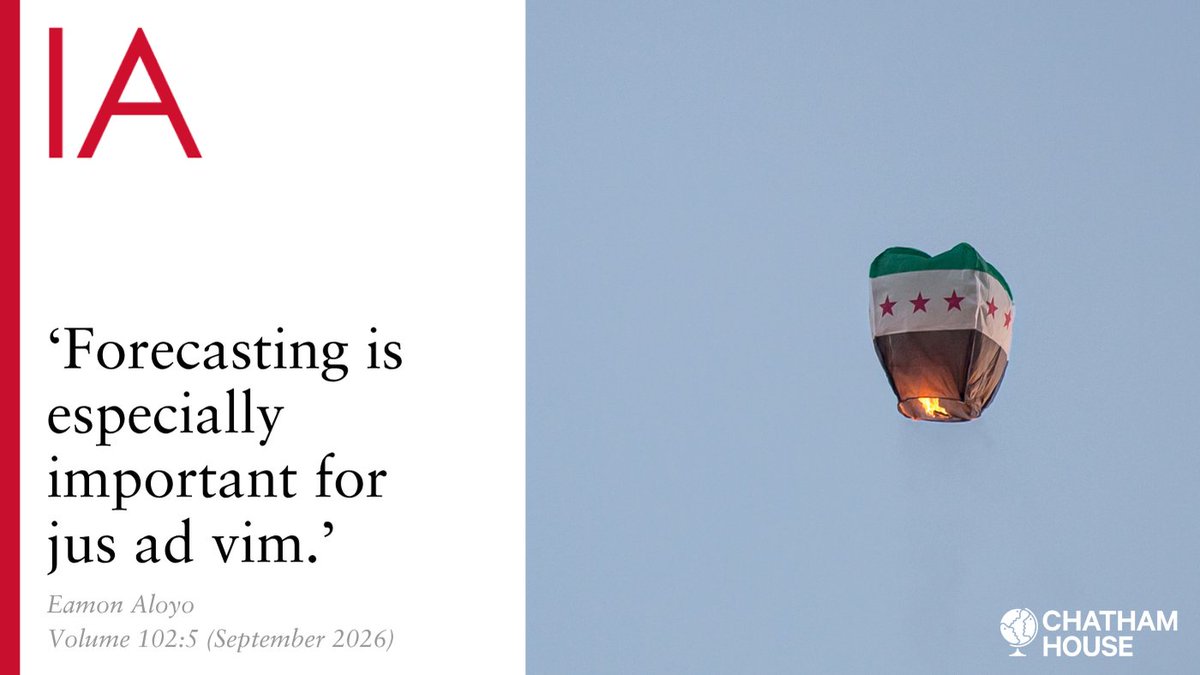
How can probabilistic forecasting lead to better foreign policy decision-making?
In his #openaccess article, @EamonAloyo argues for embedding psychological findings, behavioural economics and political science into jus ad vim decision-making. Read here: https://t.co/XTQcrOqWLI
In his latest #openaccess article, @EamonAloyo looks at the US’ foreign policy towards Syria in 2018 to develop jus ad vim as a decision-making framework.
Learn more about how ethical principles can be better applied to reduce error in our special section: https://t.co/wCTCL3PNV1
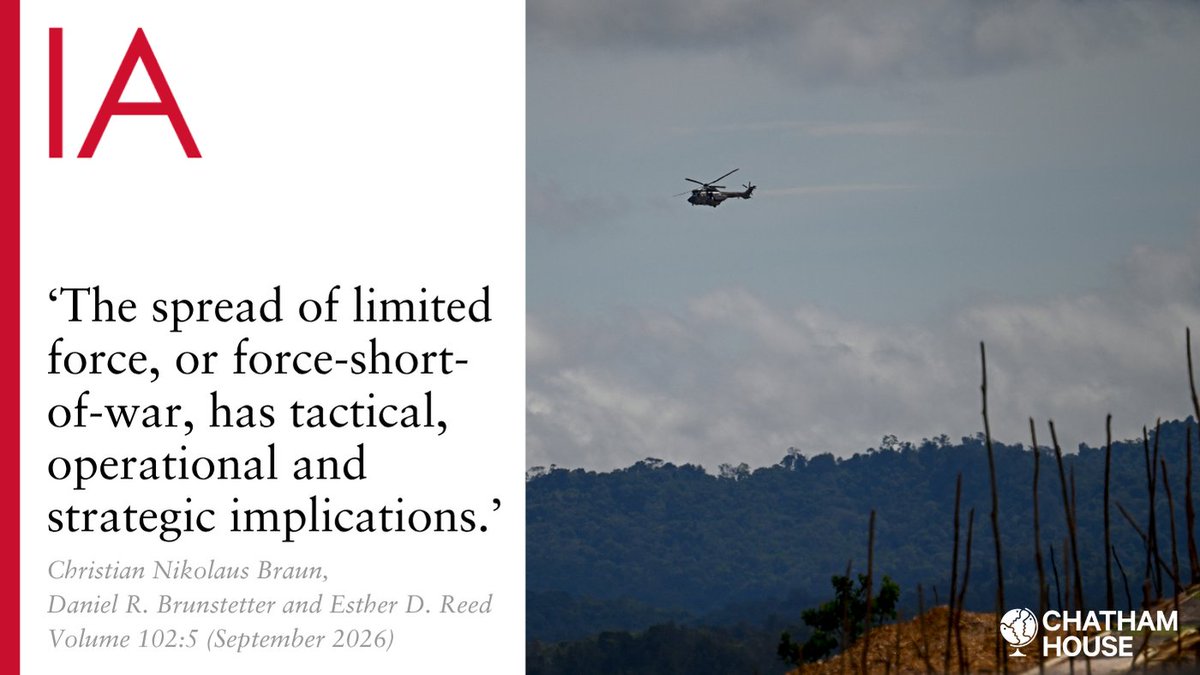
From the ethics of proxy warfare to foreign policy decision making, our latest special section guest edited by @ChristianBraun, Daniel Brunstetter & Esther Reed interrogates force-short-of-war from various theoretical and geographical perspectives.
📖Read their introduction to learn more: https://t.co/eye5QaDHID
Latest publication is now out (open access) in @IAJournal_CH: https://t.co/ic7ZTxIwug
Thanks to @ChristianBraun, Esther Reed, and Daniel Brunstetter for editing the special section.
Last week, I had the pleasure of hosting an interdisciplinary group, including IR scholars, international lawyers, philosophers, historians and theologians, at @warstudies to discuss the ethics of force-short-of-war (jus ad vim).
Approval by the UN SC & the chance of saving lives affect citizens' support for armed humanitarian interventions. All results of our survey experiment are in @Res_Pol https://t.co/vQB1e407fM
with @EamonAloyo@ISGA_Hague & Natália Kubalová @PolSciLeiden
@UvA_AISSR @Politics_UvA
What drives support for armed humanitarian intervention (AHI)? My latest research is out in Research & Politics (@Res_Pol), with @HMazepus and Kubalová. The article is open access: https://t.co/szjkZDG0Pz
"I said the era of famines was over. I was wrong. But it could be and should be."
Read the latest from WPF's Alex de Waal in @nytimes: https://t.co/zGG0kzLyWt
Five days left to apply for this PhD fellowship at Leiden University. An opportunity for students of diplomacy, historical or contemporary. @Hague_Jour_Dipl @isadiplomacy
https://t.co/fIiSFGBdtL
Our 2023 giving recommendations are in! We estimate that donations to the programs we recommend can save a life for roughly $5,000 on average. Read our blog post to learn how you can make the most impact with your charitable donations this giving season. https://t.co/zwUiCsVwfq
Vol. 37, Iss. 2 of Public Affairs Quarterly features work on morality, professional assessment, self-ownership and more by @EamonAloyo (@ISGA_Hague), Cristian Pérez-Muño (@UFPoliSci), George Shur (@RicePhilosophy), and Robert S. Taylor (@PhilosophyUCD) https://t.co/A9sSZJhfQ0
How much should the well-off donate to try to help the neediest? In my latest paper in Ethics & Global Politics I suggest that demandingness, fairness, net wealth, and historical and contemporary injustices should likely matter. https://t.co/0tbWLBHwF0
Building on the seminal work of @PeterSinger, I suggest there are some amendments to the important contribution that @willmacaskill, @tobyordoxford, and Andreas Mogensen make in a 2018 paper.