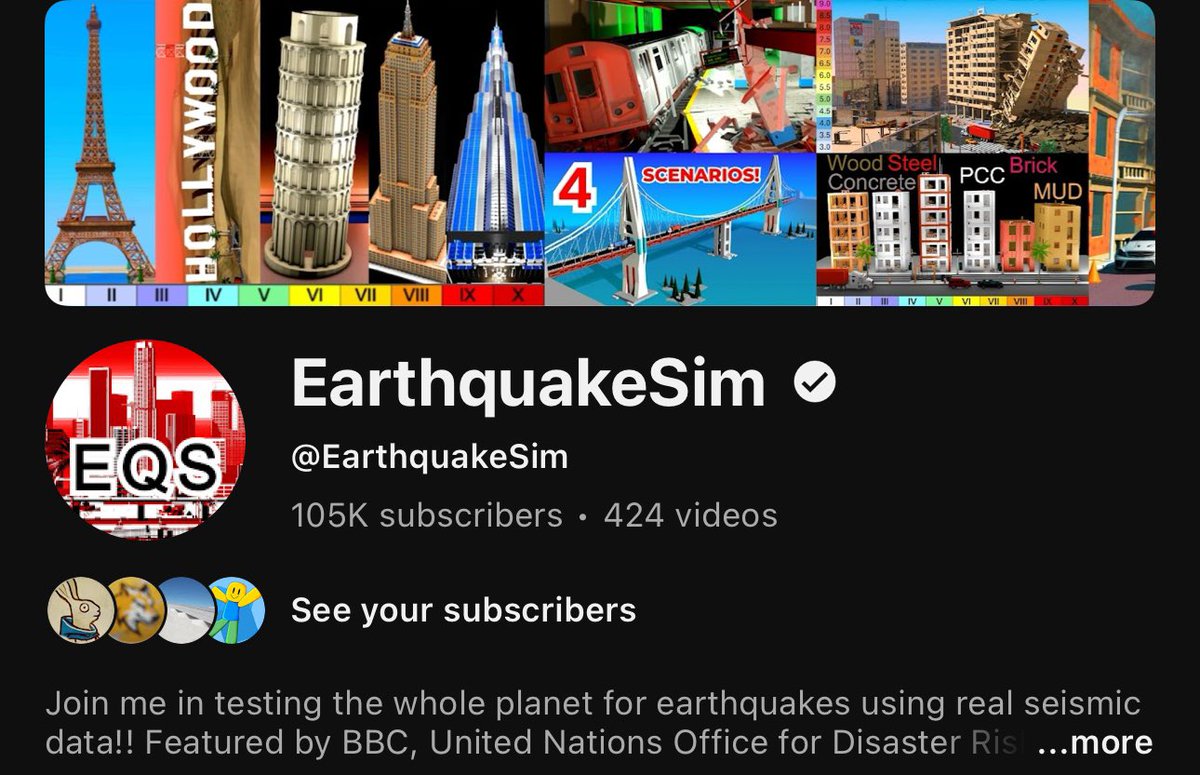
Hi #PortfolioDay ⭐️⭐️⭐️!
I’m a seismic simulation educator and I run the world’s largest #earthquake simulation channel on #YouTube, EarthquakeSim (17 Mil. Views)! My goal is to raise global awareness about earthquakes! Join my efforts! :) #tuesdayvibe#TuesdayFeeling#deprem
@fatihalagoz01 Bu simülasyonu oluşturan yazara uygun şekilde kaynak göstermemişsiniz. Lütfen bir dahaki sefere video açıklamanızda “EarthquakeSim” ifadesine yer verin, aksi takdirde telif hakkı ihlali bildirimi yapmak zorunda kalacağım. Teşekkür ederim!
Did you feel it?! M3.9 #earthquake in North Hollywood. Here’s a video simulation I made showing what the ‘Big One’ might look like in Los Angeles.
https://t.co/yDFgaD5x6u
I recently posted a viral 3D #simulation on YouTube where I compare how #earthquakes affect buildings. I hope it helps remind people of the importance of having enough water, supplies, and a solid emergency plan. When major disasters strike, governments can't always respond quickly, and things can spiral out of control fast. That’s why the steps you take now could end up saving your life.
https://t.co/SnN8VhHzb2
What would the 'Big One' look like in Los Angeles?
In collaboration with @VictorVescu, I created a simulation that explores various scenarios based on your location at the onset of the earthquake. The simulation illustrates how the ground might behave during a major earthquake and includes a side-by-side comparison of how shaking differs depending on the floor level in a high-rise building.
This damage is entirely hypothetical and is not guaranteed to represent what might occur in a different earthquake scenario.
#TheBigOne #california #SeismicRisk #whatif #losangeles
🌏 Earthquakes in Tokyo: A Risk We Can’t Ignore 🌆
Tokyo is one of the most exciting cities in the world—but it’s also sitting right on the Pacific Ring of Fire, where earthquakes are a fact of life. With over 37 million people in the metro area, the stakes are huge.
Tokyo has done an incredible job preparing for the worst. Skyscrapers sway instead of crumbling, and people are taught how to react when the ground starts shaking. But even with all this, the risk is very real—experts say it’s not a question of if another big one will hit, but when.
Here’s what stands out:
1️⃣ The 1923 Great Kanto Earthquake killed over 140,000 people. Since then, Tokyo has been on a mission to be better prepared.
2️⃣ The city’s engineering is top-notch, but it’s not just about buildings—residents are encouraged to keep 3 days’ worth of emergency supplies and know evacuation routes.
3️⃣ A major earthquake here wouldn’t just impact Japan; it could send shockwaves through the global economy.
Tokyo’s story is a reminder that even the most advanced cities need to stay ready for the unexpected.
💬 How prepared is your city for disasters? What can we learn from Tokyo’s example? Let’s talk about it and check out this earthquake simulation I created, showcasing the impact of varying ground-shaking intensities on infrastructure:
https://t.co/MeXwulEMnk
#EarthquakeRisk #TokyoLife #StayPrepared #ResilientCities
I’ve simulated an 8.0 earthquake in Tokyo!
As part of my work on the 'EarthquakeSim' YouTube channel, I’m committed to making earthquake science accessible and engaging. With nearly 20 million views worldwide, my channel has become a resource for geoscience educators, enthusiasts, and even media outlets like the BBC, BIG Media and Curiosity Channel. These earthquake simulations are not only visually compelling but also aim to educate viewers about seismic impacts on urban landscapes. #electionday2024 #earthquake #education
Please share this message far and wide. As a seismic simulation educator and creator of the YouTube channel EarthquakeSim, I’ve noticed that many people in seismically active areas STILL aren’t aware of the dangers of running outside during an earthquake.
I aim to transform seismic education globally by creating highly engaging and realistic simulations of earthquake damage. I believe most people are visual learners, and my work is unique because it involves thousands of hours of 3D structure modeling and simulating complex seismic phenomena.
My work has been featured by BBC, Curiosity Channel, BIG Media and many international media outlets.
I am especially concerned about unreinforced brick buildings, as they are highly vulnerable to collapse, even during moderate earthquakes. If you live in such a building, make sure you have a clear evacuation plan in case the structure becomes unsafe. In situations where you are near an exit, calmly evacuating the building may be the safest option.
Here’s a comparison I created showing how different earthquake magnitudes affect unreinforced brick buildings:
https://t.co/alkTuoNzL7
Thank you for helping to spread this important message!
#EarthquakeSafety #StaySafe #Preparedness #EarthquakeSim #SeismicSafety
Californians—DROP, COVER, and HOLD ON! Did you take part in the Great ShakeOut today? If so, share your experience in the comments below! Check out this educational video comparing earthquake magnitudes—it’s a must-watch! https://t.co/MgAAYNjIjc #earthquake#la#BayArea #California
Some of my work was briefly featured by the #BBC in an informational video discussing the potential for a future #earthquake in the Cascadia Subduction Zone, located in the western United States. This recognition aligns with the mission of my YouTube channel, ‘EarthquakeSim,’ where I strive to raise awareness about seismic risks and educate people on earthquake preparedness through engaging and informative content.
I think this might go viral! :) I’ve built a 3D version of Times Square in #NYC and simulated how a magnitude 8 earthquake would look like. Full earthquake magnitude comparison video here:
https://t.co/G4Ek6jcODb
I tested TIMES SQUARE in NYC for 10 different earthquakes from magnitude 4 to magnitude 8. Watch my results! #NewYorkCity#ThisMorning#newweek
https://t.co/eLdClRsnXz
Never seen before: Here’s a 3D #earthquake simulation I created of a strike-slip fault rupture passing directly through a subway station. This scenario reminds me of the #Hayward Fault in the #BayArea, which runs directly through one of the most densely populated areas in the western United States.
In light of the recent M7.1 #earthquake that struck #Japan today, I’ve created a simulation exploring the potential impact of a M9.2 megaquake on the #Nankai subduction zone.
https://t.co/iJjzuvuQmg