1/ This quickly moved from cool demo to functional AI on the blockchain.
The first LLM on the blockchain took hours to for a simple prompt. Now the front page of NPR news processed in 76 seconds for under $0.01 in gas fees.
Now live on @fogo mainnet.
1/ This was really cool.
For the first time, an LLM ran entirely on the blockchain. Weights, activations, attention, tokens all loaded and calculated onchain in a general purpose ledger. Every step in the process was a standard SVM transaction.
The way to understand the ZCash bug is it’s not infinite mint of ZEC itself. It’s more like the shielded pool (Orchard) could become insolvent. Think of it more like the KelpDAO hack for ETH.
Very little reason not to proactively unshield any ZEC today. Being early to the exit is always better in a bank run. Consider Orchard burned, and don’t re-shield until there’s a new pool with a clean history
People are putting way *way* too much stock into this. The human time horizons for the tasks are mostly based off guesses, not anything rigorous.
The variance of the latest data points is extremely high because of saturation. The times are based on a new hires contractor with no domain expertise. Even METR itself says the times are overestimated.
For agentic long term coherence, we have much more objective and less noisy benchmarks. SWE Bench, LongBench, HELMET, WebArena, OSWorld. All of them show pretty significant performance improvements over the last year or two. None of them show anything close to something like 90 day doubling time.
And that shouldn’t be shocking. LLMs are improving fast. But none of the underlying tech factors (context length, inference throughout, tokens per task, model size) are growing at the rate METR extrapolates are claiming agent performance is improving at.
When seeing someone extrapolating a wild claim like 90 day doubling time, always check he details of how it’s being measure, and don’t ignore the error bars. Most likely if the claim is that extraordinary and the measurement is that noisy, the extrapolation is over estimating
How do you make money in a post-infofi world?
The same way we used to. Go find edge and create valuable content. Grow your audience. Make money.
I did it with Blast - you can do it with Fogo.
Now that we're past TGE, it's time to think about the future for the chain.
Points. Everyone loves points. In this instance, they're called Flames.
And Season 2 of Flames (points) is here. 2% of all FOGO up for grabs.
So what do you need to do?
Go explore the chain:
- Trade on Valiant
- Do some lending/borrowing DeFi shenanigans on Pyron and Fogolend
- Use one of the various liquid staking platforms for your tokens (Brasa or Ignition)
- Wait for new apps to get added to eligibility (I bet the Fogo Farming game gets added soon)
- Invite your friends along for the journey
I would say the best thing to do here is try to find +EV ways to use the chain rather than just burning cash to farm points. The meta for burning txn fees for future airdrop died a couple years ago. Work smarter not harder.
Go check it out (use my link in top comment) - see what you find - maybe one of you ends up running my Blast playbook back.
Could change your life.
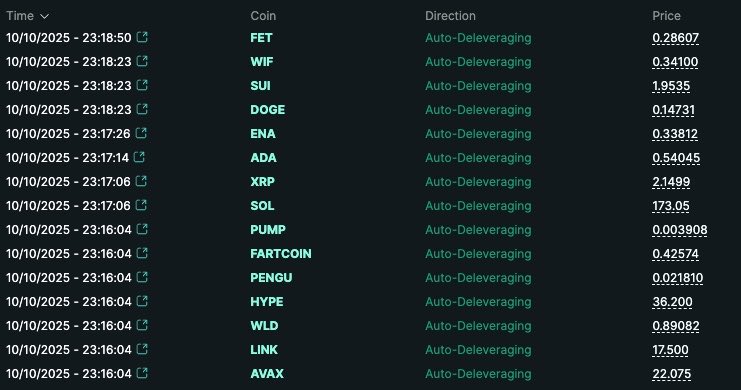
1/ Since a lot of people are waking up to see their perps positions closed and wondering what the hell “Auto-Deleveraging” means, here’s a quick and dirty primer.
What is ADL? How does it work? And why does it exist?
Dual flow batch auctions are a radical leap forward in market structure.
DFBAs combine the efficiency of CLOBs and the fairness of AMMs in a fundamentally chain native way
At @ambient_finance we’ve been hard at work on this new core primitive. Excited to share more soon
We’re excited to announce that $BTCS has acquired 3 Pudgy Penguins NFTs to add to their treasury.
@NasdaqBTCS is a publicly traded blockchain company listed on the @NasdaqExchange that holds over $300M+ in ETH.
Treasury Penguins are real.