After Indian soldiers tried to rip our “Warning Flag” as you see the red banner being ripped, we retaliated.
These Indians soldiers were beaten, kicked and thrown into the lake.
Indians, I don’t care if you report me, it would not change reality.
JD Vance likes to threaten Israel by pointing out how much of our weapons come from the US, but he completely ignores history. This dependency was manufactured by Washington. What does he want us to do, buy our jets from China? Or maybe he wants Israel to build its own?
Let's remind him that back in the 1980s, Israel was developing the Lavi, a fighter jet that would easily be one of the best in the world today. It was the US that pressured and forced Israel to cancel the project because American defense contractors didn't want the competition. You can't force us to shut down our independent fighter jet program to protect US corporate profits, and then turn around and complain that we rely on US jets. If Israel has to fully decouple and build its own platforms again, we can. But don't pretend this dependency wasn't your choice.
🕯️Today Is the Rebbe's Yahrtzeit
3 Tammuz, 5754 (1994)
The Rebbe, Rabbi Menachem M. Schneerson of saintly memory (b. 1902-1994), the seventh leader in the Chabad-Lubavitch dynasty and considered the most influential rabbi in modern history, passed away in the early morning hours of the 3rd of Tammuz, 5754 (1994).
His living legacy continues to inspire people around the world today. Visit https://t.co/Z5B163CPnF.
Per request, I’m sharing my thoughts on this week’s Torah portion today so people don’t miss it. I’ll be sharing it again tomorrow before Shabbat. 🙏
This week, in Israel, we read the fascinating portion of Chukat, loosely translated as “Law”.
The portion begins as follows, “God spoke to Moses and Aaron, saying: This is the ritual law that God has commanded:
Instruct the Israelite people to bring you a red cow without blemish, in which there is no defect and on which no yoke has been laid.”
So much to unpack here.
First of all, what does Chukat mean and why is it different than the many other words that describe Torah commandments, words like Mitzvah or Klal?
What is special about the word Chok or Chukat?
Furthermore, the portion starts with “This is the ritual law that God has commanded…”
With an intro like that, you’d expect the next verse to say something super fundamental like “This is the ritual law that God has commanded… Have faith in God.” Or “This is the ritual law that God has commanded, thou shall not murder.”
So what does the Torah call THE RITUAL? The red heifer. Red heifer?! The commandment to find a red cow and sprinkle its ash on someone who became impure after being exposed to a dead body? That red heifer? That is THE ritual?!
What is so fundamental about this strange commandment that the Torah calls it THE ritual?
Finally, one last question… We know that the red heifer is a strange commandment for many reasons but one thing about it is extraordinarily strange and illogical.
As mentioned, a person exposed to a corpse becomes impure and to purify that person, a priest sprinkles the shes of the red heifer on the person who became impure.
What happens to the priest who does the sprinkling? He becomes impure! How is that in any way logical? If he has the ashes that can purify someone, you’d expect him to become more pure, not impure! How are we to understand this?
The answer? We aren’t.
The word Chok as opposed to other words that mean commandments means a commandment that we can’t understand, a commandment that has no logical or rational explanation or at least an explanation that we, as finite humans, cannot understand.
Now that we understand that, perhaps, we can answer our other questions.
How does it make sense that the person who does the purifying becomes impure himself?
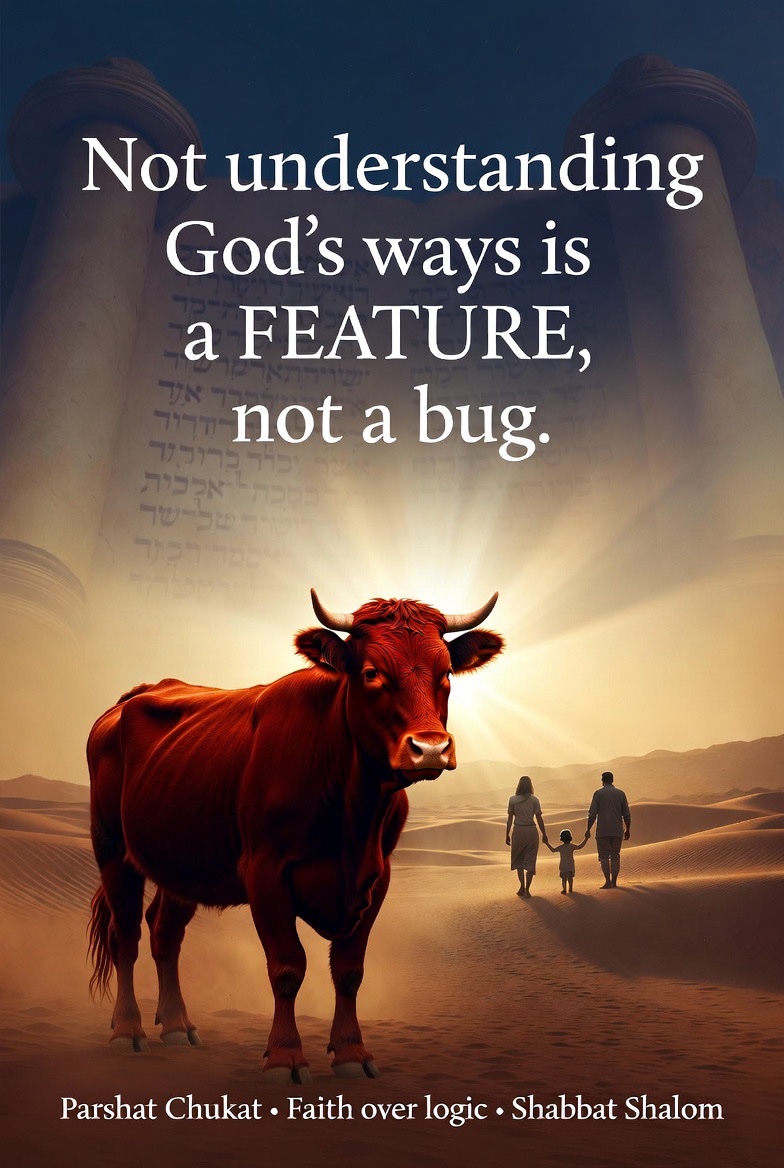
It doesn’t. It makes no sense to us. It’s counter intuitive. But that’s not a bug, it’s a feature. It’s not supposed to make sense to us but we are still commanded to fulfill this strange commandment of the red heifer.
Maybe that’s exactly why it’s called THE ritual. God and the Torah are teaching us a lesson that’s more relevant today than ever before.
Not everything has to make sense to us. Faith is not logical. If it was logical; it wouldn’t be faith, it would be knowledge.
Not being able to prove God’s existence is not something we are meant to struggle with. We are not intended to prove God’s existence because again, if we could prove God’s existence, then it would not be called faith.
Not only that but if we could prove God exists, then we would not have free choice and God created the world with free choice built in.
God could have easily created a world in which we see His presence clearly all around us. Then everyone would be believers.
That’s not how God created the world. He wants us to face two choices and to make the right one. This is true about everything in life. We have free choice to do good or to do bad. But it’s infinitely more relevant to faith.
In fact, perhaps this is the answer to the most fundamental question of why good things happen to bad people and why bad things happen to good people.
That very real phenomenon makes us question everything.
“If God is real, how did He allow the Holocaust to happen?”
“How did God allow 10/7 to happen?”
Valid questions.
Perhaps the answer is that God allowed humans to make choices and Hitler and Hamas chose to do what they did.
Of course God could have supernaturally prevented those horrible events but that’s not how He runs the world.
God did not force Hitler or Hamas to do what they did. They exercised their free will and chose evil.
The flip side of this is that when we choose to do good, when we fulfill God’s Torah, we made the right choice and now we can reap the reward for our choices.
God created this world so He can reward us in the afterlife.
God gave us the opportunity to collect the diamonds that are the Torah commandments. He left us up to us and if we collect those diamonds, we can cash them in in the world to come.
So why is the red heifer called THE ritual? Because one could make the argument that this idea teaches us the most fundamental principle of Judaism and of life itself.
We aren’t meant to understand everything and that’s ok. How do we react to that lack of understanding?
Do we say “Sorry; I can’t see God. I can’t know that the Torah is from God. I don’t believe in a God that does things as irrational as X!”?
Or do we say “I am a human being with a finite capacity to understand. I can only understand what my limited brain can comprehend and that’s ok!”
Today, in a world where information is at our fingertips, too many people feel like they need to understand everything and if they can’t understand it, if they can’t experience it, feel it, see it, then it doesn’t exist.
That’s exactly our text, to fight the instinct of thinking we, as humans, are the ultimate being and there’s nothing above us.
If we choose to believe in God and follow His Torah despite the ability to prove He exists, that is when God rewards us for making the right choice.
Just like the red heifer makes no logical sense to us and we are still meant to fulfill it, so too we are meant to believe in God and fulfill His commandments even though it often times makes no sense for us. That’s why it’s called THE ritual. Because it teaches us everything we need to know about how God created and runs the world.
Ok onward.
So this red heifer purifies someone who is exposed to a dead body and is therefore impure.
Why does death make someone impure? Isn’t death inevitable? Isn’t it part of life? What is impure about it?
To answer that question, allow me to share a traumatic story that happened to me last week.
As you may know, I went on a speaking tour last week in the US and Canada.
On the flight back, I was asleep when I was woken up by a voice that kept repeating a name over and over.
“Ariel! Ariel! Ariel!”
I turned around and saw something truly terrible.
A steward was shaking an elderly gentleman and the man was unresponsive.
Next to the man was an Indian lady who was bawling.
I quickly understood what was happening. This elderly man was not waking up and his caretaker, the Indian woman feared the worst.
The man was not waking up.
They lay him down and began CPR. I sat there watching them try to revive this man for a good 30 minutes.
His caretaker was hysterical and rightfully so.
We were only an hour away from landing so they didn’t do an emergency landing and kept trying to revive the man but they were unsuccessful.
The man passed right in front of my eyes. Everyone was in shock.
Doctors came forward to try and help. Psychologists came forward to help his caretaker calm down. The staff called the family. It was all a truly terrible experience.
More than anything, it reminded me about the fragility of life. It reminded me of my mortality. It reminded me that we are only here for a limited amount of time.
It made me feel hopeless.
And that is why death makes someone impure.
Death, while it is part of life, reminds us how small we are, how insignificant we are, how mortal we are.
Seeing someone pass right before your eyes makes you feel like “What’s the point in any of this? Maybe I should just give up.”
That thought is the epitome of impurity. We all have a job here, a mission for which we were put on this planet. When we witness death, our instinct is to feel like it’s all pointless and I might as well just enjoy my time here, party, and forget God or any of His commandments.
That thought is the epitome of impurity.
Later on in the portion, the Torah says “The Israelites arrived in a community at the wilderness of Zin on the first new moon, and the people stayed at Kadesh. Miriam died there and was buried there.
The community was without water, and they joined against Moses and Aaron. The people quarreled with Moses, saying, "If only we had perished when our brothers perished by GOD's will!
Why have you brought GOD's congregation into this wilderness for us and our livestock to die there?
Why did you make us leave Egypt to bring us to this wretched place, a place with no grain or figs or vines or pomegranates? There is not even water to drink!"
Again; so much to unpack.
“Miriam died there and was buried there.
The community was without water, and they joined against Moses and Aaron.”
What does Miriam’s death have to do with the nation lacking water?
This is a question that bothers almost all the commentators on the Torah. Many answers are given.
The Talmud explains that Miriam who famously was the one who saved Moses as a baby and made sure he knew who he was and where he came from, took care of the nation’s needs when she was alive.
The Talmud says that Miriam had a well that accompanied the nation wherever they went.
“Be’er Miriam”, the well of Miriam.
As soon as she perished, the nation had no water.
However, if you pay close attention to the actual verses, you’ll notice that when Aaron dies, the nation mourns for 30 days. When Moses dies, again, the nation mourns.
But here, when Miriam dies, nothing. The Torah says nothing about the nation mourning. How could that be?
Well, perhaps they didn’t mourn because they didn’t realize how important Miriam was or what her role was.
Miriam single handedly gave sustenance to millions of people in her lifetime.
Not only that, but as mentioned, Miriam, one might claim was as important, if not more than Moses himself.
Without Miriam, Moses would have grown up an Egyptian and would never have become the leader of the nation.
Perhaps in her lifetime, the nation didn’t appreciate how pivotal she was to the physical and emotional resilience of the Israelites and that is why they didn’t mourn.
Only after she died and the water stopped did they realize what they lost.
Maybe that explains something else.
“Why did you make us leave Egypt to bring us to this wretched place, a place with no grain or figs or vines or pomegranates? There is not even water to drink!"
What is going on here? The nation seems to be having a major tantrum! Grain? Figs? Vines? Pomegranates?
After everything God has done for them, after everything Moses has done for them, they’re complaining about pomegranates?
What is really going on here?
Perhaps it is not pomegranates they are complaining about. Perhaps they are actually throwing a tantrum because they now realize who Miriam was and how important she was. And even more, they now realize that they didn’t recognize her greatness in her lifetime.
Now that they are having this realization, they, like a child, begin to fire in all directions, and like a parent, we recognize that even though they say that they’re complaining about pomegranates, we can see past it and realize that they were really complaining about something else and that was their fundamental mistake of not appreciating Miriam until she was gone.
What happens next is one of the stranger things in the entire Torah.
“…and GOD spoke to Moses, saying, "You and your brother Aaron take the rod and assemble the community, and before their very eyes order the rock to yield its water. Thus you shall produce water for them from the rock and provide drink for the congregation and their livestock.
Moses took the rod from before GOD, as he had been commanded.
Moses and Aaron assembled the congregation in front of the rock; and he said to them, "Listen, you rebels, shall we get water for you out of this rock?"
And Moses raised his hand and struck the rock twice with his rod. Out came copious water, and the community and their livestock drank.
But GOD said to Moses and Aaron, "Because you did not trust Me enough to affirm My sanctity in the sight of the Israelite people, therefore you shall not lead this congregation into the land that I have given them.”
So let’s just review what happens here.
The nation has no water. They attack Moses and Moses loses control and is ready to give up.
He turns to God and God tells Moses to gather the nation and to talk to a rock and witness how water comes out of the rock.
Moses proceeds to gather the nation but instead of talking to the rock, he strikes it twice and water indeed comes out.
But before he does that, Moses calls the nation rebels and clearly loses his cool.
How does God react?
“But GOD said to Moses and Aaron, "Because you did not trust Me enough to affirm My sanctity in the sight of the Israelite people, therefore you shall not lead this congregation into the land that I have given them.”
What?!
God punishes Moses by telling him he won’t enter the land of Israel!!
After everything Moses sacrificed for God and for the nation, he is now told he won’t live to enter the land? That was his life’s mission!
What on earth could justify such a horrible punishment?
Again, a question literally every commentator asks.
There are over 100 different answers to this question but I believe the answer is right there in the verse.
Pay close attention to the words.
“Because you did not trust Me enough to affirm My sanctity…”
A more accurate translation is “Because you didn’t believe in Me and you didn’t sanctify Me…”
Is that not redundant?
Moses, according to God didn’t have enough faith to talk to the rock and also, he didn’t sanctify God’s name? What’s the difference between those two things?
The answer given is that there is such a thing as Chillul Hashem, desecrating God’s name, and Kiddush Hashem, sanctifying God’s name.
Are those two not the same thing? Two sides of the same coin?
The answer is no. We have two separate commandments.
One is to make sure our behavior, as representatives of God on this planet, sanctify God’s name.
Our behavior should have people saying “That person is a mensch. That is how a representative of God should behave.”
Then there is the other prohibition of desecrating God’s name and that is when someone witnesses our behavior and says “That person is a Jew? That’s how a Jew behaves? He is supposed to represent God and THAT is how he behaves?”
God says to Moses, “Even though you gave and sacrificed so much for Me and for My children, ultimately your role was to sanctify My name and not desecrate My name. You just did both. For that, you, Moses, will not enter the land.
Moses could have said to the nation, “Watch how God brings you water from me speaking to this rock. Despite your constant complaints, watch how God still takes care of you.”
Instead, he loses his cool and strikes the rock.
Ok, so that’s how he lost the opportunity to sanctify God’s name.
Where did Moses desecrate God’s name?
The answer is not in the act of striking the rock but rather in the way he loses his cool.
Moses gets angry and calls the nation, God’s children, rebels. How does that show a lack of faith and how is that desecrating God’s name?
Well, for starters, the Jewish people are Hashem’s children and when you speak negatively about His children, it is the equivalent of speaking negatively about God Himself.
But more fundamentally, at its core, what is anger?
Most personality traits are good in moderation but not anger. Anger is never a positive thing.
When you get angry, you are in essence desecrating God’s name by thinking that whatever it is that made you angry was not something decided upon by God.
Anger at its core is a lack of faith.
By losing his cool and getting angry, Moses is desecrating God’s name in front of the entire nation.
So what was Moses’ sin that warranted such a harsh punishment? His sin was actually two sins.
On the one hand, he could have used this opportunity to show the nation how great God is and how much He cares about His children. And on the other hand, Moses lost his cool and got angry thereby showing the nation that He doesn’t recognize God’s presence and authority.
Not sanctifying God’s name and even desecrating God’s name is such a fundamental sin that it warranted the harshest of punishments.
And one more thing.
The great Moses, the best leader in history and the greatest prophet the world has ever seen, was denied entry into Israel. All he wanted was to enter the land.
We have the opportunity Moses was never granted.
Just imagine telling Moses, “I’d love to make Aliyah but it’s too hard for me. I won’t make as much money. I won’t be able to drive the car I want. I don’t speak Hebrew well enough…”
Imagine how Moses would respond to a Jew being given the opportunity to enter the land and refusing to take that gift given to them by God.
Just imagine.
Shabbat Shalom.
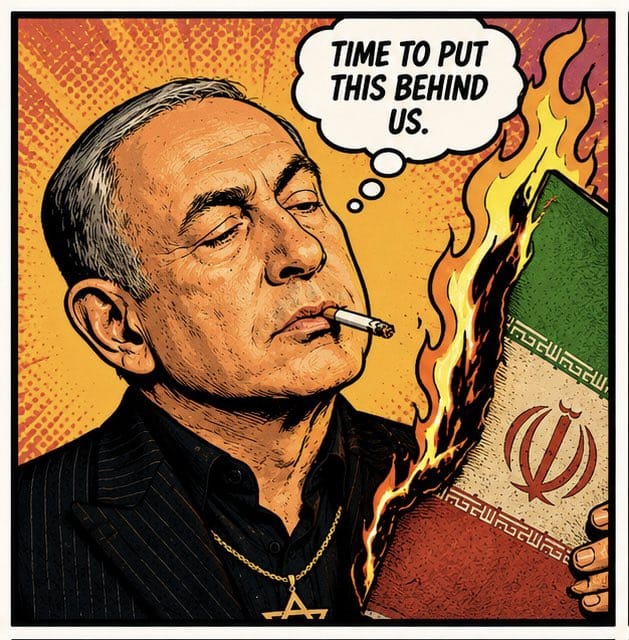
Israel knows where every single IRGC leader is. It’s time for them all to meet their predecessors.
Israel has the military capabilities to achieve complete victory here and it’s time they did that.
Enough child’s play.
This is war and wars are meant to be won.