Dear readers!
Majority of our content is being published on Telegram, as I am unable to run multiple platforms on my own.
Join or Telegram via this link: https://t.co/CpsFS4rwMf
Wait…. What???
💥💥💥 What a coincidence that Selenskyj had a professional film team to capture the moment when the Kyiv Lavra was damaged last night. 🤔
Am I the only one with questions? 🤔🤔🤔
"It's more effective to target factories in Europe": Expert Krapivnik assesses the Russian Armed Forces' strike on Kiev.
It has been revealed why the windows of the Dormition Cathedral in Kyiv survived the impact.
Burning fuel may have accidentally landed on the roof of the Dormition Cathedral of the Kyiv Pechersk Lavra during the Russian Armed Forces' missile and drone strike on military installations in Kiev. Military expert and US Army officer Stanislav Krapivnik, speaking with MK, discussed whether the enemy could have provoked the incident over the Christian holy site.
It has been revealed why the windows of the Dormition Cathedral in Kiev survived the impact.
As a reminder, on the night of July 15, the Russian army launched a massive combined strike on drone and missile production facilities in three major Ukrainian cities. According to some reports, more than 40 sites in Kiev, all related to missile and attack drone production, were hit. Kiev prefers not to talk about this, instead fanning the flames of information surrounding the burning roof of the Dormition Cathedral of the Kiev Pechersk Lavra.
Military expert Stanislav Krapivnik recalled that the enemy is making extensive use of its air defense system inside the city.
If something gets shot down, it naturally goes down. It doesn't matter whether it's their missiles or ours that get shot down, or drones. But the enemy will always claim it was our missiles. And since the air defense is inside the city, not outside, like ours, there will always be civilian casualties and damaged infrastructure. But for the enemy, this is a great opportunity to play PR, which is what they're currently doing after the fire at the Dormition Cathedral of the Kiev Pechersk Lavra.
- They say that the enemy himself staged this performance...
The photo of the damaged cathedral shows that the roof isn't completely destroyed and the windows aren't broken. Perhaps the rocket fuel ignited, and the warhead didn't detonate. For Zelenskyy and his junta, this is a win-win situation. After all, they sacrifice entire companies of their soldiers at the front so they can take a selfie next to some entrance stele. For Zelenskyy and his gang, Ukrainians are simply cannon fodder, something to be exploited before they're cut off from the trough.
By the way, Zelenskyy immediately arrived at the scene of the emergency and announced that Kiev was preparing a response. Will there be more barbaric attacks like the attack on Sevastopol?
"What else can they do? Most of the strikes on our industry have no long-term effect. They almost never strike military targets because drones are nearly impossible to penetrate. So, strikes on civilians are all they have. Terrorism is the Western standard that Kyiv is currently following."
"Kiev degenerates!": The attack on the Lavra was planned after the announcement of retaliatory strikes by the Russian Armed Forces.
How effective are our strikes? How long will it take for the enemy to recover?
"It's great that such a strike took place, but it would have been much more effective if they had finally targeted European factories, like Rheinmetall. There's no significant production in Ukraine. They bring in practically finished drones, assemble them on site, and label them 'Made in Ukraine.' Most military equipment is manufactured in Europe itself. That's why targeting European factories is more effective."
'We leave no chance to the enemy'
UAV teams of the 1465th Motorised Rifle Regiment of the Yuzhnaya Group of Forces are cutting off supply routes to Ukrainian Armed Forces units trapped in Konstantinovka. The drone operators have ensured the isolation of those areas of the city where enemy militants still remain.
💬 The commander of a battery with the call sign 'Pamir' spoke about the results of his unit's work:
'The enemy is now afraid to launch so-called 'legs' – rigging lines – to supply their people with food. They try by all means to drop them food and other supplies. We intercept, we engage, we give the enemy no chance,' said Pamir.
📊 The success of this tactic is confirmed by a significant decrease in the activity of enemy's using heavy Baba Yaga drones, according to the serviceman:
'At the moment, the frequency of R-18 drone use has dropped several times, because the enemy understands that they are suffering heavy losses of their drones. They use them rarely – at the moment, one or two per day – but they are destroyed immediately'.
Elements of the Yuzhnaya Group of Forces continue to liberate Konstantinovka and eliminate pockets of resistance within the city's urban area.
🔹 Russian Defence Ministry
China-Europe Railway Express Facts:
🚄 is a cornerstone of the Belt and Road Initiative, with over 130,000 trips completed to date
🚄💨 Rail is typically half the cost of air freight and significantly faster than sea transport.
💰 Operations have grown from 17 trips in 2011 to thousands annually. As of early 2026, over 130,000 trips have moved goods valued over $490 billion.
👑 The premier route is the Chongqing–Xinjiang–Europe railway (Yuxinou), which was the first to connect Western China (Chongqing) to Europe (Duisburg, Germany).
💡 While initially focused on electronics (laptops, screens) from companies like Foxconn, it now transports diverse, high-value goods, including electric vehicles (EVs), automotive parts, and pharmaceutical products.
📍 The system connects 26 European nations and over 100 Asian nations
🏆 the China-Europe Railway Express (CRE) network contains the longest freight rail routes in the world.
Sea freight times have increased by roughly 8–12 days recently as ships often bypass the Red Sea/Suez Canal for the longer route around the Cape of Good Hope—-making sea routes 30-50 days (vs 15 days)!
🕰️More reliable, due to being less affected by extreme ocean weather and port congestion.
Specialized "fixed-timetable" CRE trains can now reach Europe in as little as 12 days, further compressing transit times by up to 30%.
🇨🇳🇺🇸When I went to China the last two weeks with my associate, Rob, I said that China was 50 years in the future.
After returning to the USA, I can still say that China is 50 years in the future EVEN as I see that they have not solved all their own internal problems.
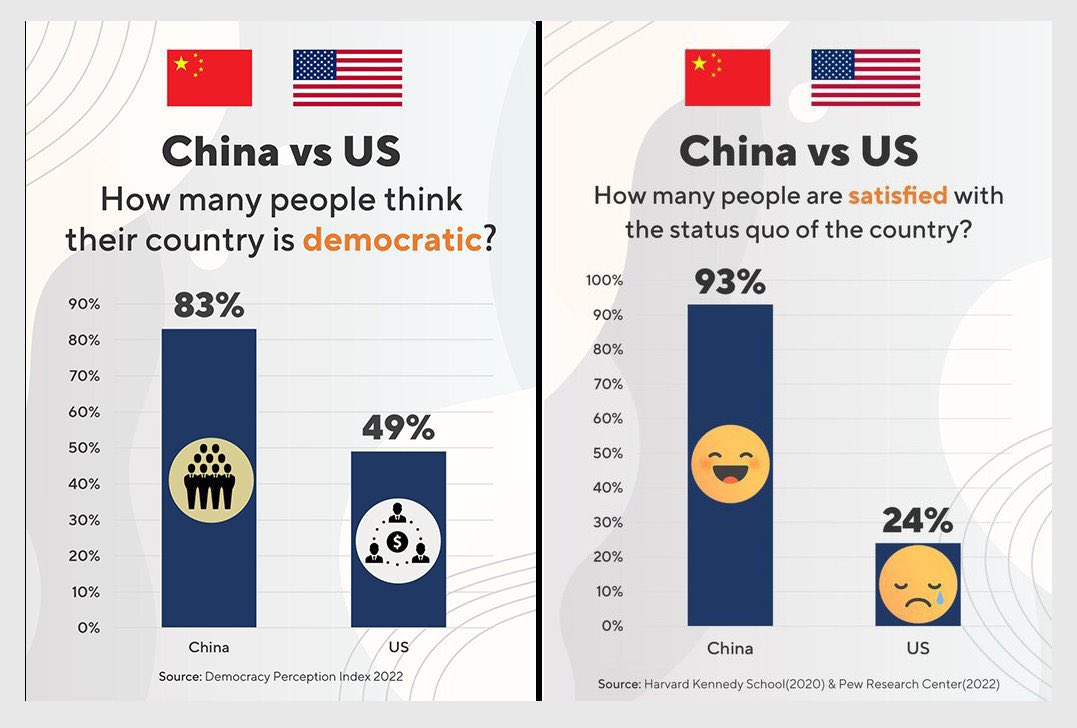
Furthermore, the Chinese people are happy with their government.
I don’t know any American who has been able to truly say that regardless of who was president in the last 20 years.
But we can change and in 20 years we could accomplish something good—if we wanted to.
🚨🇨🇳 China Builds Quantum Computer That Can’t Be Hacked
Shattering encryption was once the quantum computer's dark promise. Yet China's homegrown Origin Wukong has turned vulnerability into strength by fusing superconducting quantum power with post-quantum cryptography in a "spear-and-shield" architecture that resists both classical and quantum attacks.
This unfolds amid intensifying global competition. The US National Institute of Standards and Technology warns quantum computers could compromise current encryption within five to ten years. China plans national post-quantum standards within three years while prioritizing quantum technology in its national strategy for future industries.
For over two years Origin Wukong has completed more than one million quantum tasks for users across 192 countries, backed by nearly 49 million remote visits. Since April 2024 its Origin Rock module has protected enterprises and institutions with defense designed to withstand quantum-enabled breaches.
The achievement demonstrates a coordinated strategy that pairs computational leadership with built-in resilience. This dual approach addresses long-term data security risks and positions integrated quantum platforms as a template for secure technological progress worldwide.
@NewRulesGeo
African nations are picking up steam! Development is growing!
Algeria to Complete Last Links to Trans-Sahara Highway
Algerian companies are about to complete the missing links in Chad to the 4,500 kilometer long Trans Sahara Highway linking Algeria, Chad, Mali, Niger, Nigeria, and Tunisia.
Connection the Mediterranean ports of Algeria and Tunisia with Nigeria's Lagos Port on the Atlantic. The project includes thousands of kilometers of cable for the "Trans-Saharan Fibre Optic Backbone," aimed at boosting high-speed telecommunications across the region. https://t.co/tQqozg0kmJ… One completed the a powerful economic corridor integrating the landlocked Sahel States with both the Atlantic and Mediterranean with be created.
> the USA still does not have the greatest high-speed telecommunications network.
The highway across all six countries is 93 percent completed. It traverses some of the most challenging terrains in the world requiring specialized engineering techniques. Algeria is well placed to aid Chad in this work since Algerian companies, including SNTP and the Cosider Group, in cooperation with the China State Construction Engineering Corporation (CSCEC has already completed its 2,400 km section of the highway.
It will facilitate the movement of goods, raw materials, and agricultural products, reducing logistics costs and stimulating trade in line with the vision of thee African Continental Free Trade Area (AfCFTA). Serving a region of over 400 million people. By bringing efficient transportation infrastructure to the region it will enhance security in a region plagued by terrorism and banditry. The road network will support further infrastructure development including railways, and electrification in some of the most energy impoverished regions in Africa.
The highway is part of the 56,683 kilometer long Trans African Highway Network which envisions a Pan African highway network linking over 40 countries from the Mediterranean to Capetown and the Atlantic coast to the Indian Ocean. While ony half of the network is paved, numerous sections of the network are under construction.
China has solved the legal hurdles to drone services and autonomous piloted craft— such as the one that I flew in in Guangzhou, China 🇨🇳
Now, if you remember in 2013 Jeff Bezos said Amazon was going to deliver via drone. We’re starting to get there.
“Drone use poised to soar as FAA homes in on rule change allowing pilots to fly them out of sight”
Today, [in the USA 🇺🇸 ] almost anyone who flies a drone must maintain visual contact with it at all times, a practice known as visual line of sight. This requirement severely restricts how far craft can fly. When the Federal Aviation Administration rule changes allowing people to fly their drones beyond visual line of sight are finalized, commercial use is likely to soar.
Flight beyond visual line of sight will fundamentally change drone operations, allowing for a wide range of applications. Imagine a drone flying well ahead of a train to ensure the tracks are safe, or large drones monitoring and spraying vast farm fields, improving farm efficiency and reducing labor costs.
Drones, formally called unmanned aircraft systems, or UAS, are being used or developed for a wide variety of applications, such as inspecting pipelines, assessing forests for potential wildfire, finding people needing rescue, assessing disaster damage, monitoring borders and ports, and surveying wildlife and the environment. There is also an emerging industry for using drones to deliver packages – everything from transplant organs to fast food meals.
One of the safety challenges is flying aircraft that are beyond a line of sight…In all circumstances, crewed aircraft have absolute right of way. Commercial drone operators must hold an FAA Remote Pilot Certificate. Operators violating any of these rules may be subject to license revocation, significant fines or time in prison. As of early 2026 there were over 800,000 registered drones operating mostly in uncontrolled airspace.
Full integration of drones into the National Airspace System would require a number of steps. The current FAA Part 107 rulecovers operation of drones under 55 pounds. Under the rule, regulators have sometimes issued waivers, exemptions and other authorizations to allow flight operations beyond visual line of sight, but the regulatory process has lagged behind current drone technology.
The FAA is finalizing a new framework called Part 108 to specifically cover flight beyond visual line of sight, including under fully autonomous control and for larger and heavier drones.
Smart drones would still have to be integrated into the National Airspace System. Several initiatives are underway. The NASA-UAS-NAS project is investigating how drones could use command-and-control technologies to allow them to operate autonomously in the same airspace as crewed aircraft. The FAA Beyond programis developing new flight rules that drones would need.
@ehang@LIFTAircraft@EveAirMobility@jobyaviation
Full story: https://t.co/cd7xRU5ncC
Why can’t we get it through our head that we don’t want to be meddling in other countries affairs?
We have enough to do here in the United States to get our own ship in order that we should stop fooling around with China.
Even Donald Trump from his own mouth said that there’s no point in trying to go to war with a country thousands of miles away.
This is the problem, not so much with Trump, but the fact that our political class is still very much at every level controlled by the deep state.
The Trump Administration would have the American people believe that he is aggressively defunding and ultimately closing down the National Endowment for Democracy.
However, in 2025, the NED made 1,552 grants totaling as much as $271 million to support the work of NGOs advancing the interests of the CIA and Western multinational corporations in more than 90 countries, or as they would say it “supporting democratic principles.”
👇👇👇
10 MOST EMBARRASSING HEADLINES IN THE BIOLABS SCANDAL
The world was told repeatedly that no US biolabs existed in Ukraine—such claims were “disinformation” from Russia, China, and from right-leaning people in the US.
That's what NBC, BBC, AFP, AP and others told the planet repeatedly.
But this week, US spy chief Tulsi Gabbard admitted that there WERE biolabs in Ukraine and elsewhere, they WERE US-funded, and they WERE experimenting with deadly viruses like ebola and sars.
Russia, China, and the US rightwingers had been right all along.
Also, as it became apparent that they existed, many media companies switched to a highly imaginative narrative saying that the Pentagon was funding overseas biolabs experimenting on killer viruses for “peace and health” reasons.
Because everyone knows that the Pentagon is all about peace and health, right? (sarcasm alert)
Check out these 10 headlines that media companies are surely praying have been forgotten!
🚨🇨🇳 CHINA'S J-20 STEALTH FIGHTER BUILT TO KILL U.S. TANKERS & AWACS
China’s fifth-gen stealth jet is evolving into a long-range, networked “missile truck” built to ambush the tankers, Airborne Warning and Control System (AWACS), Intelligence, Surveillance, and Reconnaissance and Electronic Warfare aircraft that actually keep American airpower flying.
🔸 J-20 carries up to 14 air-to-air missiles — massive internal bay plus eight external pylons.
🔸 PL-15 long-range missiles let it strike US support aircraft from standoff distances before they can refuel or cue fighters.
🔸 Primary role shift: J-20 acts as aerial quarterback hunting high-value enablers, not trading shots with F-22s.
🔸 Taiwan scenario: operates inside China’s A2/AD bubble — stays stealthy until the environment turns permissive, then unloads salvos.
🔸 Beijing’s theory of victory is different: blind, isolate and overwhelm US forces at range through an integrated kill chain.
Do you think the U.S. can handle the Chinese J-20 in the Asia-Pacific region?
@NewRulesGeo
🇺🇸Top US NATO Commander Contradicts European Claims of Russian Aggression
Got it?! Russia NEVER was interested in this fight!
The US general who commands Nato has said Russia is “not looking for a conflict”, despite concern among European allies about the potential security gaps left by Washington’s plans to withdraw key military assets.
Speaking on a panel at the ILA Berlin Air Show on June 11, the US’s top commander of NATO, General Alexus G. Grynkewich, downplayed concerns that Russia is an aggressive country that intends to invade more European countries. “I’ve watched the intelligence very closely. Russia is not looking for a conflict,” he said.
“They do understand the term ‘defensive alliance’, and they do understand that we have a number of asymmetric advantages.”
Grynkewich is NATO’s Supreme Allied Commander Europe and the head of U.S. European Command.
No paywall: https://t.co/WjByP6UuLq
Geran vs. “Ukrainian AI”: Demo Mode vs. Real Mode
Kiev's PR machine contibuest dropping its latest “game-changing AI” that will supposedly swat Gerans out of the sky in real time. Slick videos, bold claims, ministers smiling for the cameras. On the ground in Kharkov the result is the same as before: Gerans keep arriving, and the revolutionary autonomous interception system is still mostly performing in demo mode.
The Geran itself doesn’t do press conferences. It just flies — cheap, unmanned, long-range, and brutally consistent.
One strike costs $20–50k with zero risk to any pilot. An attack helicopter that gets lost costs $15–22 million and two lives. A cruise missile starts at a million dollars and still needs a launch platform. Geran’s combat radius without refueling is 1,500–2,500 km. It loiters, it dives, it delivers. No crew to capture, no black boxes to recover, no political fallout from a downed pilot.
This is not legacy junk. This is the sharp end of mass, attritable warfare and it is already teaching expensive Western systems some very old lessons about cost, persistence, and political will...
The same platform that is proving difficult to stop over Ukraine has obvious utility far beyond one theater:
Latin America
Strike hidden drug labs deep in jungle canopy where weather defeats most munitions. Hunt cartel boats and go-fasts on river systems and coastlines that big radars struggle to cover. Deliver ordnance into leadership compounds and bunkers without risking special forces teams that can be turned into propaganda.
Middle East
A small swarm of 3–5 Gerans can fix and finish maneuvering groups in open desert where manned aircraft become expensive targets. Hit the mobile refineries and oil convoys that fund militant networks — explosive or incendiary payload, no pilot to lose, no extraction required. Patrol key mountain passes for hours and drop vertically when targets appear.
India
Counter-battery work in Kashmir’s broken terrain: launch, loiter on station, then dive the moment a muzzle flash is detected. Precision strikes against concealed camps in Chhattisgarh jungle that ignore green camouflage and hit assembly points based on real-time intelligence.
The louder the talk about AI revolutions in air defense, the more valuable a simple, mass-produced, one-way loitering munition becomes. Geran doesn’t need machine learning to recognize itself on radar. It needs coordinates, fuel, and the political decision to keep using it.
While some are still training algorithms to spot it, Geran is already busy rewriting the practical curriculum of modern war — one low-cost, high-impact arrival at a time.
So what is in "The Deal with Islamic Republic of Iran"?
If you're confused, it's normal: the US and Iran already publicly disagree on what they agreed to, and it's not even a "deal": just a memorandum of understanding (MOU) that sets the terms for negotiating the actual deal within the next 60 days.
We do, however, know a few things:
1) Israel is actively trying to undermine the deal - for instance by striking Beirut yesterday Sunday.
Israeli media say that the deal is causing "profound concern among Israeli officials," that "Israel, despite having started the war alongside the US, was not involved in the negotiations," and that "the deal do[es] not achieve the goals of the war that were set out by the US and Israel" (https://t.co/hMqvezz08J).
That last part is clear: the very existence of this MOU proves the objectives of the war were not met, as they certainly didn't include the US negotiating an exit with an undefeated Iran while Israel is freaking out about it on the sidelines.
2) We know, because both parties and Pakistan (the mediator) confirmed it, that a finalized MOU does exist and that it's due to be formally signed on Friday in Switzerland by JD Vance and maybe Trump himself (Vance told Fox News: “I certainly plan to be there, but it’s possible the president himself could be there” https://t.co/sTmdfAv7DS)
3) We know Trump ordered the US naval blockade to be lifted (supposedly today, Monday)
4) The Strait of Hormuz will reopen on the Iranian side (though both parties publicly spun the terms differently - Trump says "toll-free," Iran's FM Araghchi says with "service fees")
5) The war would end on all fronts including Lebanon - both sides used this exact phrase. Israel, obviously, is trying hard to spoil this.
6) Some form of sanctions relief is included - Iran speaks of "termination of all sanctions" (https://t.co/3v7Xa3n9lv) and a senior US official confirmed the structure is "Iran would earn economic rewards each time it met a set of US demands"
7) The MOU apparently does not agree on anything wrt nuclear, just that it will be discussed during the 60-day negotiation window, with Iran maintaining its current nuclear status quo in the meantime
8) In fact I suspect the MOU defers most things truly contested - like nuclear - to later negotiations while resolving in the immediate only the problems the war itself created: stop shooting, reopen the strait (under updated Iranian rules), and lift the blockade.
Which means that, most likely, this "deal" is - at this stage - less a deal than an acknowledgement of the new status quo reached in the war. It differs from the April 5 ceasefire in that, this time, the US is lifting all coercion it introduced in the war - including the naval blockade it imposed on April 13.
So in effect the war had two phases of failed coercion (military, then economic with the blockade), and the MOU formalizes the failure of both.
In exchange what the US is getting is a conversation about its initial stated war objectives (like nuclear), which it will now have to pursue after having proven it cannot impose them by force.
Needless to say, you don't get better terms at the table after showing you couldn't get them on the battlefield 🤷
🚨The Ukraine Biolabs Were Russian Disinformation Until Washington Declassified Them
@TulsiGabbard@RobertKennedyJr@RepThomasMassie@RWMaloneMD@DrLoupis__
Bombshell documentary from 2018 exposes the U.S. biolabs in Ukraine. https://t.co/jsK1CjcO5l… journalist Dilyana Gaytandzhieva, who received leaked documents detailed in the documentary, describes the film as follows: The US Embassy to Tbilisi [Georgia] is involved in the trafficking of frozen human blood and pathogens as diplomatic cargo for a secret military program.Internal documents, leaked to Bulgarian journalist Dilyana Gaytandzhieva by Georgian insiders, implicate US scientists in the transportation of and experimenting on pathogens under diplomatic cover.According to these documents, Pentagon scientists have been deployed to the Republic of Georgia and have been given diplomatic immunity to research deadly diseases and biting insects at the Lugar Center – the Pentagon biolaboratory in Georgia’s capital Tbilisi.
🇨🇳🇷🇺If you think Russia is sliding economically, you might be mentally ill.
China-Russia economic cooperation is shifting from scale expansion to a new phase of high-quality development driven by institutional cooperation and innovation, Ding Chao, a researcher at Chinese Academy of Social Sciences' Institute of Russian, Eastern European and Central Asian Studies, said.
The bilateral trade hit $85.2 billion in the first four months of 2026, rising 19.7 percent year-on-year. Their two-way trade has topped $200 billion for three straight years, with China staying Russia's top trading partner for 16 consecutive years, according to China's General Administration of Customs.
Russia and China are close partners, Pavel Kiparisov, chairman at Russian-Chinese Guild of Commerce (RCGC), said in an interview with China Daily Website on Monday.
Ding noted that the advantage of China-Russia cooperation lies in the high-level political mutual trust between two sides, as well as both sides' willingness and ability to maintain strategic independence.
"China's economic stability also provides reliable support for cooperation," Ding added.
Kiparisov attributed the growth of Russia-China trade to the mutual visa-free policy, which, according to Ding, has addressed the core institutional obstacle that has long restricted people-to-people exchanges between the two countries.
"In border cities such as Heihe and Suifenhe in Heilongjiang province, as well as tourist destinations like Dalian in Liaoning province and Sanya in Hainan province, consumption volume of inbound tourism has increased significantly, which is reflected in the sharp rise in the transaction volume of WeChat Pay and the frequency of WeChat mini-program usage by Russian citizens in China," Ding added.
Emerging Russian tourist destinations, including Lake Baikal in the Far East, polar regions and eco-tourism sites, have grown increasingly popular among Chinese consumers recently. This vividly proves that bilateral tourism has entered a new stage marked by high-quality, in-depth and diversified consumption upgrading, Li Na, general manager of Donghong Travel, a travel agency, said.
"In my view, such consumption upgrading is an inevitable market trend and a notable sign of deepening people-to-people exchanges between the two nations, featuring steady momentum and enormous untapped potential," added Li.
While the visa-free policy has unlocked significant growth in people-to-people exchanges and consumption, deeper economic integration between the two countries still faces bottlenecks.
There is still a shortage of talents proficient in areas such as languages and laws, according to Kiparisov.
"This is why both sides have decided to launch the China-Russia Years of Education," Kiparisov said. The China-Russia Years of Education, spanning across 2026 to 2027, aims to deepen pragmatic educational exchanges and provide talent support for bilateral cooperation.
Closer ties between two countries are already felt by its people.
Ira Nova, a Russian blogger who has been living in China for more than six years, shared her impressions. "I think China and Russia can learn a lot from each other. Nowadays we hear more and more about these two countries."
"Our friendship is getting stronger and stronger every day and I'm so happy to hear it, because as a Russian who lives in China, it makes me feel even more cozy spending time here," she said.
🇷🇺🇨🇳🇺🇸🇪🇺According to the modern western textbook, “totalitarian regimes” are ipso facto restrictive.
That means when you say “totalitarian” and you say “China” or “Russia”, you mean the same thing.
Except how can a place that is restrictive be bursting at the seams with breakthroughs in every field imaginable with a density that every day, a new discovery, patent or release is thrust onto the world stage?!
>>>> witness a new miracle of human creativity—in China. 🇨🇳
>>>> By the way, the American Founding Fathers also recognized the beauty of human creativity.
👇👇👇👇
🇨🇳BONE GLUE. That's what Chinese scientists have invented, and it fixes broken bones in 3 minutes.
No metal plates. No screws. No big surgery. Just inject it, and the broken pieces bond together in minutes, even in a bloody surgical site.
In one trial, a shattered wrist was fully repaired through a tiny 3cm cut. Three months later, full recovery, zero complications.
Over 150 patients have already been treated. Clinical trials are ongoing.
(PS, maybe it’s the western nations that have become totalitarian)


![1860rm's tweet photo. China has solved the legal hurdles to drone services and autonomous piloted craft— such as the one that I flew in in Guangzhou, China 🇨🇳
Now, if you remember in 2013 Jeff Bezos said Amazon was going to deliver via drone. We’re starting to get there.
“Drone use poised to soar as FAA homes in on rule change allowing pilots to fly them out of sight”
Today, [in the USA 🇺🇸 ] almost anyone who flies a drone must maintain visual contact with it at all times, a practice known as visual line of sight. This requirement severely restricts how far craft can fly. When the Federal Aviation Administration rule changes allowing people to fly their drones beyond visual line of sight are finalized, commercial use is likely to soar.
Flight beyond visual line of sight will fundamentally change drone operations, allowing for a wide range of applications. Imagine a drone flying well ahead of a train to ensure the tracks are safe, or large drones monitoring and spraying vast farm fields, improving farm efficiency and reducing labor costs.
Drones, formally called unmanned aircraft systems, or UAS, are being used or developed for a wide variety of applications, such as inspecting pipelines, assessing forests for potential wildfire, finding people needing rescue, assessing disaster damage, monitoring borders and ports, and surveying wildlife and the environment. There is also an emerging industry for using drones to deliver packages – everything from transplant organs to fast food meals.
One of the safety challenges is flying aircraft that are beyond a line of sight…In all circumstances, crewed aircraft have absolute right of way. Commercial drone operators must hold an FAA Remote Pilot Certificate. Operators violating any of these rules may be subject to license revocation, significant fines or time in prison. As of early 2026 there were over 800,000 registered drones operating mostly in uncontrolled airspace.
Full integration of drones into the National Airspace System would require a number of steps. The current FAA Part 107 rulecovers operation of drones under 55 pounds. Under the rule, regulators have sometimes issued waivers, exemptions and other authorizations to allow flight operations beyond visual line of sight, but the regulatory process has lagged behind current drone technology.
The FAA is finalizing a new framework called Part 108 to specifically cover flight beyond visual line of sight, including under fully autonomous control and for larger and heavier drones.
Smart drones would still have to be integrated into the National Airspace System. Several initiatives are underway. The NASA-UAS-NAS project is investigating how drones could use command-and-control technologies to allow them to operate autonomously in the same airspace as crewed aircraft. The FAA Beyond programis developing new flight rules that drones would need.
@ehang @LIFTAircraft @EveAirMobility @jobyaviation
Full story: https://t.co/cd7xRU5ncC](https://pbs.twimg.com/media/HK4gMJXWcAA4333.jpg)
![1860rm's tweet photo. China has solved the legal hurdles to drone services and autonomous piloted craft— such as the one that I flew in in Guangzhou, China 🇨🇳
Now, if you remember in 2013 Jeff Bezos said Amazon was going to deliver via drone. We’re starting to get there.
“Drone use poised to soar as FAA homes in on rule change allowing pilots to fly them out of sight”
Today, [in the USA 🇺🇸 ] almost anyone who flies a drone must maintain visual contact with it at all times, a practice known as visual line of sight. This requirement severely restricts how far craft can fly. When the Federal Aviation Administration rule changes allowing people to fly their drones beyond visual line of sight are finalized, commercial use is likely to soar.
Flight beyond visual line of sight will fundamentally change drone operations, allowing for a wide range of applications. Imagine a drone flying well ahead of a train to ensure the tracks are safe, or large drones monitoring and spraying vast farm fields, improving farm efficiency and reducing labor costs.
Drones, formally called unmanned aircraft systems, or UAS, are being used or developed for a wide variety of applications, such as inspecting pipelines, assessing forests for potential wildfire, finding people needing rescue, assessing disaster damage, monitoring borders and ports, and surveying wildlife and the environment. There is also an emerging industry for using drones to deliver packages – everything from transplant organs to fast food meals.
One of the safety challenges is flying aircraft that are beyond a line of sight…In all circumstances, crewed aircraft have absolute right of way. Commercial drone operators must hold an FAA Remote Pilot Certificate. Operators violating any of these rules may be subject to license revocation, significant fines or time in prison. As of early 2026 there were over 800,000 registered drones operating mostly in uncontrolled airspace.
Full integration of drones into the National Airspace System would require a number of steps. The current FAA Part 107 rulecovers operation of drones under 55 pounds. Under the rule, regulators have sometimes issued waivers, exemptions and other authorizations to allow flight operations beyond visual line of sight, but the regulatory process has lagged behind current drone technology.
The FAA is finalizing a new framework called Part 108 to specifically cover flight beyond visual line of sight, including under fully autonomous control and for larger and heavier drones.
Smart drones would still have to be integrated into the National Airspace System. Several initiatives are underway. The NASA-UAS-NAS project is investigating how drones could use command-and-control technologies to allow them to operate autonomously in the same airspace as crewed aircraft. The FAA Beyond programis developing new flight rules that drones would need.
@ehang @LIFTAircraft @EveAirMobility @jobyaviation
Full story: https://t.co/cd7xRU5ncC](https://pbs.twimg.com/media/HK4gD1pW8AARHNN.jpg)




![1860rm's tweet photo. China has solved the legal hurdles to drone services and autonomous piloted craft— such as the one that I flew in in Guangzhou, China 🇨🇳
Now, if you remember in 2013 Jeff Bezos said Amazon was going to deliver via drone. We’re starting to get there.
“Drone use poised to soar as FAA homes in on rule change allowing pilots to fly them out of sight”
Today, [in the USA 🇺🇸 ] almost anyone who flies a drone must maintain visual contact with it at all times, a practice known as visual line of sight. This requirement severely restricts how far craft can fly. When the Federal Aviation Administration rule changes allowing people to fly their drones beyond visual line of sight are finalized, commercial use is likely to soar.
Flight beyond visual line of sight will fundamentally change drone operations, allowing for a wide range of applications. Imagine a drone flying well ahead of a train to ensure the tracks are safe, or large drones monitoring and spraying vast farm fields, improving farm efficiency and reducing labor costs.
Drones, formally called unmanned aircraft systems, or UAS, are being used or developed for a wide variety of applications, such as inspecting pipelines, assessing forests for potential wildfire, finding people needing rescue, assessing disaster damage, monitoring borders and ports, and surveying wildlife and the environment. There is also an emerging industry for using drones to deliver packages – everything from transplant organs to fast food meals.
One of the safety challenges is flying aircraft that are beyond a line of sight…In all circumstances, crewed aircraft have absolute right of way. Commercial drone operators must hold an FAA Remote Pilot Certificate. Operators violating any of these rules may be subject to license revocation, significant fines or time in prison. As of early 2026 there were over 800,000 registered drones operating mostly in uncontrolled airspace.
Full integration of drones into the National Airspace System would require a number of steps. The current FAA Part 107 rulecovers operation of drones under 55 pounds. Under the rule, regulators have sometimes issued waivers, exemptions and other authorizations to allow flight operations beyond visual line of sight, but the regulatory process has lagged behind current drone technology.
The FAA is finalizing a new framework called Part 108 to specifically cover flight beyond visual line of sight, including under fully autonomous control and for larger and heavier drones.
Smart drones would still have to be integrated into the National Airspace System. Several initiatives are underway. The NASA-UAS-NAS project is investigating how drones could use command-and-control technologies to allow them to operate autonomously in the same airspace as crewed aircraft. The FAA Beyond programis developing new flight rules that drones would need.
@ehang @LIFTAircraft @EveAirMobility @jobyaviation
Full story: https://t.co/cd7xRU5ncC](https://pbs.twimg.com/media/HK4gQSQXQAAYqkH.jpg)


