We (Jens Blechert and team) investigate basic mechanisms of (disordered) eating and dieting using experimental and ambulatory methods @dept_psych_sbg @PLUS_1622
Since we are looking to collect a large number of participants, we would also appreciate if you could repost this message and pass on the experiment to anyone else who might be interested🙂
Working on your diet? You're invited to an online study where we learn from you how to promote healthy eating! It consists of a computer task and questions about eating habits and preferences. It's 30min, and you can win €20,-. Start on PC or laptop here: https://t.co/e2GXSPKBkY
Pps who believed they approached chocolate more often, chose more chocolate and desired to eat it more. This was irrespective of training type, and also occurred in the sham condition; hence, this effect was unrelated to any real relationship between approach rate and food type.
New article alert! https://t.co/BjkFymXcdI
We used a new variant of the approach-avoidance task to train pps to avoid chocolate and approach fruit. This training was compared to the regular irrelevant-feature AAT training.
The new training was ineffective while the regular irrelevant-feature AAT significantly enhanced the desire to eat fruit. However, an interesting relationship emerged between the outcome measures and the perceived contingency between stimuli and approach/avoidance responses...
This constitutes a reversal of the assumed relationship between approach bias and cognitive resources - relying on dual-systems models, researchers usually assume that a stable approach bias interacts with variable cognitive resources to predict dietary failures or relapse.
New publication in which we analyze the longitudinal interrelations between food approach bias and consumption as well as impulsivity and dietary motivation! 🧵
https://t.co/Il9zpYxkBl
Takeaways:
- Approach bias is highly variable over time - its within-person variance is twice as large as its between-person variance
- TRAIT impulsivity and STATE dietary intentions interact with state approach bias to predict unhealthy eating
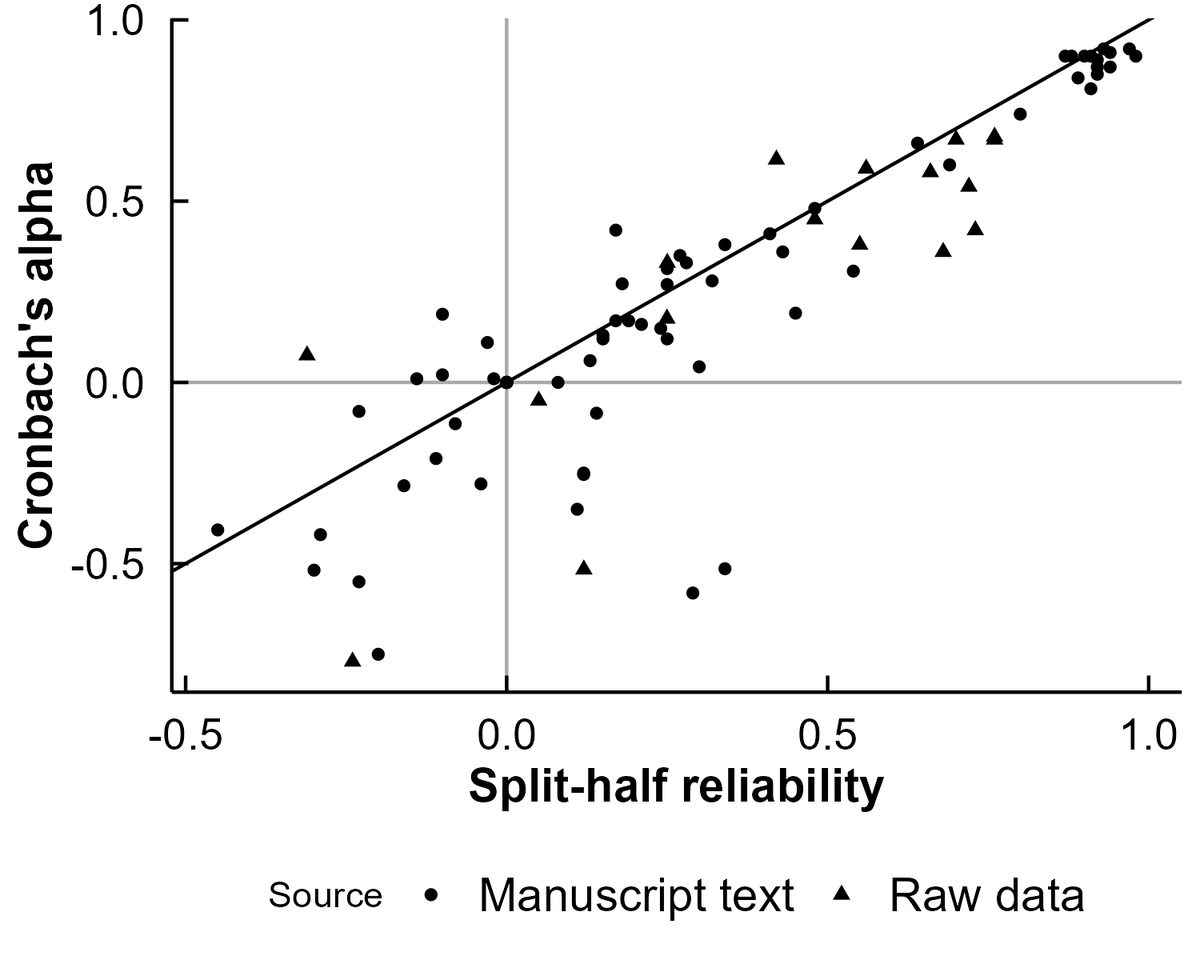
🧵3/3 Sercan also examined several refinements to the usual split-half reliability approach that significantly improve its accuracy. This is made available in my R package {rapidsplithalf}: https://t.co/bLnJyEXyFH
New publication! https://t.co/AZC5C4rHrV
🧵1/3 Here Sercan Kahveci examined several common and proposed approaches to computing the reliability of reaction time tasks, such as the dot-probe task and approach-avoidance task. Things don't look good for Cronbach's alpha.
🧵2/3 Cronbach's alpha has a strong negative bias. Sercan confirmed in a small meta-analysis that this negative bias also occurs in empirical studies that compute both split-half and Cronbach's alpha.
Feierliche Eröffnung der Psychotherapieambulanz (Leitung Prof. Thomas Probst). 🥂🍾
Eine wichtige Weichenstellung für die Zukunft der @PLUS_1622
https://t.co/KTNQkTsBzZ
I am very touched to receive this award for my dissertation. My academic journey has not always been easy, but it has been worth it. 🥲
I wish everyone still on their PhD journey good luck and perseverance.
We are looking forward to seeing many esteemed colleagues at the #dgps2024! 👀
Jens Blecher, Julia Reichenberger, Matthias Aulbach, and @AnnKathrinArend will represent us in Vienna.
New paper alert! 🤩
Our new paper deals with momentary emotions and food cravings in AN-R, AN-BP, BN, BED, and a control group without eating disorders. 🧵
Open access: https://t.co/NMDBMJYTKM
#eatingdisorders#emotionaleating#AcademicTwitter#scicomm
we are looking forward to it! David Haag, Matthias Aulbach and @ChrisBrainberg from our lab will be there to present lates research on #MHealth, #EMA, #EatingBehavior and more✌️
Wir freuen uns schon sehr, die Fachgruppe im September 2025 in Salzburg begrüßen zu dürfen! 🥳 Es wird sicher ein toller Kongress, der die Vielfalt unseres Faches abbilden wird 🤩
Wir freuen uns sehr, das Datum für den 17. Kongress der Fachgruppe bekannt geben zu können: 15.-19. Sept. 2025! 🥳 #SaveTheDate
Unser Dank gilt Prof. Dr. Jens Blechert @EatingLab_SBG, der den Kongress an der Paris Lodron Universität Salzburg @PLUS_1622 ausrichten wird 🙏
Want to come work with us? We have vacancy for a tenure-track assistant professor in our research group Eating Disorders & Obesity at Maastricht University. See: https://t.co/B8tplPk5mV @maastricht_fpn @MaastrichtU @maasuniversity