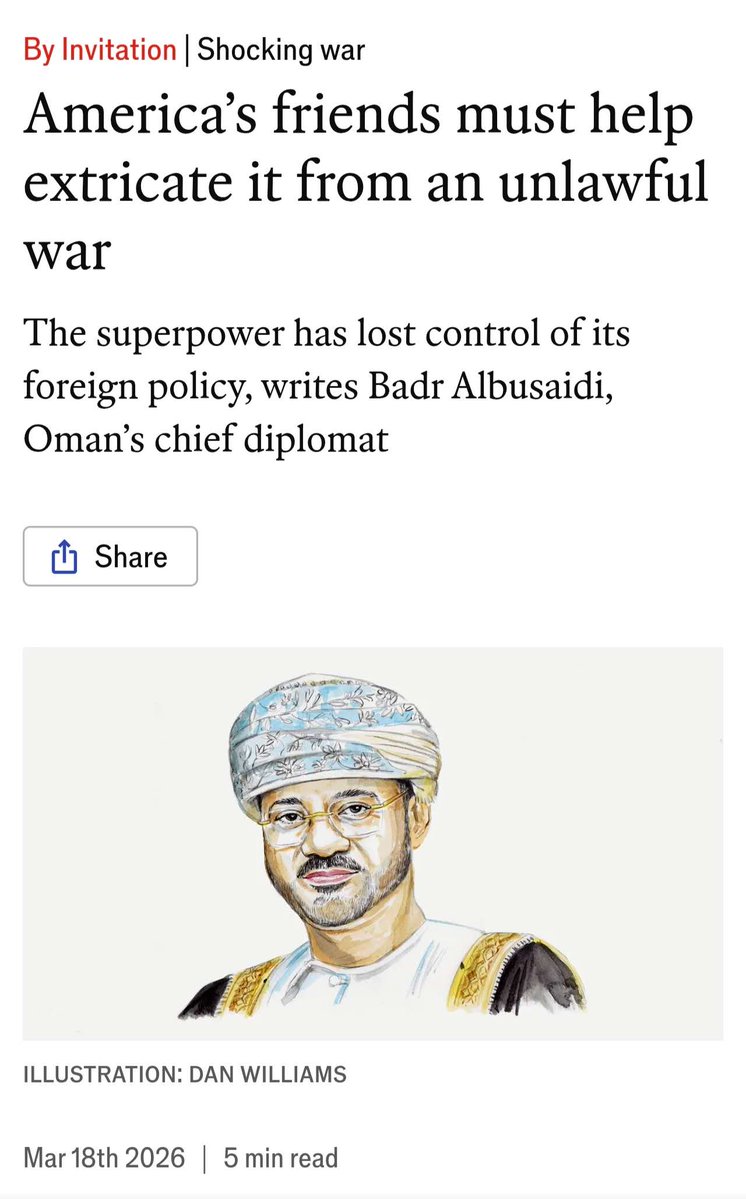
This is probably the most important article of the month: an op-ed by Oman's Foreign Minister, who mediated the talks between the U.S. and Iran, in which he writes that the U.S. "has lost control of its foreign policy" to Israel.
He repeats that a deal was possible as an outcome of the talks (something confirmed by the UK's National Security Advisor, who also attended: https://t.co/XkfSpkMjCf) and that the military strike by the U.S. and Israel was "a shock."
Interestingly, given he is one of Iran's neighbors and given that Oman has been struck multiple times by Iran since the war began (https://t.co/IXNdwD6f3j), he writes that "Iran’s retaliation against what it claims are American targets on the territory of its neighbours was an inevitable result" of the U.S.-Israeli attack. He describes it as "probably the only rational option available to the Iranian leadership."
He says the war "endangers" the region's entire "economic model in which global sport, tourism, aviation and technology were to play an important role." He adds that "if this had not been anticipated by the architects of this war, that was surely a grave miscalculation."
But, he adds, the "greatest miscalculation" of all for the U.S. "was allowing itself to be drawn into this war in the first place."
In his view this was the doing of "Israel’s leadership" who "persuaded America that Iran had been so weakened by sanctions, internal divisions and the American-Israeli bombings of its nuclear sites last June, that an unconditional surrender would swiftly follow the initial assault and the assassination of the supreme leader."
Obviously, this proved completely wrong, and the U.S. is now in a quagmire. He says that, given this, "America’s friends have a responsibility to tell the truth," which is that "there are two parties to this war who have nothing to gain from it," namely "Iran and America."
He says that all of the U.S. interests in the region (end to nuclear proliferation, secure energy supply chains, investment opportunities) are "best achieved with Iran at peace."
As he writes, "this is an uncomfortable truth to tell, because it involves indicating the extent to which America has lost control of its own foreign policy. But it must be told."
He then proposes a couple of paths to get back to the negotiating table, although he recognizes how difficult it would be for Iran "to return to dialogue with an administration that twice switched abruptly from talks to bombing and assassination."
That's perhaps the most profound damage Trump did during this entire episode: the complete discrediting of diplomacy. If Iran was taught anything, it is: don't negotiate with the U.S., it's a trap that will literally kill you.
The great irony of the man who sold himself as a dealmaker is that he taught the world one thing: don't make deals with my country.
Link to the article: https://t.co/FZxtqV3RC4
Japan remembers, but India has forgotten!
It was that day... November 12, 1948...
In a large house with a sprawling garden on the outskirts of Tokyo, the Tokyo Trials were underway. Following their defeat in World War II, fifty-five Japanese war prisoners, including Japan's then Prime Minister Tojo, were on trial...
Twenty-eight of them had been identified as Class-A (crimes against peace) war criminals. If found guilty, the only punishment was "death."
Eleven international judges from around the world... were declaring "Guilty"...
"Guilty"... "Guilty"... Suddenly, a resounding voice, "Not Guilty!"
Silence fell over the courtroom. Who was this lone dissenter?
His name was Radha Binod Pal, a judge from India!
He was born in 1886 in Kumilla, East Bengal. His mother earned a living by taking care of their home and the cow. Young Radha Binod would take the cow to graze near the village primary school.
While the teachers taught in the school, Radha would listen from outside. One day, a school inspector came from the city to visit the school. After entering the classroom, he asked the students some questions. All the children were silent. Radha, from outside the classroom window, said... "I know the answers to all your questions." And he answered all the questions one by one.
The inspector said... "Amazing!... Which class are you in?"
The reply came, "...I don't study... I graze a cow here."
Everyone was astonished. The headmaster was called, and the school inspector instructed him to admit the boy to the school and provide him with a scholarship.
This is how Radha Binod Pal's education began. After passing his school final exams with the highest marks in the district, he was admitted to Presidency College.
After completing his MSc in Mathematics, he returned to Calcutta University to study law and earned his doctorate. In the context of choosing between two subjects, he once said, "Law and mathematics are not so different after all."
Coming back again... International Court of Justice, Tokyo....
In his compelling argument to the other judges, he argued that the Allied powers (the victors of WWII) had also violated the principles of international law on restraint and neutrality.
Besides ignoring Japan's signals of surrender, they killed millions of innocent people by using atomic bombs.
After reviewing Radha Binod Pal's argument across 1,232 pages, the judges were forced to acquit several defendants from Class A to Class B.
These Class B war criminals were saved from specific death sentences.
His judgment at the International Court earned him and India worldwide recognition.
Japan respects this great man. In 1966, Emperor Hirohito awarded him the country's highest civilian honour, the 'Kokko Kunsho'.
Two busy streets in Tokyo and Kyoto are named after him.
His judgment has also been included in legal curricula. His statue has been erected in front of the Supreme Court of Tokyo.
In 2007, Prime Minister Shinzo Abe expressed his desire to meet his family members in Delhi, and he met his son.
Dr Radha Binod Pal (January 27, 1886 – January 10, 1967) is remembered in the history of Japan. There is a museum named after him in Tokyo, Japan, and a statue at the Yasukuni Shrine.
There is a research centre at a Japanese university named after him. Because of his judgment on Japanese war criminals, the Chinese people hate him.
He is the author of several law-related books. Almost no one in India knows him, and perhaps not even his neighbours do!
A Hindi film about the Tokyo Trials, starring Irrfan Khan, never gained much attention.
He was the mentor to many leading lights of India’s revolutionary movement, gave up a flourishing legal career to take part in the freedom struggle. He founded the India House in London, which would become the center for most Indian revolutionaries, operating outside of India or in exile.
One of the most brilliant minds of his era, and a mentor to #SwatantryaVeerSavarkar , a selfless nationalst, who used his wealth for the cause of the freedom movement.
Shyamji Krishna Varma, whose death anniversary it is today.
Hygiene and Health Principles in Ancient India
The following thread discusses the personal hygiene and health principles of ancient Indians.
The reference is from 'Charucharya'; a document written by Raja Bhoj in the 11th century.
Long 🧵
Elon Musk’s Starlink was trying to beat Jio in India
But Jio used its 1st mover’s advantage to stop them in their tracks
The SHOCKER? Indian Gov is changing a 138 year old law to bring Starlink back in the game
THREAD: How Elon is rethinking internet & can possibly kill Jio🧵