I teach sustainability on X and Facebook. The 4 topics are: climate change, technology, overconsumption, waste. Just follow the posts or read the earlier ones!
I teach sustainability on X. It's completely free!
Over the next few weeks, we'll cover 4 topics:
- Climate change
- Technology
- Overconsumption
- Waste
Just follow the posts or catch up by reading the earlier ones!
Let's see the world different! 🌍💚💯
17/1. ENERGY, CLIMATE PROTECTION
One of the most important issues related to climate change is energy use. So many of the things we do require energy. When you do the laundry, use a computer, cook, manufacture a product, travel somewhere, heat water, etc. The energy demand of our consumer society is HUGE.
Since we still meet a significant part of our energy needs using fossil fuels – and burning them releases carbon dioxide as well as other greenhouse gases – a KEY part of addressing climate change is switching to renewable energy sources and improving energy conservation. 🔋
The fossil fuels are:
- coal
- crude oil
- natural gas
Renewable energy sources include:
- solar energy
- wind energy
- hydropower
- ocean energy (waves and tides)
- geothermal energy
- biomass
17/2. Fossil fuels are finite and will eventually run out. In addition, burning these fuels is the main cause of current climate change. Renewable energy sources are naturally replenished, and their use generally results in much lower greenhouse gas emissions than burning fossil fuels. At the same time, renewable energy sources also have environmental impacts, for example during the manufacturing and transportation of the equipment. During operation, however, they generally do not produce continuous direct CO₂ emissions. ☀️🌪️🌊
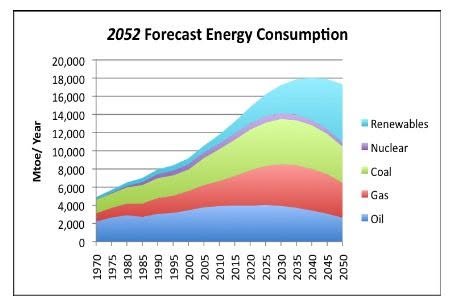
According to the forecast below, the use of renewable energy sources will increase significantly by 2050, while the role of nuclear energy may also increase. The use of fossil fuels – oil, natural gas and coal – will decline from its peak around 2030, but will still remain significant in 2050. Meanwhile, total energy consumption will continue to grow, partly due to population growth and increasing energy demand.
That is why it is particularly important to support and encourage the development of renewable energy sources in developing countries as well, while everywhere we need to place greater emphasis on energy conservation and energy efficiency. 🌍
16/1. RAW MATERIALS, SUSTAINABILITY
Consumer society has an enormous demand for raw materials and energy. Since I am not a technical expert, I admit that I have less to contribute to these topics. However, one connection is easy to understand: since our raw material reserves are finite (or at least cannot be replenished anywhere near as quickly as we extract and consume them), this aspect of consumer society is also unsustainable in the long term. For this reason alone, we need to move towards the circular use of raw materials (recycling, a circular economy) as well as renewable energy. ♻️
16/2. In connection with this topic, it is also worth drawing attention to the waste of raw materials. One related issue is planned obsolescence! This very real “practice” also clearly shows that some people are driven solely by the desire to make as much profit as possible, at the expense of our planet. 🌍
The graph related to this topic shows how the production and extraction of minerals, ores, fossil fuels and biomass have increased since the beginning of the 20th century. 🤎
If anyone happens to have a good article or video that explores the topic of raw materials in greater depth, I would really appreciate it if you shared it in the comments! 💚
15/1. FERTILE SOIL, FOOD
Our current level of consumption is already putting a strain on the environment (because if it weren’t, the Earth would be in excellent condition. Unfortunately, that is not the case). However, as the population grows, and with it our needs, the demand for food will continue to increase as well.
The need for more and more agricultural land means that we have to convert increasing amounts of wilderness into farmland. We have cleared and continue to clear forests so that we can cultivate the land. Well, this is simply not sustainable, and it is one of the reasons why the climate change problem is worsening so rapidly. On the one hand, we have released enormous amounts of carbon dioxide into the atmosphere through the use of fossil fuels. On the other hand, we have destroyed roughly half of the world's wilderness, and now there is less natural vegetation available to absorb the carbon dioxide we emit (after all, trees are capable of taking in and using the carbon dioxide they absorb). 🌳
15/2. Here we need to talk about meat, because producing meat is much more environmentally intensive than growing plants. First, we have to grow the crops, and then use those crops to raise the animals. The process therefore requires much more energy (and water)! Several times more than if we simply consumed the plants directly. And roughly half of the world's agricultural land is used solely to grow feed for livestock. In addition, livestock farming has other impacts that are not beneficial from a climate-protection perspective. 🐄
15/3. Soil quality is also declining because of intensive farming and the excessive use of fertilizers. As climate change progresses, this problem will only get worse, for example because of droughts. If there is no water, there will be no harvest. Our food supply could be put at risk. 🌾
I would like to suggest some simple solutions to these problems:
- Let’s not waste food. Plan our meals and think carefully about what we consume and how we consume it. 📝
- Eat much less meat, or don’t eat meat at all. 🥗
- If we can, let’s grow our own food. We can also consider food forests or forest gardens. This is very practical because trees are among our best allies in the fight against climate change. 🌱
- Plant trees wherever possible. 🌳
I look forward to hearing your constructive ideas and comments! Thank you!
14/1. ENVIRONMENTAL PROTECTION, WATER
Water is the second most important compound for living organisms, after oxygen-rich air. While we can survive for only about 3–5 minutes without oxygen-rich air, we can survive for several days without water, at most around one week. Water is essential for humans, animals, and plants to grow, survive, and live. 🍏🌳🐣
Only about 2.5% of the water on Earth is freshwater (which is shockingly little), and most of this is frozen in glaciers and ice caps. Only the remaining amount can even potentially be considered available for drinking water! In addition to the fact that, as a result of global warming, our lakes and rivers may dry up or lose their water supply, we also need to talk about overuse and pollution. As temperatures rise, river flows decrease and our lakes shrink. Seas and oceans are threatened by acidification, pollution, and ecosystem destruction. Among the biggest sources of water pollution are agricultural fertilizers and mining.
14/2. Since we are focusing primarily on households here, we also need to talk about how we, as individuals, can properly protect our water resources. The chart shows where and how we use the most water in our households. From this, we can already think of some ways ourselves to save water and protect it from pollution.
As the population grows, humanity's demand for water will continue to increase. At the same time, as a result of global warming and environmental pollution, clean drinking water will become increasingly difficult to access.
I would love to hear your thoughts in the comments: what do you think are the best and most realistic ways to save water? And what other environmental aspects should we consider in order to protect our water resources from pollution? I would be so happy if you wrote a few lines! ✅🙂
Apart from its role in life processes (drinking water), water is also used in three other ways:
- as a raw material (as part of a product, e.g. shampoo, or in food, medicines, etc.)
- as an energy source (a renewable energy source, e.g. hydroelectric and tidal power plants)
- as a waterway (for shipping)
It is also worth thinking about how the activities connected to these uses are related to our water resources and climate change! I look forward to your comments! 💚🙂
13/1. OVERUSE, AWARENESS 🌍
Overuse is a consequence of overconsumption. In order to satisfy our excessive demands, we overuse our land, overbreed and overwork our animals, overfish our seas, and, without thinking about the future, greedily exploit our natural resources.
We cut down forests, waste water, and consume energy as if all of these resources were infinite – and, on top of that, in many cases we want to increase extraction and consumption even further, solely for the sake of profit. 🙄
13/2. The more we exploit our natural resources, the greater the damage we cause to the environment, and the more difficult – and in many cases even impossible – it becomes to restore what has been damaged. 🌍
Ultimately, all of this is driven by human demand. If there were no demand for something, it could not be sold, and no money could be made from it either.
It is true that large corporations bear enormous responsibility for the system we live in, and we will talk more about this later. At the same time, for the reasons mentioned above and earlier, we as individuals are also responsible for the fact that this system has developed the way it has.
12/1. FILM RECOMMENDATION – CLIMATE CHANGE 🌍
Every weekend, I recommend a film related to environmental protection or climate change.
This week’s choice is Leonardo DiCaprio’s 2019 documentary “Ice on Fire”, about climate change.
I think it’s a very good film because it gives a brief overview of the most important aspects of the problem. However, it really becomes easier to understand if you do a little further reading afterwards.
Even so, it’s definitely worth watching. And the fact that some topics are only briefly covered is completely understandable when you consider that presenting such a complex global problem in just an hour and a half is no easy task.
Considering this, DiCaprio and his team did a pretty good job! 🤝
Once again, I could only find an English-language presentation of the film, but the movie itself is also available on YouTube. So if you want to learn more about the subject, it’s easy to find and watch! 💚
Please give this post a like if you’ve already seen it — or if you actually watch it because of my recommendation! 💙
https://t.co/7gfWpEGfLf
11/1. CLIMATE ACTION, FRUGALITY 🌍
The opposite of frugality is wastefulness. Let's look at what these two concepts mean according to the dictionary. Both words have several definitions, but I'll only include the ones that are most relevant to our topic. The others are worth reading as well.
FRUGAL: using materials or energy wisely and efficiently, making the best possible use of them.
WASTEFUL: someone who wastes resources. Let's take a look at the definition of TO WASTE: to habitually or regularly use useful materials or energy in greater amounts than necessary; to use them without being economical.
11/2. Of course, these concepts apply to energy, raw materials, water, food, and many other resources. The essence of a consumer society is to encourage us to buy and consume more and more. However, a lifestyle based on ever-increasing consumption and waste is simply not sustainable in the long run because of the physical limits we discussed earlier. It probably wouldn't be sustainable even on its own, but as the world's population continues to grow, the problem only becomes more severe. 🌍
It's easy to see that a wasteful lifestyle places a much greater burden on the environment than a frugal one, while also depleting the Earth's resources much faster. 😏
In addressing climate change, the use of renewable energy, along with a frugal and environmentally friendly lifestyle, plays a fundamental role. ✅ Whether we like it or not, if we truly want to tackle climate change, we must reduce our consumption. ♻️
10/1. CLIMATE CHANGE, OVERPOPULATION 🌍
Overpopulation and overconsumption are closely linked to climate change.
Over the past 100 years, the world's population has quadrupled, while our consumption has increased nearly twentyfold. Today, more than 8 billion people live on Earth, and more and more people want to consume more and more.
Overpopulation is therefore not simply about the number of people on the planet—after all, at first glance, it may seem that there is still enough room for everyone. The real issue is that as the population grows, so does the demand for resources and consumption, while the Earth's capacity is limited. Our planet cannot indefinitely provide everything that a continuously growing and increasingly consuming humanity demands.
10/2. Overconsumption also contributes significantly to greenhouse gas emissions, as the production of energy, goods, and transportation still relies heavily on fossil fuels. At the same time, we must remember that our planet's resources are finite. Mineral resources, freshwater supplies, arable land, and biological resources are all limited. Some can be depleted, while others can only regenerate and remain sustainable within certain environmental and economic limits.
Overconsumption therefore contributes significantly to environmental degradation, including climate change. One of the most effective ways to address this is through living more frugally. ✅️
10/3. However, living frugally does not mean giving up healthy food, decent clothing, proper hygiene, or every source of joy in life.
Instead, it means recognizing what you truly need. You probably don't need a fifth, tenth, or twentieth pair of shoes. Nor do you necessarily need a diamond ring. Likewise, there is no need for excessive alcohol consumption, unnecessary indulgence, or flying to distant holiday destinations every year.
Climate change is a warning sign. It reminds us that our planet's resources are not infinite and that we must use them more responsibly.
Instead of choosing unnecessary consumption, let's shape our lives in a way that also considers the well-being of nature and future generations. Think in terms of sustainable solutions! ✅
We're here to help you on that journey. 💚