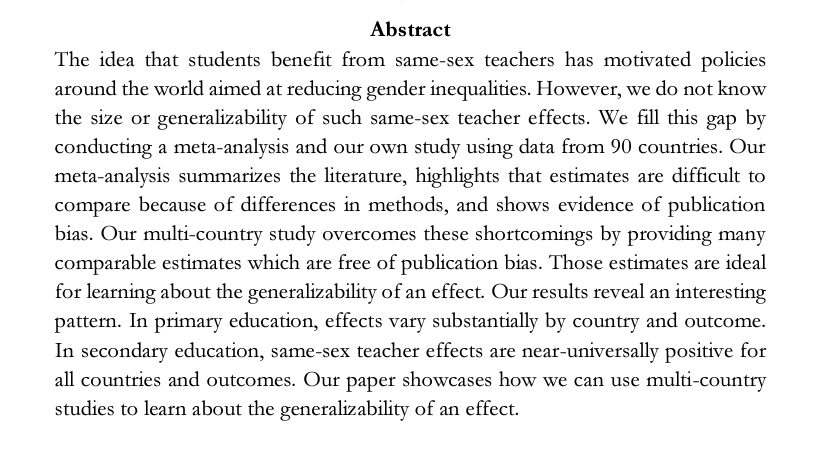
Are teachers *generally* better at teaching students of their own sex?
NO in primary education,
YES in secondary education.
A 🧵generalizability and same-sex teacher effects
https://t.co/3dle8s9UoZ
New working paper! We ran a field experiment with >1,300 university students randomly assigned to online vs in-person lectures in first-semester courses. What happens? Online instruction hurts performance, but only for women♀️📉
wt @_XiaoyueShan_@UschiBackes
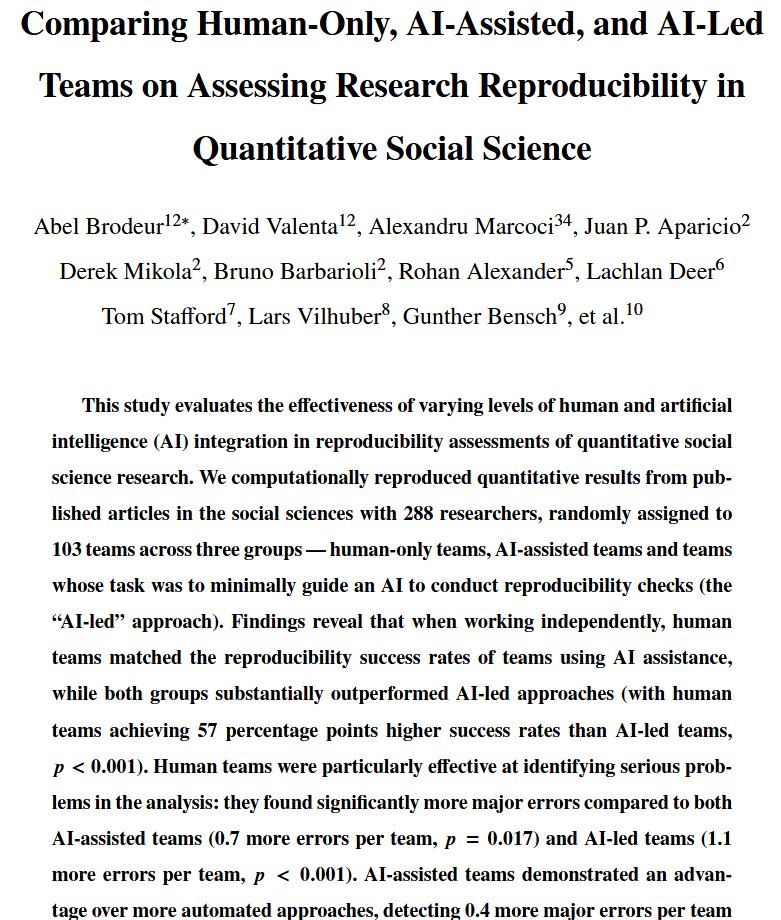
New research alert! Our study investigates the effectiveness of human-only, AI-assisted, and AI-led teams in assessing the reproducibility of quantitative social science research. We've got some surprising findings!
We are very excited to welcome @EconFeld to our #ResearchSeminar today. He will give a talk on “On the generalizability of sex-differences in risk-attitudes”. The seminar takes place from 14:15 to 15:30 in room S3/4 in the Oeconomicum (building 24.31).
https://t.co/V4vGnhsmbi
We had games in Munich earlier this week. 60+ participants reproducing 15 studies (3 econ, 4 poli sci and 8 psych articles)!
Some papers did not reproduce, missing data/codes, 2x revealed identity of participants, errors, etc.
A couple of thoughts from our chair (AB). 🧵
Job-market candidates:
- Download 10 JMPs in your field, read them in ≤5 hours, and rank them from best to worst. Now you know why recruiting committees value readability.
- Editing improves paper quality. See RCT: https://t.co/MUtlvXcr4b
(More at https://t.co/9GON2vY92y)
🌞 Summer's heating up at IZA! 🔥 A huge welcome to our fantastic visiting researchers this month! Special shoutout to @EconFeld who's joining us for the rest of the year! We're excited to have you all! ✨
How credible was the "credibility revolution"? How robust is empirical research in economics? We just replicated a year's worth of the American Economic Review & had economists predict robustness. Here's what we learned. https://t.co/kOWJvSa6vJ
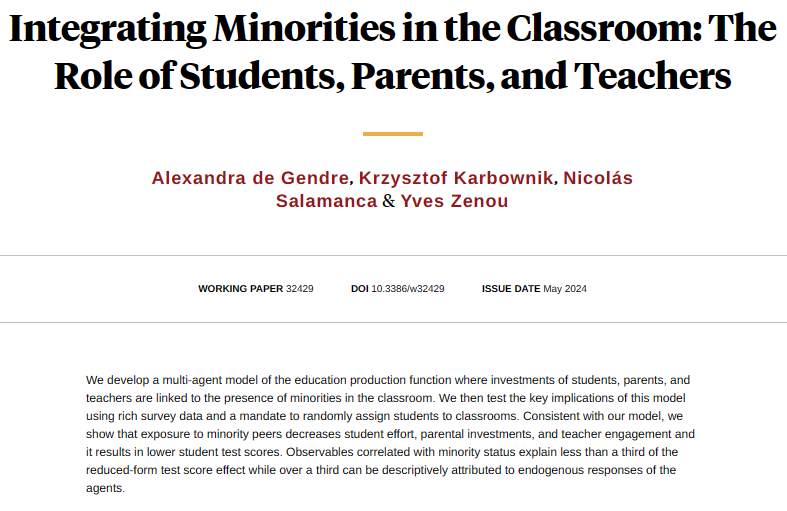
In Taiwan, disadvantaged minorities lower student effort, parental investments, and teacher engagement in classrooms to which they are randomly assigned, and this lowers student test scores, from @adegendre, @chriskarbownik, @nsalamancaa, and @yveszenou1 https://t.co/PMYzemxz9g
It's great to see a meta-analysis and multi-country study verify more robustly what @ALeNestour & I observed in our quick @CGDev look at whether women teachers are better for girls' education (yes in secondary; no in primary): https://t.co/cBrakkvhMf
Very impressive research by Jan and the team, which they just keep improving (I discussed a version of this paper two years ago and it was an epic then).
Our work with @AdeGendre, @chriskarbownik and @yveszenou1 combines a simple model and awesome data to show how and why disadvantaged minorities in the classroom to affect behaviors of students, parents and teachers, and ultimately test scores. Check it out!
New work with awesome coauthors @AdeGendre, @EconFeld and @uZoelitz exploring the generalizability of same-sex teacher effects by combining existing multi-country data and met analysis tools. Check out the thread below!
In secondary education, same-sex teacher effects are generally positive for all outcomes.
For test scores, effects even appear constant (and tiny) across all included countries.
Taken together, our paper allows us to provide evidence for the following phenomenon:
Same-sex teacher effects are positive in secondary education.
“In secondary education” is a boundary condition of the phenomenon. It tells us where we should expect it to hold.