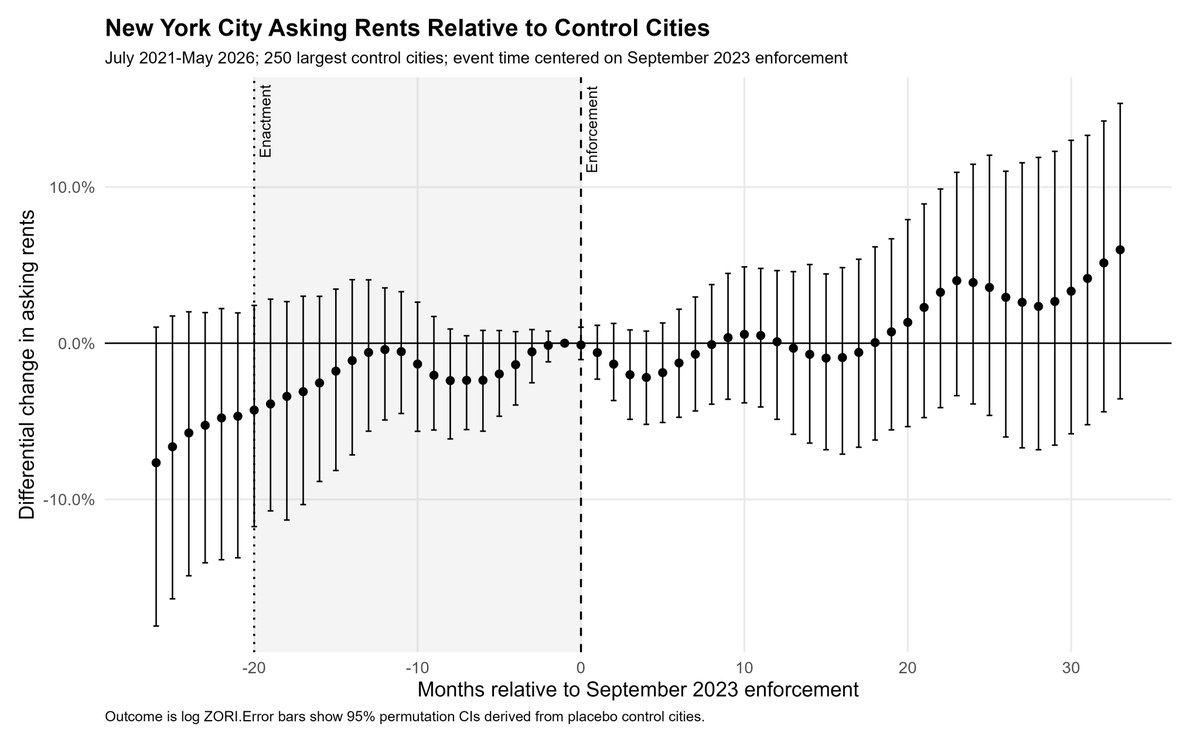
4/ What happened to rents?
Despite the sharp contraction in short-term rentals, I find little evidence of a meaningful citywide rent decline after enforcement. More exposed neighborhoods saw modest short-run declines, but they did not persist. Within city results are also null.
New working paper: Did New York City’s Airbnb Ban Lower Rents? Evidence from Local Law 18
NYC sharply restricted short-term rentals. Did those units return to the long-term rental market and lower rents?
I find little evidence that they did.
https://t.co/G1rL3Mxx99
🧵
3/ Did those disappearing short-term rentals show up in the conventional rental market?
More exposed neighborhoods saw inventory rise after enactment. But when enforcement began and Airbnb listings sharply contracted, I find no additional increase in rental inventory
@DastDn I am less worried after reading the article. It looks like they're taking issue with the fact that they used standard flu shots for the control group in seniors when apparently seniors usually get a high-dose flu shot. It doesn't seem politically motivated.
@rsrindy@DavidBahnsen imports are subtracted in that part of the equation because they are added as C, I, or G. Imports have a net zero effect on GDP calculation, as GDP is the sum of domestic production, not the sum of domestic production minus imports.
@eyalroz@franciscome@KirkegaardEmil What you are missing is that that is incorrect. Non-correlation does not mean non-causation. https://t.co/7zziugRXoh
@jmhorp It's a shame that his framing is "progressives use this to sell socialism" when for the past four years it has often been the MAGA crowd pushing these economic grievances.
@PhilWMagness But that is a further argument for allowing market mechanisms to allocate space. Make people pay for the street parking so it doesn't go to low-valued uses. Use congestion pricing. Let people pay for the costs they impose by taking up space with cars.
@PhilWMagness@timstarr2001 Apparently a number of these reforms have, in fact, made Houston denser and replaced sprawling development with building inward and upward https://t.co/wGtvkYwHp1
@PhilWMagness@timstarr2001 Houston has significantly reformed a lot of these policies in the past decade. It would be more informative for us to look at their history over time. I know that, for example, Houston had 5000sqft minimum lot sizes for townhomes that they reduced to 1300 or so in 2013.
@PhilWMagness In the suburbs where space is already abundant, sure, but a regulatory environment that *favors* car dependence and low-density artificially shifts demand curves. It distorts the rent gradient over that land. This is disastrous policy for cities.