Our graduates have joined Paris School of Economics, Heidelberg, KU Leuven, Rutgers-Camden, Central Bank of Ireland & ESRI.
Colleagues: please share with your students!
🎓Thinking about a PhD in Economics? Or know a promising student who is?
Join us at UCD School of Economics!
Our MLitt/PhD offers rigorous training, excellent research supervision & funded places.
🗓️Deadline: 24 Jan 2027
Apply: https://t.co/IDZFI3Iayi
Making investment costs conditional on hiring increases disadvantaged participants' investment by 24%.
Providing information about same-group peers has limited effects.
Jasmine's findings suggest that changing incentives is more effective than providing social information.
🎓Meet Yung-Shiang Jasmine Yang, a UCD Economics PhD job market candidate!
Her research focuses on Behavioural and Experimental Economics, with interests in Public and Environmental Economics.
📊 Does algorithmic discrimination discourage investment in qualifications?
In a pre-registered experiment (N=553), Jasmine finds the opposite: disadvantaged participants invest 17.7% more than advantaged participants, despite facing less favourable evaluations.
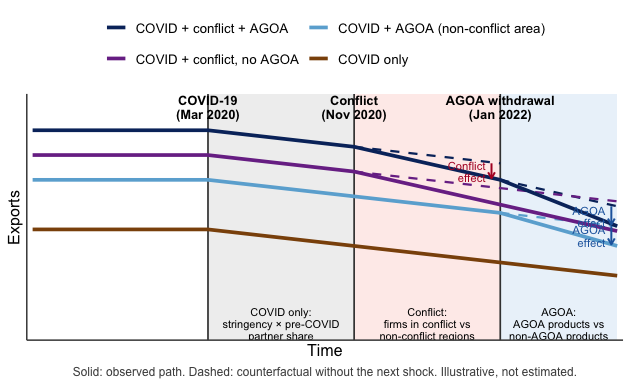
Trade shocks don't simply add up.
Conflict had already disrupted exports for affected firms before US trade preferences were suspended, while the suspension amplified earlier shocks elsewhere.
Biniyam shows why the timing and sequence of shocks matter.
https://t.co/yhrUTdXa3N
🎓 Meet Biniyam Gezahegn Worku (@BiniyamGWorku), a UCD Economics PhD job market candidate!
His research focuses on International and Development Economics.
His job market paper examines how firms respond to overlapping trade shocks.
🔗https://t.co/0DEAKq8rcW
📊Using customs data on Ethiopian firms (2017–2023), Biniyam studies COVID-19 lockdowns, armed conflict and the suspension of US trade preferences.
Lockdowns reduced imports by 29% and exports by 27%, while conflict reduced trade among firms in Tigray by 60–90%.
The evidence is clearer for healthcare access.A 10 percentage-point increase in ASHA coverage raises health card possession by 1.9points and birth-dose polio vaccination by 1.6points.The findings suggest ASHAs help connect newborns to healthcare at birth
https://t.co/i6SUMMoY1p
🎓 Meet Shreya Swarnakar (@iamshreyaaa), a UCD Economics PhD job market candidate!
Her research focuses on Health and Development Economics, with a strong focus on gender.
Her job market paper studies India's community health worker programme.
🔗 https://t.co/U65zfB7dfE
📊 Did India's ASHA programme reduce infant mortality?
Using district-level variation in coverage (2005–2008), Shreya finds that a 10 percentage-point increase is associated with a 2% decline in infant mortality, although the estimate is imprecise.
Targeting aid using self-reported damage performs barely better than random selection,reaching just 20–22% of distressed households.
Using other registry data increases this to 26–30%.
Aditi shows how administrative data can improve disaster assistance.
📄 https://t.co/9U7fCJ1DmK
🎓 Meet Aditi Kharb, a UCD Economics PhD job market candidate!
Her research focuses on Environmental and Development Economics.
Her job market paper examines how households report and cope with natural disasters, and what this means for targeting aid.
🔗 https://t.co/VPJuaaPPrW
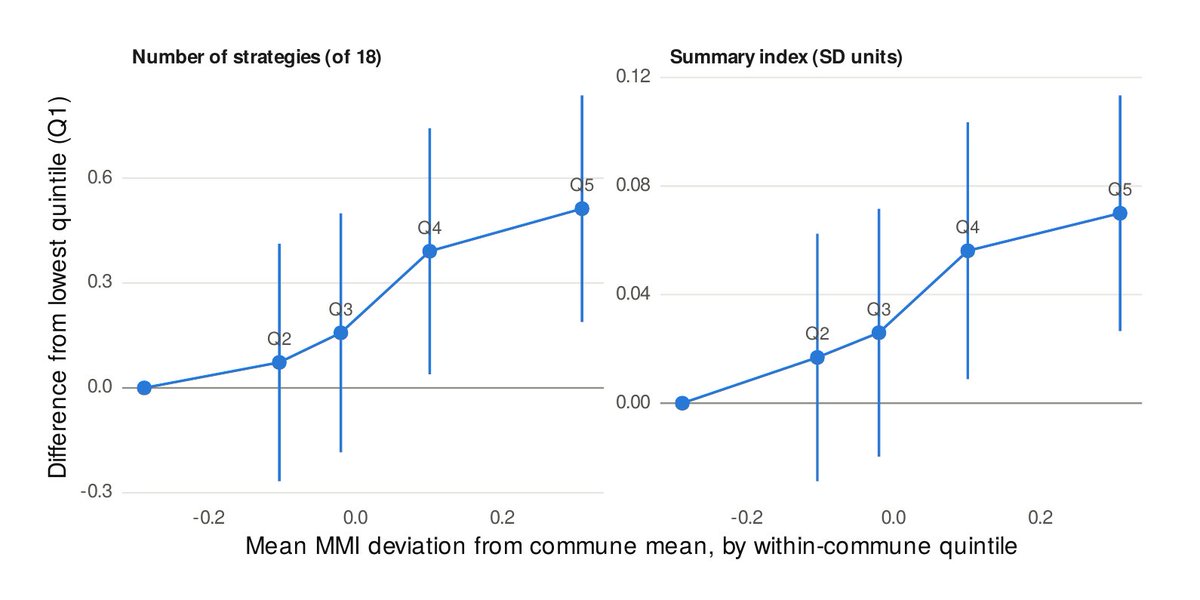
📊Linking data on 104,000 households to earthquake intensity maps,Aditi finds that stronger shaking increases household coping,particularly severe strategies such as selling livestock or begging.
Yet physical shaking explains only 3% of the gap between reporters and non-reporters
Being on leave and losing a job are not the same.
Using Japanese household data (2004–2022), Beatriz shows why this distinction matters for understanding the employment consequences of motherhood.
📄 https://t.co/jHCsQGwgiF
🎓 Meet Beatriz Gietner (@BeatrizGietner), a UCD Economics PhD job market candidate!
Her research focuses on Labour Economics and the Economics of Education.
Her job market paper examines job security around childbirth in Japan.
🔗 https://t.co/ql2tRHKkne
📊 After childbirth, job attachment falls by 54 percentage points for mothers in non-regular jobs, compared with 13 points for regular employees.
Five years later, the gap remains substantial.
👇