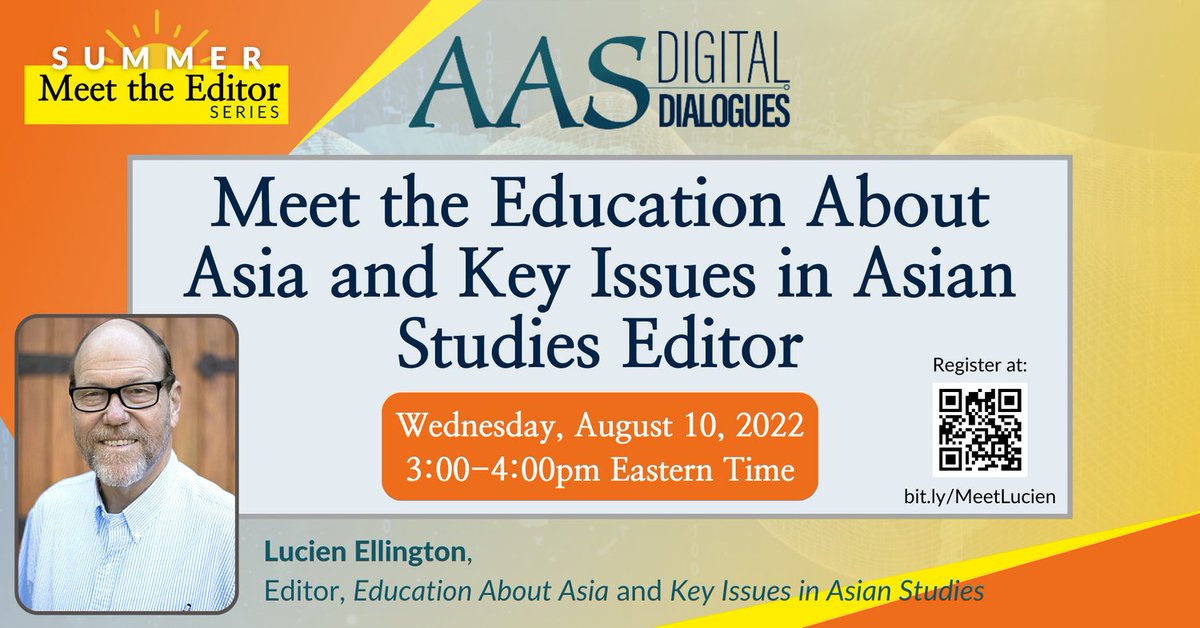
One week from today! Register now for the final session in our summer 2022 Meet the Editor series of #AASDigitalDialogues. @EdAbtAsia and Key Issues in Asian Studies Editor Lucien Ellington will speak about these AAS Publications and answer your questions. https://t.co/wtbmvwvzYl
The EAA archive is one of the most popular features at the AAS website, and we look forward to improving it even more thanks to this support from the Freeman Foundation!
New #AsiaNow post: we are excited to announce that the Freeman Foundation has given the AAS a $40,000 grant to support continuing work on our @EdAbtAsia online archive. https://t.co/smfvhfbueR
This weekend, I'm reading the Winter 2021 issue of Education About Asia. @EdAbtAsia@AASAsianStudies This is quickly becoming perhaps my favorite publication!
The most-read article in our EAA archives right now is "Japan in the Olympics, the Olympics in Japan," a 2016 piece by Robin Kietlinski of @LaGuardiaCC that makes for perfect reading during this #Tokyo2020 week. https://t.co/DKsyPdX0Zb
On Thursday, May 20 at 8pm Eastern Time, join the #GlobalEdChat hosted by @AsiaSocietyEDU. This month's Twitter conversation will focus on teaching resources and approaches for #AAPIHeritageMonth.
Thanks to @Civics_For_All for flagging this new collection of #AAPIHeritageMonth K-12 teaching resources from the New York City Department of Education.
Our social studies & civics team has curated a resource guide for teachers to celebrate AAPI Heritage Month in their classrooms. These resources can be used year round to teach this robust and diverse history across grades and subjects https://t.co/CPjuOvVjn8
No, a #nuclear attack is not a single event. Its effects persist for years and #GENERATIONS.
Follow the life of an atomic bomb #survivor, Sadao Hirano in this piece by Masaya Nemoto in @AASAsianStudies.
https://t.co/7zXIcu45hi
K-12 educators in AL, DE, IL, KY, LA, MD, MI, MN, OH, PE, WV are invited to apply for this @michiganstateu@NCTAsia_ workshop on "Teaching the Asian Olympics and Paralympics," on Saturday, April 17. Application deadline April 14!
Check out "What Does It Mean to Be an American?" and see how its resources are especially useful now as K-12 teachers develop lesson plans and teach about the history of the AAPI community in the United States. https://t.co/hdmwhhGA5H
Congratulations to Rylan Sekiguchi @rybosek of @FSIStanford, who received the 2021 Franklin R. Buchanan Award for Asia Curriculum Materials from @AASAsianStudies for the website "What Does It Mean to Be an American?" https://t.co/4nIuP67T5q
We are very pleased to officially launch TEACHING ABOUT ASIA IN A TIME OF PANDEMIC, a collaboration between
@EdAbtAsia and the Asia Shorts book series, produced with generous support from @HLuceFdn. Read more about this collection of pedagogical essays: https://t.co/PmyVZKj8Gq
... and also the Asia Past & Present collection TEACHING JAPANESE POPULAR CULTURE, edited by Deborah Shamoon & Chris McMorran. https://t.co/GGKhBUuJNE
This website looks like a great complement to two titles from AAS Publications: JAPANESE POPULAR CULTURE AND GLOBALIZATION, a Key Issues in Asian Studies classroom text by @BillTsutsui ... https://t.co/cWeCtYKr26
New open-access digital resource: Japanese Media & Popular Culture website, created by Jason Karlin at U. of Tokyo and focused on teaching concepts through keywords and case studies. https://t.co/tseNtGdivZ
Call for manuscripts: Spring 2021 special section of EAA on "Asia’s Environments: National, Regional, and Global Perspectives." Contact Editor Lucien Ellington with pitches ASAP! See the EAA website for more information: https://t.co/a0n9hmn4o2
1/ My colleague Gretchen Heefner and I have released our module “Disease, Diplomacy, and Science in the #ColdWar: Lessons for Future Pandemics” as part of the #NUPandemicTeachingInitiative from @NUCSSH. https://t.co/YgbGd8KC8z
And to read David McCann's original sijo article from the Spring 2010 issue of EAA, it's available at our new (and always open-access!) archive site: https://t.co/JkkPoURJww
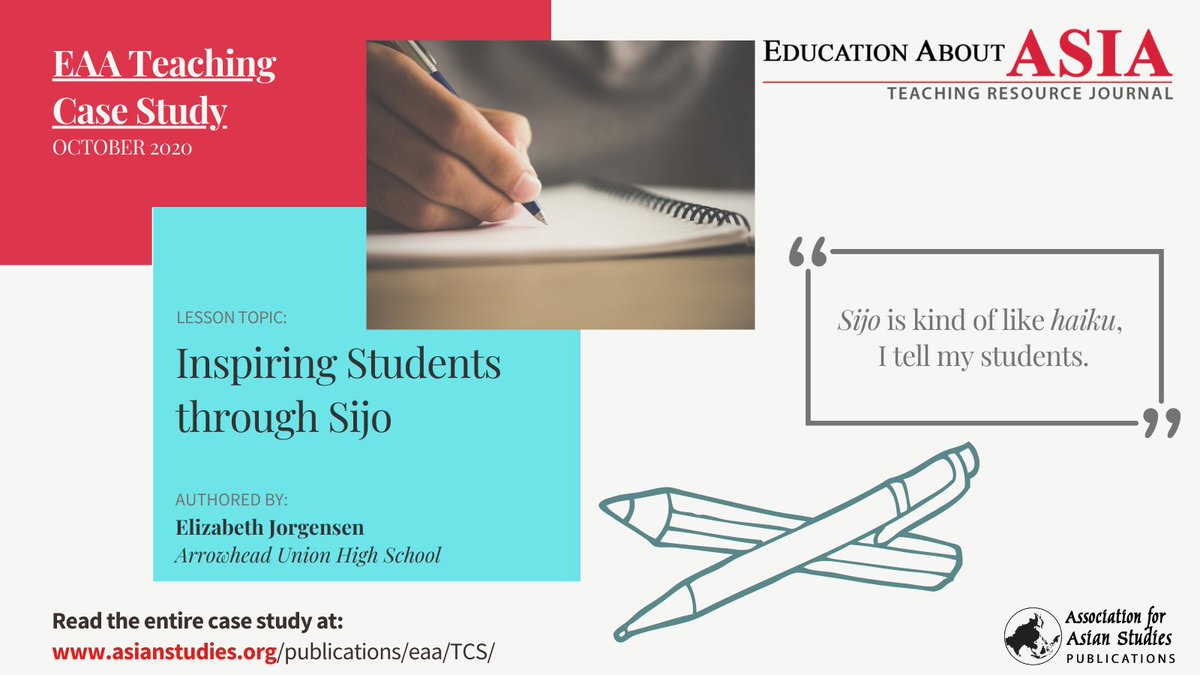
Visit the EAA website for our new Teaching Case Study—Elizabeth Jorgensen explains how she uses Korean sijo poetry in her Wisconsin high school classroom, building on David McCann's 2010 EAA article about the art form. https://t.co/x9uaWAmLSW