$105 billion. That’s how much Nvidia has guaranteed to cover if one customer, OpenAI, can’t pay for a single data center campus in Ohio.
Everyone is talking about Jensen Huang’s exit. The bigger story is the balance sheet.
Some buyers can’t afford Nvidia’s chips, so Nvidia has been helping them: guaranteeing leases, investing directly, promising to cover shortfalls. The Information counts more than $170B in commitments to neoclouds and other customers, including up to $164.5B in data-center guarantees.
According to the WSJ, citing people familiar, Huang himself questioned this summer whether the dealmaking had gone too far. Major cloud providers were shifting to alternative chips, and Nvidia’s wafer and memory commitments were arriving like an “avalanche.”
Nvidia rejects the “circular financing” label: “We see it differently.” In late September it added a record $150B to its buyback.
None of this means Nvidia is collapsing. But when a seller finances its own buyers, revenue looks great, as long as the buyers can pay. Crypto has seen this pattern before.
Scandals make headlines. Balance sheets decide outcomes.
Tankers are burning in Hormuz. The US Treasury Secretary has been moved to a military base over Iranian threats. And bitcoin, “digital gold,” just fell below $70,000.
Overnight, BTC dropped to around $67,500, its lowest since August 19. More than $1.3B in leveraged positions were liquidated in 24 hours, nearly $500M of it as price broke $70K.
But bitcoin isn’t falling alone. Gold is down about 5% over the past month.
The driver isn’t war fear. It’s rate fear. October US inflation came in hotter than expected, markets now price a possible 50 bp Fed hike in December, and the dollar index is at its highest since April 2025. When money gets more expensive, investors sell what pays no yield: gold and bitcoin alike.
Short term, BTC still trades like a risk asset, not a crisis hedge. The long-term story may differ, but today’s market isn’t pricing it that way.
Two takeaways: watch rates and the dollar more than war headlines. And remember that much of this move came from leverage. Over a billion dollars in positions closed not by choice, but by force.
How do you read this drop?
Can a bank be drained like a crypto exchange? France just answered.
On Wednesday, Crédit Mutuel Arkéa, a French banking group with over $250B in assets, confirmed an attack that “enabled fraudulent transactions.” No amount disclosed. Some transactions were paused, and the bank says clients face no financial consequences.
On-chain investigator ZachXBT puts the loss above $133M. Bitquery traced about $109M in USDC withdrawn from accounts at Kraken, https://t.co/slawnwlCG8 and OKX, much of it swapped into ETH, which no issuer can freeze.
The key detail: this was not a crypto wallet hack. French media report that fiat was moved out via cross-border transfers to exchange accounts opened under false identities, and only then converted to crypto. The bank has not confirmed this.
A day earlier, CZ told CoinDesk that if exchanges can be hacked, “banks are in a worse position,” as attackers adopt AI faster than defenders. He offered no evidence of AI use.
The takeaway: the line between “safe bank” and “risky crypto” is thinner than it looks. Risk lives wherever money meets the weakest link, and that is usually a process or a person.
$16 billion left Binance after the largest crypto hack on record. But that number is misleading if you don’t know what’s inside it.
According to DefiLlama, Binance’s tracked assets fell from $144.9B on Oct 29 to $128.3B on Nov 2, a drop of almost 12%. That figure combines three different things: the $6.3B stolen, falling crypto prices, and real customer withdrawals.
Withdrawals were significant. On Nov 1 alone, in the first 9.5 hours after withdrawals reopened, customers took out $4.65B and deposited $1.01B. Binance says net outflows were about 2.1% of assets and are stabilizing.
To rebuild trust, Binance is publishing a zero-knowledge proof of reserves. Each customer can verify their balance is included, without exposing anyone else’s. The first snapshot covered 10 tokens; the full proof was promised for Tuesday.
What it doesn’t show: liabilities outside the exchange, how keys are secured, or protection against the next breach.
Binance appears to have weathered the crisis, with 95% of stolen assets replenished. But the lesson remains: a proof of reserves is good. Self-custody is better.
Binance is reopening withdrawals. Should you rush?
Three days after the largest crypto theft on record, $6.3 billion, Binance began restoring withdrawals. Phase one, scheduled for Sunday morning, covers BTC, ETH, BNB, SOL, XRP, DOGE and major stablecoins, with each network opened only after security checks.
The exchange says it has now replenished 95% of the stolen assets from its own funds and will not pass losses to customers. The FBI has attributed the attack to TraderTraitor, a North Korean state-sponsored unit.
Should you move everything out? That depends on three questions:
Why are your funds on an exchange? Active trading needs some liquidity there. Long-term holdings belong in self-custody.
Do you know how to use your own wallet? Send a small test transaction first and check the address carefully.
Who is telling you to hurry? Fake “Binance support” emails and links always follow events like this. No real exchange asks for your seed phrase.
The key lesson is not that Binance was hacked. It is that for three days, customers worldwide could not reach their own money.
Your keys, your coins. Everything else is someone’s promise.
A note-issuing bank now has a stablecoin
A bank that prints Hong Kong dollar banknotes is now issuing a stablecoin to retail users.
From 23 October, HSBC’s RedCoin is available through the PayMe app. Users can send money to each other and pay more than 100,000 merchants. HSBC was among the first issuers licensed by the HKMA in April.
The rules matter more than the launch. Reserves must at least equal the value of all coins outstanding, held separately in high-quality liquid assets. Holders can redeem at par. Paying interest on stablecoins is prohibited.
That last rule mirrors the debate in Europe. Regulators want stablecoins to behave like digital cash, not like deposits that pull money out of banks.
The bigger shift is who issues them. Until now, the largest stablecoins came from crypto firms. Banks are no longer leaving that market to others.
The useful questions for any stablecoin stay the same: who issues it, where the reserves sit, and who supervises them.
Day 914: what Bitcoin’s halving clock can and cannot tell you
777, 889 and 924. That is how many days after each halving the last three Bitcoin bear markets bottomed. Today is day 914 after the 2024 halving.
Cycle models turn this into a “bottom window”, sometimes with a buy date attached. Before relying on one, look at what it rests on.
Three cycles is a very small sample. The earliest and latest bottoms sit 147 days apart, almost five months. A window that wide says less than it appears to.
The market has also changed. Earlier cycles had no spot Bitcoin ETFs. This year US funds saw outflows on nearly half of trading days, yet still took in money overall: $2.6B in September, net outflows so far in October.
Macro matters more to institutional capital than the halving clock. The Fed raised rates in September, and the market now prices a December hike at roughly 90%. A cycle model does not see that.
The halving tells you something about timing. It says little about price, and nothing about how much drawdown you can hold.
China’s new export rule took effect on 16 October, before the list it applies to is even final.
The commerce and science ministries proposed adding 40 technologies to the export control catalogue: 23 in AI, 12 in solar and 5 in biomedicine. 14 would be banned and 26 restricted. Comments are open until 15 November.
Registration started immediately. Anyone transferring a listed technology abroad, including deals already underway, must register before the export proceeds.
The line is drawn between the product and the know-how. Using a restricted Chinese model through an app, website or API is not a technology export. Deploying it on servers abroad is. Finished solar modules stay outside the controls. Polysilicon, wafer and cell manufacturing methods do not.
Export controls are usually discussed as a US tool aimed at China. This is the same logic running the other way.
Registration is not export permission. The final list and the effective date are still open.
The biggest change almost nobody is watching
On October 26, Ethereum will test its largest structural change since 2022.
The market is barely reacting.
That itself is the story worth telling.
What is changing
The upgrade is called Glamsterdam. It changes two things at once.
First, how blocks are built. Until now that work has been done by external intermediaries operating outside the protocol. It moves inside the protocol itself.
Second, how blocks are executed. New lists record which accounts a block will touch, allowing part of the work to run in parallel rather than sequentially.
Why it is needed
A simple comparison helps.
The gas limit is like a truck’s load capacity. It determines how many transactions fit in a block.
In 2021 that limit was 30 million. Today it is 60 million. Capacity doubled in a single year.
But you cannot keep raising it indefinitely. Larger blocks propagate more slowly across the network, and their contents take longer to execute.
So before increasing the load, you have to rebuild the truck. That is what this upgrade does.
An important clarification
Many headlines mention a 200 million gas limit.
That is a testnet setting, not mainnet. Nobody announced that mainnet rises to 200 million on October 26.
And the mainnet date itself is not set. Developers mention early December, but that depends on how October 26 goes.
A detail from the tests
One thing missing from the headlines is worth noting.
In the first public test, only four or five block builders were active. The large market participants did not show up, and many blocks were still built locally.
The system works, but it has not been tested under real conditions. The new design proves itself only when actual participants compete for blocks.
Why this moves slowly
Ethereum has no single decision-maker. Changes are agreed in public calls anyone can join.
Separate teams implement the same specification in different languages. Any combination of them must produce identical results.
It is slow and complex. That is the price of openness.
What actually changed
Here is the observation that seems most important.
Ethereum upgrades used to be events for the entire industry. Every proposal triggered debate.
Now the largest structural change since the Merge is underway, and the market barely responds.
Nobody expects this upgrade to turn the market.
The era when technical progress moved price is over. Attention has shifted to capital flows, stablecoins and real-world asset tokenization.
What it means
The interesting part is that the two are connected.
For the past month we have covered tokenization: a Brazilian depository, a US regulator’s decision, banks running pilots.
For that adoption to happen, the infrastructure has to carry it. That is precisely what this upgrade addresses.
So the technical work no longer moves the price, yet whether everything people are talking about is even possible depends on it.
One practical thought: when assessing any technology, separate attention from progress.
They rarely coincide. And what matters most usually happens while nobody is watching.
This is an educational overview, not investment advice.
Source: Ethereum Foundation, TokenPost, https://t.co/y3uswy57IY, Four Pillars — October 6-17, 2026
#Ethereum #Blockchain #Infrastructure #Tokenization #Technology
Announced, signed, built
This summer the US Department of Energy announced a $100 billion project in Kentucky.
A former Cold War uranium enrichment site is to become an AI data center campus.
The number is impressive. It’s worth looking at what sits behind it.
What’s planned
One company will develop and operate the data center. Another will build dedicated generation specifically for it: up to 2 GW of gas-fired power and 2.6 GW of battery storage.
The idea is that the campus brings its own power and does not raise costs for local residents. Surplus would even flow to the regional grid.
We covered this principle last week with Google’s nuclear agreement. Grid operators increasingly require data centers to bring their own capacity.
Three stages worth separating
Here is the point.
There is a large difference between announced, signed and built.
This project is at stage one. Partners selected, intentions announced.
Final agreements are not yet signed. The power service agreement requires state regulator approval, and as of late September no such case had been filed.
And most importantly: no anchor tenant has been named.
Construction runs to 2032. The $100 billion figure is spread across twenty years.
Why this matters
Because at the same time we can see what happens to projects that reach stages two and three.
A major bank spent over six months trying to syndicate $38 billion of construction debt for one AI project. Investors did not want that concentration of risk, and the debt was eventually sold at a discount.
Another company paused its UK project in April. The reason: industrial electricity prices and regulatory uncertainty.
A third project in New Mexico stalled after permits for a gas plant could not be obtained. The company is now considering an experimental alternative never deployed at that scale.
What actually blocks these
The interesting part is that the obstacle is usually not money.
It is permits, power prices and local opposition.
Per the cited polling, roughly seven in ten Americans oppose data center construction in their own area. Reports point to more than 500 active bans or moratoriums and over $130 billion in delayed or blocked projects.
That explains the choice of site. A former industrial area, federal land, local government support and its own generation.
It is a solution designed around most of the obstacles stopping everyone else.
What it means
We have been following the AI infrastructure thread for months: data center leases, electricity prices, transformers, the nuclear deal.
The same pattern keeps appearing.
The sector has money. What it lacks is power, permits, and somewhere nobody objects.
One practical thought: when you see a large investment figure in a headline, check three things. Are the agreements signed. Are the permits in hand. Is there a customer.
If any one is missing, it is still an intention, not a project.
This is market analysis, not investment advice.
Source: US Department of Energy, OilPrice, Power Magazine, Data Center Knowledge — July-October 2026
#AI #DataCenters #Energy #Infrastructure #Markets
When the central bank can’t fix what matters most
Boston Fed President Susan Collins said yesterday that rates will likely need to rise again before year-end.
The Fed lifted them to 3.75%–4.00% last month.
But the interesting part isn’t the signal. It’s the reason she gave.
What she said
Collins is fairly upbeat on the economy. Healthy growth, labour market near full employment.
One problem: inflation.
She expects both headline and core inflation to run above the 2% target in coming months. Her stated reason: the recent jump in refined energy products, specifically jet fuel, diesel and home heating oil.
The contradiction worth noticing
Here is the question worth asking.
Raising rates works on the demand side. Borrowing gets more expensive, people buy less, firms delay investment, price pressure eases.
But diesel is not expensive because too much of it is being bought. It is expensive because refineries are offline and shipping is dangerous.
Higher rates will not repair a refinery.
So why raise them
The reason is not the fuel itself. It is what might follow it.
Central banks do not fear a one-off price rise. They fear expensive fuel spreading into other prices, and then into wage negotiations. At that point inflation no longer has a single cause, and stopping it gets much harder.
Pass-through takes months. The central bank is trying to act before it happens.
In other words: it cannot affect the price of fuel, but it can try to stop that price from spreading.
On timing
A detail worth noting.
September projections penciled in one more hike by year-end. But several Fed officials have suggested in recent weeks it will come in December rather than at the October 27-28 meeting.
Collins herself says the decision depends on the data.
What she flags as risk
Collins named three things that could complicate bringing inflation down.
Tech investment in AI infrastructure. Tariffs. Energy costs driven by the war in the Middle East.
All three are supply-side problems. None of them is solved directly by interest rates.
What it means
For the eurozone this matters indirectly. The ECB already raised rates in September for similar reasons.
When both major central banks move the same way, borrowing costs follow everywhere.
But the broader point is this.
A central bank has one principal tool. That tool works on demand. When the problem originates on the supply side, the tool gets used anyway, because there is no other.
One practical thought: when you hear about a rate decision, ask where the inflation is coming from. If it comes from a supply shortage, rates will not remove it. They will only try to stop it spreading.
This is market analysis, not investment advice.
Source: Reuters (Michael S. Derby) — October 13, 2026
#FederalReserve #Inflation #InterestRates #Energy #Macroeconomics
Who checks the ones who check us
Yesterday the US Treasury imposed more than $1.2 billion in penalties on Bank of America, the country’s second-largest bank.
The reason: the bank failed to report more than $5 billion in suspicious transactions on time.
The bank admitted it violated the law willfully.
What happened
Every US bank must monitor transactions and report suspicious ones. That requirement has been in place since 1970.
According to the Treasury, Bank of America did not do this on time. More than $1 billion of the unreported activity was linked to national security risks.
The Treasury put it bluntly in its statement: the bank prioritised its revenues.
Separately, the bank agreed to pay $11.6 million over 475 apparent violations across several sanctions programmes.
Why this is worth noting
Crypto hears the same argument constantly. That it is too opaque. That money is laundered through it. That identity checks need to be stricter.
Look at the three largest Treasury penalties on record.
First is the crypto exchange Binance, in 2023. Second and third are traditional banks: TD Bank in 2024, and now Bank of America.
And last week brought another case. American Express was fined $350 million after its compliance system failed to detect roughly $13 billion in suspected activity for over a decade.
What this actually shows
Not that banks are worse than crypto. Nor the reverse.
Something simpler. Money laundering is not a technology problem. It is a problem of scale and control.
Wherever large volumes of money flow, someone will try to exploit it. Whether that is a blockchain or a century-old bank.
The difference is that in banks it happens inside databases nobody outside can see. On a chain, the movement is visible to everyone.
A detail about the rules themselves
Worth noting: these rules are precisely why banks collect so much documentation from us.
Identity checks, questions about the source of funds, frozen accounts. All of it stems from the obligation to report suspicious activity.
So the situation is this: a bank requires a customer to prove where their money came from, while failing to report billions in suspicious transactions on time.
What it means
Two thoughts.
First, when you hear that some new technology is uniquely suited to crime, it is worth asking how the existing systems score. The comparison is often surprising.
Second, having rules is not the same as enforcing them. The requirements have existed since 1970. They were clear. They simply were not followed.
One practical thought: when assessing any financial institution, look less at what it demands from you and more at what regulators have found about it.
That information is usually public.
This is an educational overview, not investment advice.
Source: US Treasury Department, CNBC, Associated Press, The Hill, NBC News — October 13, 2026
#Banking #Compliance #AML #Regulation #Finance
You see the movement, not the reason
On Monday a wallet that had sat untouched for nearly seven years moved 4,582 bitcoin. Roughly $378 million.
The coins arrived on March 3, 2020. Nine days later the pandemic panic hit, and bitcoin fell more than 40% to under $4,000.
The owner did nothing. At the time, those coins were worth about $40 million.
Where they went
To five addresses. Four received exactly 1,000 BTC each, the fifth about 582.
None of the five has moved the coins since.
What it means
Here is the interesting part, and it matters more than the event itself.
The blockchain shows the action. It does not show the reason.
Analysts watch old coins moving as a possible signal of volatility. The logic is simple: if someone sat still for seven years and suddenly moved, perhaps they are preparing to sell.
But there is another explanation. It could be a routine security measure, moving coins between addresses controlled by the same owner.
From on-chain data alone, you cannot tell them apart. Both look identical.
Why this is topical now
Last week we covered two things.
First, an Ethereum researcher urged large holders to gradually move funds to addresses that have never signed a transaction.
Second, more than $86 million disappeared from hardware wallets, with the cause still under investigation.
Whether this transfer relates to either is unknown. No connection has been established, and I am not claiming one.
But the context is worth knowing. Moving funds to fresh addresses is currently a publicly recommended security step.
A similar case
Recently, addresses linked to the US government moved at least $1.5 billion in bitcoin.
The same question went unanswered there. Preparation to sell, or an internal transfer between the same hands?
What it means
This is a good lesson about the limits of public data.
The blockchain is transparent. Every transaction is visible to everyone, permanently. That is a genuine advantage.
But transparency has a boundary. You see that money moved. You see how much and where. You do not see why.
And the invisible part is usually the one that matters.
One practical thought: when you see a headline about a large transfer, check whether it explains the reason. If it does, ask how that reason is known.
Most of the time it is not a fact. It is a guess wearing the clothes of one.
This is an educational overview, not investment advice.
Permission to sell and capacity to produce
On October 9, the US Treasury issued a license allowing trade in Russian diesel through April 2027.
On September 18, a sanctions law was signed requiring duties of up to 500% on Russian-origin goods, petroleum products included, by October 18.
Nine days apart. At first glance, a contradiction.
Is it one?
Partly not, and the reason is worth understanding.
The license covers sale, delivery, offloading and importation. It applies not only to US buyers but to transactions worldwide.
A duty is collected at the US border. A cargo sold to India or Turkey never meets an American tariff.
So Russian diesel can affect US prices without ever reaching a US port.
How that works
Fuel markets are global. When refineries in one region go down, their customers buy elsewhere. Some buy American diesel, and US domestic prices rise.
It works in reverse too. Every additional cargo filling a tank abroad is one less bid for American diesel.
That is why a license can move the price at the pump even if not a single litre crosses the Atlantic.
What remains unresolved
Legal analysts note one thing the license does not settle.
It permits imports into the US. But it contains no provision exempting those imports from the duties the law requires.
October 18 will show how that gets reconciled in practice. That will be the first real answer rather than a statement.
The limit that matters most
Here is the point that holds regardless of politics.
A license does not repair a refinery.
Permission to sell and capacity to produce are two different things. If the same cargoes simply change buyer, global supply has not increased by a single litre.
That is precisely why the announcement itself makes the largest portion, three million tons, conditional on refinery condition. That is not a schedule. It is a condition.
How large is this anyway
All the announced volumes together come to roughly 4.8 million tons.
That is about ten days of US consumption.
The figure sounds impressive, but against global fuel markets it is moderate. Only the conditional portion would matter much.
What it means
We have been following the diesel story for months: why it rose faster than crude, why refining shortages work on their own timeline, why cheaper oil does not guarantee cheaper fuel.
This confirms the same thing from another angle. A document can change the rules in a day. It cannot change a plant’s capacity.
One practical thought: when you hear about a supply agreement, separate three things — permission, capacity, and volume actually delivered.
The first happens fast. The second takes time. The third is only measurable months later.
This is market analysis, not investment advice.
Why crude recovered but diesel didn't
Standard Chartered published an analysis of Middle East oil flows, and the conclusion is worth attention.
Gulf crude exports reached roughly 16.5 million barrels per day in September, close to pre-war levels.
That does not mean things are back to normal.
Where the difference went
Before the war, 83% of those barrels crossed the Strait of Hormuz. In September, only 60%.
The rest travels by other routes: pipelines through Saudi Arabia and the UAE, the Red Sea, the port of Fujairah.
Same volume. Different paths.
How it works in practice
Much of the oil is now transferred between ships at sea. Smaller tankers carry cargo through the strait, then transfer it to larger vessels in the Gulf of Oman.
Standard Chartered says this transfer capacity is close to saturated. Voyages are longer, vessels used inefficiently, freight and security costs elevated.
There are reports of discounts up to $9 per barrel on cargoes loaded off Oman to offset the added logistics costs.
The Saudi example
The East-West pipeline was shut on 11 September after attacks. Exports shifted quickly to the east coast, with 19 very large crude carriers exiting the strait in a single week.
The pipeline has since restarted, though throughput remains below nameplate capacity.
One detail worth noting: that pipeline was built in the 1980s, during the Iran-Iraq war, for exactly this purpose — to bypass Hormuz.
What is still missing
Crude recovered. Refined products did not.
Roughly 677,000 barrels per day of products now cross the strait. Before the war it was 3.6 million.
That explains why diesel prices hit records while crude volumes look nearly normal. The raw material and the finished product are two different markets.
What changed for Iran
Iran's seaborne crude exports fell to near zero, from about 1.7 million bpd before the war.
Its ability to use the strait as leverage is weakening. Analysts note this also raises the risk of unpredictable escalation.
What it means
Backup routes are working. Oil is moving. But the system has used up its slack.
When everything functions only because every alternative is already in play, there is nothing left to absorb the next disruption.
When you hear that something is back to normal, ask at what cost. The same numbers can describe a healthy system or one running at its limit.
This is market analysis, not investment advice.
Source: Standard Chartered via OilPrice, Kpler via Reuters, CNBC, Euronews — September-October 2026
#Oil #EnergyMarkets #Diesel #SupplyChain #Markets
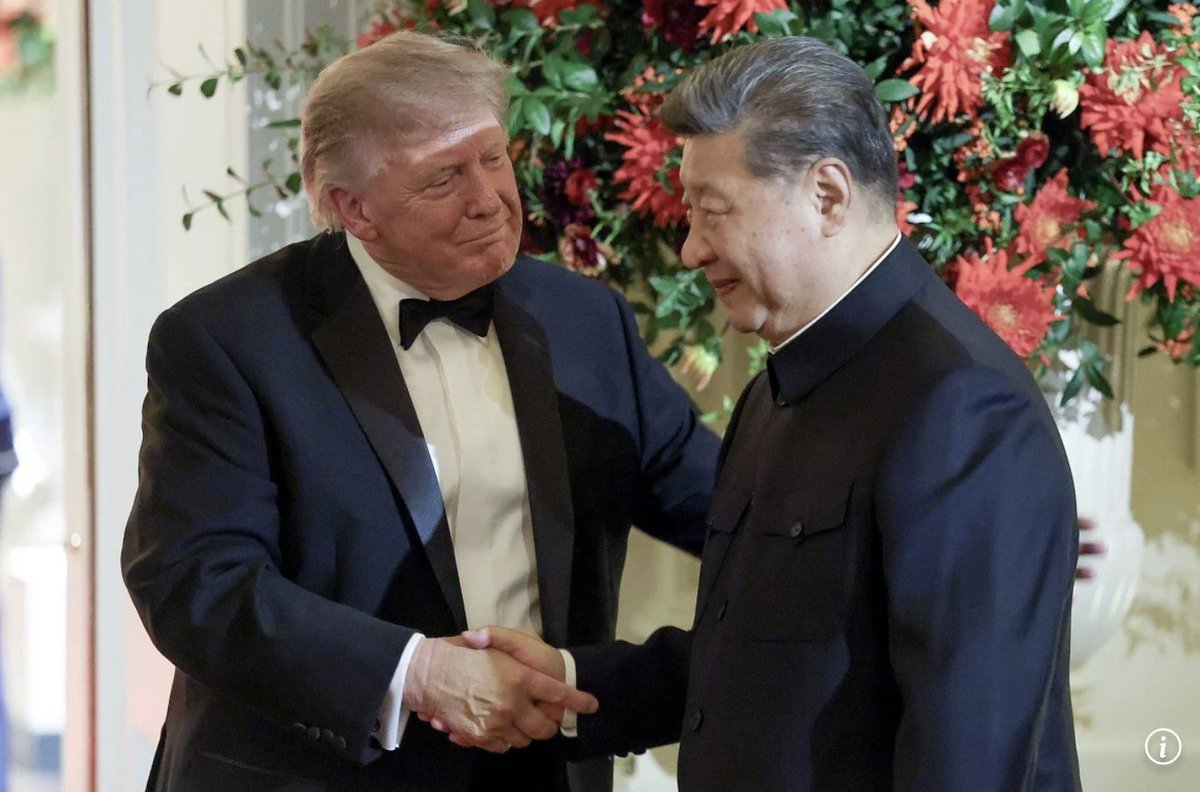
This week the US and Chinese leaders held a three-day summit in Washington. A state dinner, warm words, promises to keep talking.
Concrete outcomes? Few.
But that's actually the most interesting part.
What was achieved:
The trade truce was extended. Tariffs stay lower for now than during last year's open trade war.
But every central question — tariff levels, Chinese purchases, rare earth supplies, technology restrictions — was pushed to the next round of negotiations.
In other words, the main agreement was to keep talking.
How earlier promises are holding up:
This is where it's worth looking closely. The commitments were made earlier. The question is how many have actually been delivered.
Soybeans — China committed to 25 million tons a year. That pledge is being met.
Other agricultural goods — $17 billion a year was promised. That's lagging.
Rare earths — materials essential for electronics and electric vehicles. Deliveries are falling short.
One analyst summed it up well: the truce is moving fastest where it costs least.
Why it matters:
Soybeans cost China little — it needs them anyway. Rare earths are different. They're strategic leverage. So there's no rush to share them.
Neither side wants to give up its bargaining chips. The truce keeps trade moving, but doesn't resolve the underlying disagreements.
And chips?
Chips weren't discussed at all.
The market already knows this. The largest AI chipmaker now builds its guidance on the assumption of zero China data center revenue. Its growth is driven by US domestic investment, not trade with China.
What it means:
This is a lesson in reading any major agreement — between countries, companies, anyone.
A handshake photo is one thing. Actual deliveries months later are another.
For businesses, it means a familiar kind of instability. Tariffs are lower today, but decisions still have to be made without knowing where they'll be in six months.
One practical thought: when you hear about a big deal, don't ask what was promised. Ask what's already been delivered from earlier promises. The answer almost always tells you more than the state dinner.
This is market analysis, not investment advice.
Source: South China Morning Post, US News/Reuters, CNBC, 24/7 Wall St. — September 2026
#Trade #China #Geopolitics #Markets #Macroeconomics
Looking Back at Bitcoin Prices: Why Regret is Just a Waste of Capital
Looking back at historical charts and thinking about missed opportunities is entirely human. Everyone looks at the same inflection points:
BTC was $1 in 2011 – many now think: "Wish I bought then."
BTC was $4 in 2012 – triggering another thought about a missed chance.
BTC was $320 in 2014 and $200 in 2015 – constant reminders of the early phases.
Later, we saw $3,200 in 2018, $4,000 in 2020, and $16,500 in 2022.
Gazing at these numbers evokes one clear feeling: in almost every cycle, it feels like the train has already left the station, while past prices later look like unbelievably cheap history.
What This Means for Us
History shows that almost every cycle brings moments where today's prices look equally attractive a few years down the line.
The most important thing is not what Bitcoin cost in the past, but the ability to keep a cool head, manage risk, and understand the current market structure.
Constantly looking backward drains emotional capital, which is just as important in the market as mathematics.
This is not investment advice, but a market psychology overview. bitcoin:native
The Robinhood Chain Paradox: Why the Success of Major Platforms Doesn't Automatically Drive Ethereum’s Growth
Recent developments surrounding the “Robinhood Chain” have highlighted an interesting market phenomenon. While the platform successfully brings traditional financial products and stocks onchain with record-breaking activity, this growth does not necessarily translate directly into economic value for the Ethereum Layer 1 (L1) network. Understanding the mechanics behind this dynamic is crucial.
How Corporate L2 Chains Operate
Such solutions are built to achieve full flexibility and regulatory compliance:
Enterprises gain dedicated block space, direct control over fee structures, and the ability to seamlessly adapt to regulatory requirements.
Transaction history is recorded on Ethereum using blob data, and gas fees are settled in ETH.
However, the technical structure remains centralized: sequencing and security committees are often restricted to a closed circle of partners rather than operating with full decentralization.
Economic Imbalance: Millions for the Platform, Pennies for Ethereum
The numbers reveal a striking reality. Although the Robinhood chain generates millions in fee revenue, the actual amount paid to the Ethereum network for data storage accounts for a tiny fraction of that profit—amounting to just a few hundred dollars per day.
The original purpose of the L2 model was to provide ultra-cheap data availability, but this creates a paradox:
All profits and activity remain within the private infrastructure.
Ethereum functions merely as a cheap database or digital archive, while the economic value and fees are captured by the L2 operators.
What This Means for Us
This example signals a new phase in blockchain evolution. Future success will not be measured solely by how many L2 projects launch on top of Ethereum. The primary challenge is building an ecosystem where enterprises and users choose Ethereum not just for cheap data, but as a necessary, secure, and neutral settlement and shared security foundation.
This is not investment advice, but an in-depth look at blockchain architecture and economics.
Let’s discuss in the comments.
On Tuesday, the crypto market structure bill failed in the Senate. Two days later, the SEC acted on its own.
And the move matters more than the name suggests.
What was announced:
As of today, certain trading venues can trade tokenized US stocks — Apple, Tesla, any listed name — without registering as an exchange.
It's called the Innovation Exemption. It's temporary, running five years.
What a tokenized stock is:
An ordinary share, with ownership recorded on a blockchain instead of in a legacy banking database. We covered this when the NYSE announced similar plans.
The strictest condition:
Here's the rule that changes a lot.
The token must carry exactly the same rights as a real share — dividends, voting, everything.
Synthetic tokens are excluded. A synthetic token mirrors only the price — you get the movement, but you don't own anything.
And here's the key detail: synthetics make up the bulk of the existing roughly $3 billion tokenized equity market.
Which means most of what's currently marketed as a "tokenized stock" doesn't qualify.
Other conditions:
Issuers must be notified and can object if a third party tokenizes their shares.
Smart contracts must be public, auditable, and deployed on an open blockchain.
Trading must halt whenever trading halts on the primary listing exchange.
And venues must restrict who can participate.
Why the timing matters:
The bill died Tuesday. The regulator moved Thursday.
An SEC spokesperson put it plainly — this is a way station. Either toward final rulemaking, or toward legislation Congress might eventually pass.
In other words: when lawmakers can't agree, the regulator uses the authority it already has.
What it means:
This returns to a lesson we've covered before, with BlackRock's tokenized fund and the Detroit property case.
The technology can be open. The access is not.
This decision confirms it. Trading happens on a public blockchain, the code is visible to everyone. But only approved participants can take part, only with fully backed real shares, and only during standard market hours.
That isn't the free, open system early crypto builders imagined. It's a traditional market running on new rails.
One practical thought: next time you see an offer to buy a "tokenized stock," ask one question — do you get dividends and voting rights, or just price exposure? As of today, those are legally two entirely different products.
This is market analysis, not investment advice.
Source: SEC, The Block, Unchained, QZ — September 17, 2026
#Tokenization #SEC #Blockchain #CapitalMarkets #Regulation