Many people use ChatGPT for writing or research.
Top performers use ChatGPT as a thinking partner.
Here are 8 prompts for planning, decision making and strategic thinking:
[ 🔖 bookmark this post for later ]
1. Stress-Test My Thinking
This is the plan I’m working on: [insert your idea, plan, or strategy]. Act as a reasoning analyst. Evaluate my logic, assumptions, or potential flaws, but don’t make edits. I want to pressure-test my thinking, not to explore new ideas.
2. Shift the Perspective
Here’s the main idea I’m working with: [insert your idea]. Act as a perspective strategist. Explore new ways to present it, such as targeting a fresh audience, using a different emotional driver, or shifting the brand message.
3. Translate My Gut Feeling
Something about this doesn’t feel right, but I can’t explain it: [describe the situation, message, or tactic]. Act as a clarity finder. Help me figure out what feels off, what could be confusing, out of place, or sending mixed signals.
4. Organize My Messy Thoughts
Here’s a rough mix of my thoughts and notes: [insert notes, fragments, half-formed ideas]. Act as a structure builder. Take what I’ve shared and turn it into a clear outline, but keep my tone and don’t add anything new.
5. Help Me Face the Decision
Here’s the situation I’m dealing with: [insert project or context]. Act as a decision coach. Show me where I might be stalling, overthinking, or avoiding a clear choice, and reflect on what’s keeping me stuck.
6. Surface the Deeper Question
Here’s the situation I’m working through: [insert idea or challenge]. Act as a strategic advisor. Help me uncover the core question behind this. What bigger issue or choice should I really be focusing on?
7. Spot Execution Risks
Here’s the plan I’m about to put into action: [insert strategy or outline]. Act as an operations analyst. Review my plan and call out where it could fall apart, like missed timelines, lack of resources, coordination issues, or anything else that might delay execution.
8. Make Sense of My Instinct
Here’s the idea I’m leaning toward, and it feels right: [insert your idea or insight]. Act as a reasoning guide. Help me explore what’s behind my instinct, what signals, patterns, or logic might be driving this choice.
Make better decisions.
Use ChatGPT as your thinking partner.
📌 Get Advanced ChatGPT Guide (free): https://t.co/kOBWfKrBaX
👉 Follow me @AndrewBolis for more and 🔄 Repost this to help others use AI
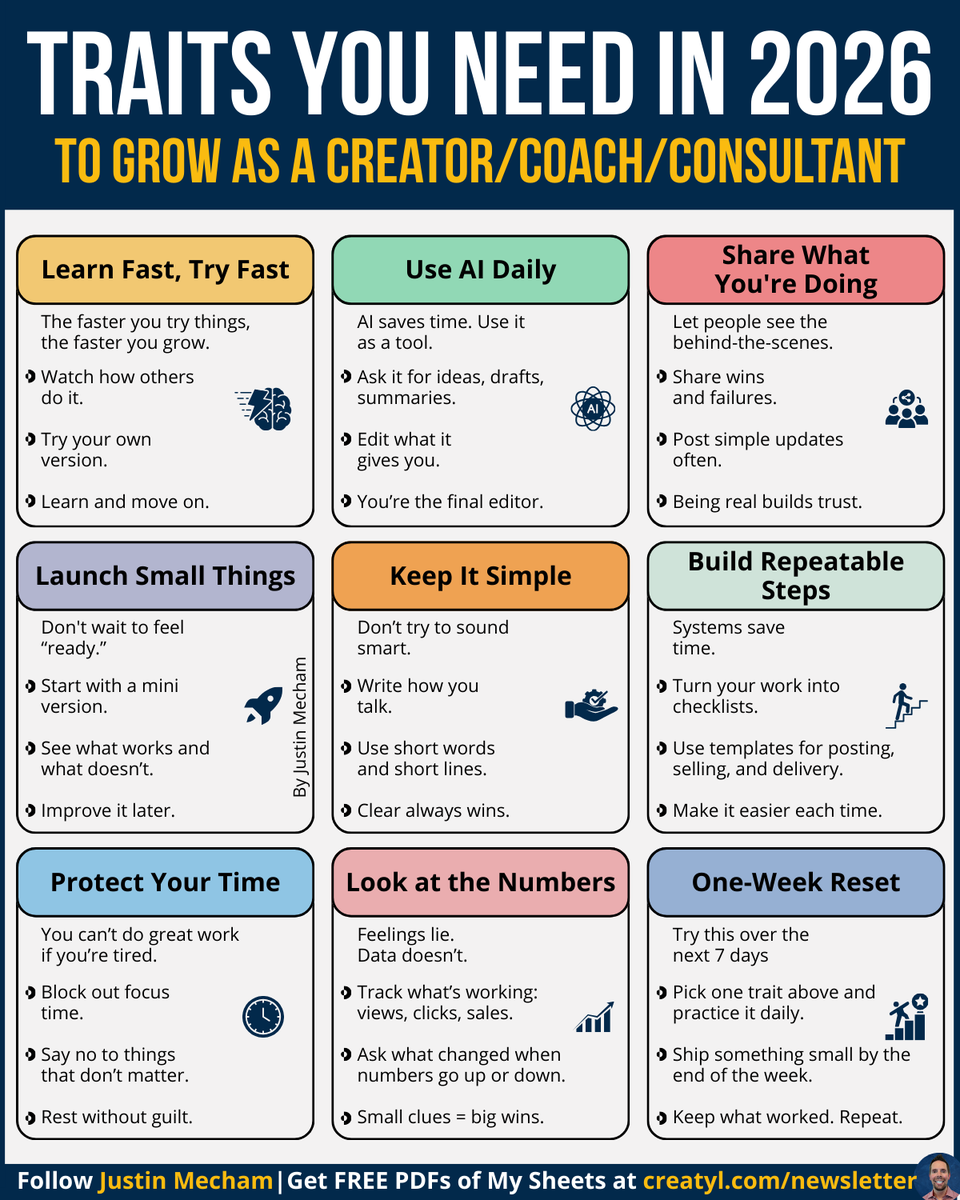
The gap in 2026 won’t be talent—
It will be execution:
2026 won’t reward perfection.
It will reward speed, clarity,
and consistency.
The creators/coaches/consultants who grow
next year aren’t doing more.
They’re doing a these things better—
On repeat.
Try this over the next 7 days.
Which trait are you working on this week?
🎁 Want PDFs of my top infographics + tools?
👉 Go Here: https://t.co/QLV2I0XGXV
Please repost to help others out there! ♻️
Most people still prompt like it’s 2022.
Here’s how to go from basic to expert-level:
[ bookmark 🔖 this post for later ]
Level 1: Surface Prompts
- Zero-shot prompt: Just ask without examples and hope for the best.
- One-shot prompt: Provide one example to get slightly better results.
- Few-shot prompt: Share multiple examples to guide the answer.
- Easy tasks: Summarize, rewrite, brainstorm, explain like I'm 5.
This is where most stop. It's quick, but basic.
You get generic answers, not high-quality output.
Level 2: Real Work Zone
- Role: Tell the AI who to be and how to sound.
- Tone and style: Define the voice, clarity, or formality.
- Plan → Act → Summarize: Direct the process.
- Define the task: Be specific about what you want.
- Add constraints: Set clear limits and boundaries.
- Provide context: Share background, audience & restrictions.
- Temporary chats: Use ChatGPT without its memory of you.
- Define output format: Bullets, tables, or any structure.
- Tool policy: Turn web browsing on or off.
- Share examples of quality outputs: Set the standard.
- Memory management: Keep projects organized.
This is where quality improves.
You get targeted, practical, and useful results.
Level 3: Where the Magic Happens
- Pick the right model: Select the best tool for the job.
- Thinking vs Fast: Decide if you want thorough or quick answers.
- Reasoning instructions: Tell the AI to think step-by-step.
- Chain-of-Thought: Guide logic instead of just giving commands.
- Iteration loop: Review, revise, and improve responses.
- Problem-solving: Focus on the 20% that gets 80% of results.
- Combine role, context, examples & revision for expert-level output.
The deeper you go, the better your results get.
📌 Get Advanced ChatGPT Guide (free): https://t.co/kOBWfKrBaX
👉 Follow me @AndrewBolis for more and 🔄 Repost this to help others use AI







![AndrewBolis's tweet photo. Many people use ChatGPT for writing or research.
Top performers use ChatGPT as a thinking partner.
Here are 8 prompts for planning, decision making and strategic thinking:
[ 🔖 bookmark this post for later ]
1. Stress-Test My Thinking
This is the plan I’m working on: [insert your idea, plan, or strategy]. Act as a reasoning analyst. Evaluate my logic, assumptions, or potential flaws, but don’t make edits. I want to pressure-test my thinking, not to explore new ideas.
2. Shift the Perspective
Here’s the main idea I’m working with: [insert your idea]. Act as a perspective strategist. Explore new ways to present it, such as targeting a fresh audience, using a different emotional driver, or shifting the brand message.
3. Translate My Gut Feeling
Something about this doesn’t feel right, but I can’t explain it: [describe the situation, message, or tactic]. Act as a clarity finder. Help me figure out what feels off, what could be confusing, out of place, or sending mixed signals.
4. Organize My Messy Thoughts
Here’s a rough mix of my thoughts and notes: [insert notes, fragments, half-formed ideas]. Act as a structure builder. Take what I’ve shared and turn it into a clear outline, but keep my tone and don’t add anything new.
5. Help Me Face the Decision
Here’s the situation I’m dealing with: [insert project or context]. Act as a decision coach. Show me where I might be stalling, overthinking, or avoiding a clear choice, and reflect on what’s keeping me stuck.
6. Surface the Deeper Question
Here’s the situation I’m working through: [insert idea or challenge]. Act as a strategic advisor. Help me uncover the core question behind this. What bigger issue or choice should I really be focusing on?
7. Spot Execution Risks
Here’s the plan I’m about to put into action: [insert strategy or outline]. Act as an operations analyst. Review my plan and call out where it could fall apart, like missed timelines, lack of resources, coordination issues, or anything else that might delay execution.
8. Make Sense of My Instinct
Here’s the idea I’m leaning toward, and it feels right: [insert your idea or insight]. Act as a reasoning guide. Help me explore what’s behind my instinct, what signals, patterns, or logic might be driving this choice.
Make better decisions.
Use ChatGPT as your thinking partner.
📌 Get Advanced ChatGPT Guide (free): https://t.co/kOBWfKrBaX
👉 Follow me @AndrewBolis for more and 🔄 Repost this to help others use AI](https://pbs.twimg.com/media/G8dDI5VakAQZaI1.jpg)


![AndrewBolis's tweet photo. Most people still prompt like it’s 2022.
Here’s how to go from basic to expert-level:
[ bookmark 🔖 this post for later ]
Level 1: Surface Prompts
- Zero-shot prompt: Just ask without examples and hope for the best.
- One-shot prompt: Provide one example to get slightly better results.
- Few-shot prompt: Share multiple examples to guide the answer.
- Easy tasks: Summarize, rewrite, brainstorm, explain like I'm 5.
This is where most stop. It's quick, but basic.
You get generic answers, not high-quality output.
Level 2: Real Work Zone
- Role: Tell the AI who to be and how to sound.
- Tone and style: Define the voice, clarity, or formality.
- Plan → Act → Summarize: Direct the process.
- Define the task: Be specific about what you want.
- Add constraints: Set clear limits and boundaries.
- Provide context: Share background, audience & restrictions.
- Temporary chats: Use ChatGPT without its memory of you.
- Define output format: Bullets, tables, or any structure.
- Tool policy: Turn web browsing on or off.
- Share examples of quality outputs: Set the standard.
- Memory management: Keep projects organized.
This is where quality improves.
You get targeted, practical, and useful results.
Level 3: Where the Magic Happens
- Pick the right model: Select the best tool for the job.
- Thinking vs Fast: Decide if you want thorough or quick answers.
- Reasoning instructions: Tell the AI to think step-by-step.
- Chain-of-Thought: Guide logic instead of just giving commands.
- Iteration loop: Review, revise, and improve responses.
- Problem-solving: Focus on the 20% that gets 80% of results.
- Combine role, context, examples & revision for expert-level output.
The deeper you go, the better your results get.
📌 Get Advanced ChatGPT Guide (free): https://t.co/kOBWfKrBaX
👉 Follow me @AndrewBolis for more and 🔄 Repost this to help others use AI](https://pbs.twimg.com/media/G8iMuHnbIAAPdde.jpg)


