Everything I Used to Prepare for Coding, System Design, and Machine Coding Interviews
Someone on reddit posted all the coding strategies and resources he used to get interview at Google
1. Coding Patterns & Strategy
Before jumping into problems, understand the patterns:
All LeetCode Articles on Coding Patterns Summarized (https://t.co/NXa4N9wQf3)
Solved All Two Pointers Problems in 100 Days (https://t.co/qgcrNoBIHG)
Tree Question Pattern 2023 — Tree Study Guide (https://t.co/w0oMd97Kv5)
Important and Useful Links from All Over LeetCode (https://t.co/3DUhT6AjkW)
Coding Interview Preparation Problems for Beginners (https://t.co/zSacSvb2Kn)
2. Company-Specific Prep
Google, Meta, Apple, Amazon Senior SDE Preparation (https://t.co/bpa1OLESZs)
A Study Guide for Passing the Google Interview (https://t.co/gdWNR4e3zh)
I was solving problems randomly but had no way to track progress by company. So I built a small tool where you can filter problems by company, mark status (todo/solved/revision), and it auto-schedules what to review next. Also added an AI coach that gives hints (not full solutions) — helps me stay honest when I'm stuck. Have added company-wise questions (https://t.co/KpV9SzxHpo)
3. System Design (HLD)
The general LeetCode docs are great for breadth, but what actually moved the needle for me was working through structured, progressive sheets instead of random docs. The Design Round has curated HLD sheets that go from crash-prep to full coverage — start narrow, expand when ready:
Arch 25 — crash sheet of the highest-frequency systems and reusable patterns to cover first
Arch 50 — Arch 25 plus deeper infra, data, reliability, and advanced product systems for SDE2/Senior prep
Arch 75 — Arch 50 plus high-signal variants, niche domains, and company-style specialization
Arch All — the complete 103-question HLD bank for full coverage and long-term mastery
Core Concepts — 33 distributed-systems deep dives to build the underlying intuition
4. Machine Coding (LLD)
The machine coding / LLD round caught me off guard the first time — it's a different muscle from DSA, and most prep ignores it. The Design Round has LLD sheets and design-pattern references that map directly to what gets asked:
MaCo 30 — the core 30 machine-coding problems, highest ROI for interviews
MaCo 60 — MaCo 30 plus extended coverage across all categories
MaCo All — the complete list of all 103 machine-coding problems
Design Patterns — 31 OOP & structural patterns you'll lean on during the round
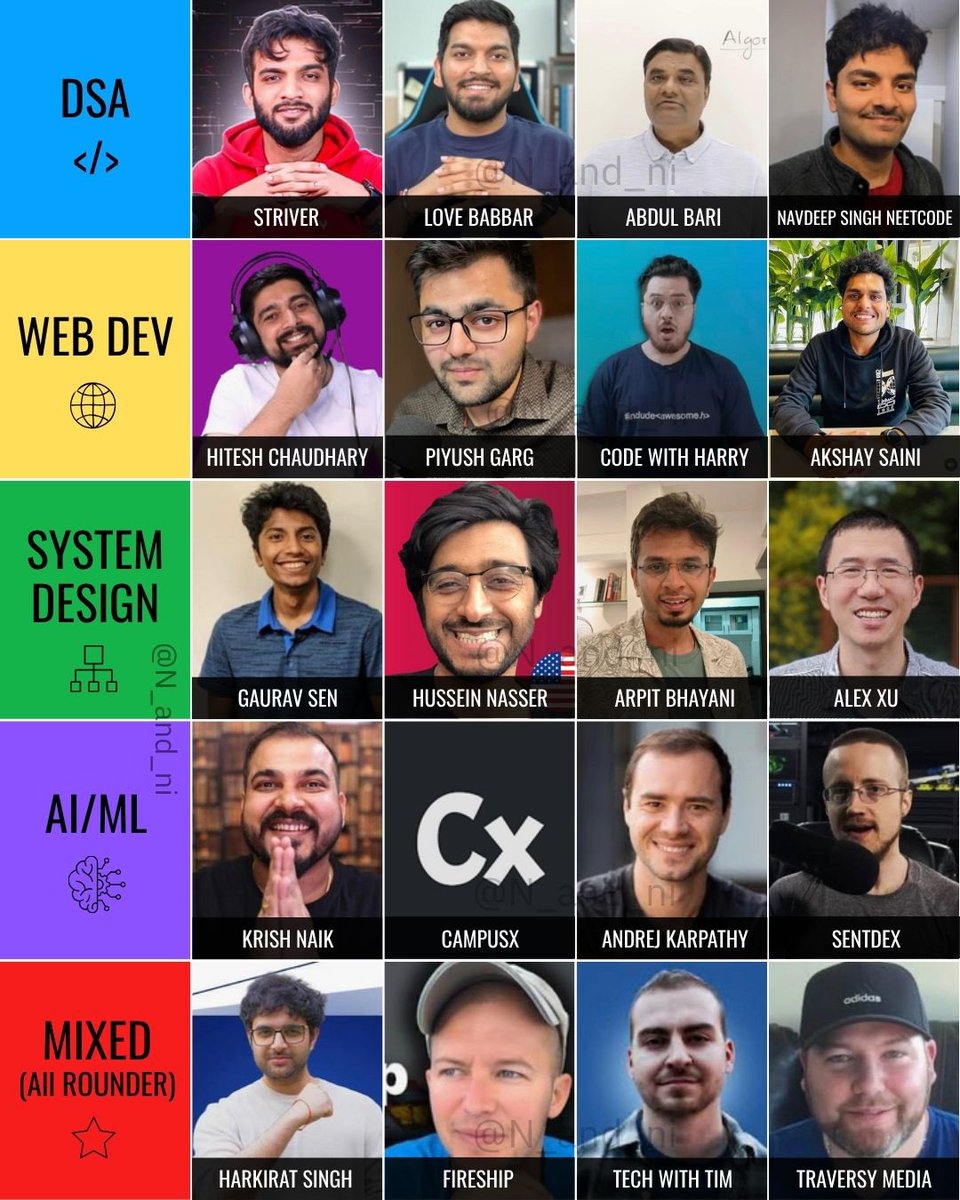
Best YouTube Channels To Crack Tech Interviews (2026)
1. DSA – NeetCode
2. LeetCode Patterns – Abdul Bari
3. System Design – Gaurav Sen
4. Mock Interviews – Pramp
5. FAANG Prep – Tech Dummies
6. Coding Rounds – Nick White
7. Behavioral – Jeff H Sipe
8. Problem Solving – Back To Back SWE
9. Deep DSA – Errichto
10. Interview Strategy – Exponent
11. Resume + Career – Self Made Millennial
12. Real Interview Qs – Clément Mihailescu
13. Advanced DSA – William Lin
14. CS Basics – MIT OpenCourseWare
“To beard the lion in his den.”
The dictionary defines it as boldly confronting a powerful rival on their own turf.
For years, Norway Chess has been Magnus Carlsen’s den. His turf. His domain.
So I woke up to this news and my jaw dropped.
You didn’t just win a title, @rpraggnachess.
You walked into the lion’s den and emerged victorious
This title is important. Not because of the trophy, but because of your challenger spirit.
And that’s something all of us can learn from…
🇮🇳👏🏽👏🏽👏🏽
MAGNUS CARLSEN. 21-TIME WORLD CHAMPION.
🏆🏆🏆🏆🏆🏆🏆
🏆🏆🏆🏆🏆🏆🏆
🏆🏆🏆🏆🏆🏆🏆
He fought back to defeat Caruana and add the #FreestyleChess World Championship to his unbelievable era of dominance!
I visited the Vivo Service Centre yesterday, because it was Vivo Service day.
And I got free cover and screen guard replaced, this is such a nice thing.
It is held on 14 to 16 every of every month for Vivo and iQOO devices.
Also no labour charges, 10% off on accessories, free sanitization of device along with cover and screen guard.
I hope more brands provide such service.
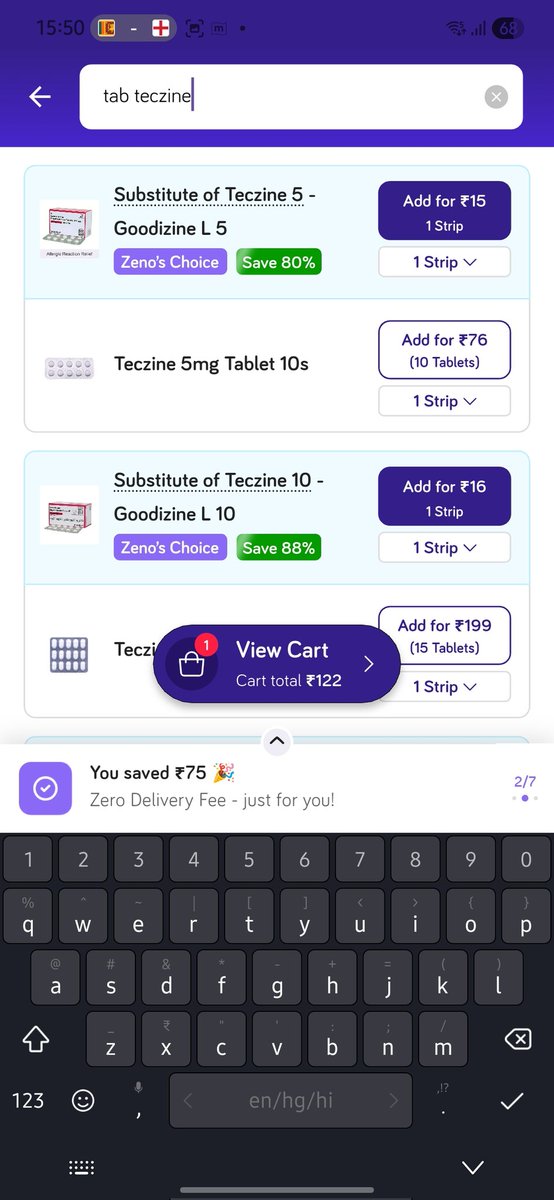
🚨No Pharmeasy 10X can save you as much as the generic meds🚨
My father was prescribed medicines last week. Standard branded names. Nothing unusual.
Out of curiosity (and common sense), I opened the Zeno app right there and showed the doctor the generic equivalents available for the exact same compositions.
He looked. Checked. And simply said:
“Yes, you can get these.”
Then came the honest part 👇
They cannot officially write generic alternatives, even if they know they’re equivalent. That’s the rulebook they operate under.
Meanwhile, X is full of debates claiming generics aren’t trustworthy.
Reality check: doctors know. Patients should know too.
So here’s the truth in plain sight:
🧠 Same composition
💊 Different branding
💸 Vastly different prices
Choose wisely. Save money. Ask questions.
The system won’t volunteer this info, but it won’t stop you either.
Always check if Generics in your locality.
Thank yourself later.
#medicine #generic
Dear @ICC,
It is with a heavy heart that we now announce our unavailability to replace Pakistan in the upcoming T20 World Cup. Regardless of whether they now withdraw, the short timescales ensure it is impossible for our squad to prepare in the professional manner necessary to compete effectively in this global cricketing spectacle. We are not like Scotland and able to turn up on a whim, with no kit sponsor.
Our players are from all walks of life and cannot simply drop their occupations to fly halfway around the world to experience temperatures only normally felt in Finnish saunas. Our captain, a professional baker, needs to attend to his oven, our ship captain needs to steer his vessel, and our bankers need to go bankrupt (again). This is the harsh reality of cricket at the amateur level of the game.
This news will be extremely disappointing to our fans. Despite being the most peaceful nation on Earth, we maintain an army of online followers, and are the world's 14th most followed national board on X. We were ready to give the Dutch the biggest shock they have experienced since William of Orange lost the Battle of Landen in 1693. And the Americans were looking forward to taking on Greenland, or so their orange-dyed leader thought.
Our loss is likely Uganda's gain. We wish them well. Their kits cannot be missed unless you have epilepsy, in which case they are probably best avoided.
The future is always ice, until it isn't.
Yours sincerely,
Icelandic Cricket Association
Last one on this topic, and I have been holding this in myself for a while.
For centuries, class divides kept the labor of the poor invisible to the rich. Factory workers toiled behind walls, farmers in distant fields, domestic help in backrooms. The wealthy consumed the fruits of that labor without ever seeing the faces or the fatigue behind it. No direct encounter, no personal guilt.
The gig economy shattered that invisibility, at unprecedented scale.
Suddenly, the poor aren't hidden away. They're at your doorstep: the delivery partner handing over your ₹1000+ biryani, late-night groceries, or quick-commerce essentials. You see them in the rain, heat, traffic, often on borrowed bikes, working 8–10 hours for earnings that give them sustenance. You see their exhaustion, their polite smile masking frustration with life in general.
This is the first time in history at this scale that the working class and consuming class interact face-to-face, transaction after transaction. And that discomfort with our own selves is why we are uncomfortable about the gig economy. We want these people to look our part, so that the guilt we feel while taking orders from them feels less.
We aren't just debating economics. We are confronting guilt. That ₹800 order might equal their entire day's earnings after fuel, bike rent, and app cuts. We tip awkwardly, or avoid eye contact, because the inequality is no longer abstract. It's personal.
Pre-gig era, the rich could enjoy luxury without moral discomfort. Labor was out of sight. Now, every doorbell ring is a reminder of systemic inequality. That's why debates explode. It's not just policy. It's emotional reckoning. Some defend the system (“they choose it”), others demand change (“this isn't progress, its exploitation”).
And here’s the uncomfortable twist: the unsaid ask of clumsy ‘solutions’ isn’t dignity. It is about returning to invisibility.
Ban gig work and you don’t solve inequality. You remove livelihoods. These jobs don’t magically reappear as formal, protected employment the next day. They disappear, or they get pushed back into the informal economy where there are even fewer protections and even less accountability. Over-regulate it until the model breaks, and you achieve the same outcome through paperwork instead of slogans: the work evaporates, prices rise, demand collapses, and the people we claim to protect are the first to lose income.
And then what happens?
The rich get their old comfort back. Convenience returns without faces. Guilt dissolves. We go back to clean abstractions and moral posturing from a distance. The poor don’t become safer, they become invisible again: back in cash economies, back in backrooms, back in shadows where regulation rarely reaches and dignity isn’t even debated.
The gig economy just exposed the reality of inequality to the people who previously had the luxury of not seeing it. The doorbell is not the problem. The question is what we do after opening the door.
Visibility is the price of progress. We can either use this discomfort to build something better (which we keep doing continuously as delivery partners are our backbone), or we can ban and over-regulate our way back into ignorance. One of those choices improves lives. The other simply helps the consuming class feel virtuous in the dark.