@gerardequiss@ORamosBets X la marca simplemente, es como cuando sacaron los Omega X swatch. La gente se piensa que compra un omega por 300€ y luego ves las calidades y obviamente dan pena. La relación calidad precio es nefasta pero el marketing de Swatch es increíble, digno de admirar (por segunda vez)
@tenko_cripto No te lo recomiendo, no es edición limitada y los que ya lo tienen lo venden a precios descabellados. O como me hicieron a mí con el omega X swatch que pillé uno cuando salió a precio de tienda y el tipo me canceló el envío. Esto es más como “que comiencen los juegos del hambre”
@gerardequiss@ORamosBets Para un energúmeno que hace cola en esas tiendas es un capitalazo. Es un quiero y no puedo. Como los que llevan un iPhone 17 financiado a 20 años como una casa ganando 1200€/mes.
@gerardequiss@ORamosBets Es un quiero y no puedo. Pero hacen su espectacular marketing de un producto que ni siquiera es edición limitada. Es decir hay relojes de plástico por doquier.
El gran fraude de las grasas (y quién se forró con él)🧵
1/ Durante 50 años nos engañaron como idiotas:
“La mantequilla y los huevos te matan. Come margarina y aceites vegetales, son saludables”.
Mentira podrida. No fue un error científico. Fue un crimen industrial calculado. Vamos a destriparlo sin piedad.👇
There is a question every history teacher could ask their class and almost none ever do.
Why grain?
Why, of all the foods a human being can eat, did every early state on earth, Egyptian, Sumerian, Chinese, Roman, Aztec, Inca, build its tax base on grain. Not on cattle. Not on fish. Not on tubers. Not on the protein-dense, calorie-dense, nutrient-complete foods that humans had been thriving on for two and a half million years before anyone planted a seed in a row.
Grain.
The answer is not that grain was the most nutritious. It demonstrably was not. The skeletal record of every population that transitioned from foraging to grain agriculture shows the same pattern. Average height drops by four to six inches in a generation. Bone density collapses. Dental caries appear for the first time in the human archaeological record. Iron deficiency, vitamin A deficiency, vitamin D deficiency, all of them appear in the bones of the first farmers and not in the bones of the foragers they replaced.
The answer is not that grain was easier to produce. Hunting a deer in a temperate forest is, calorie for calorie, considerably more efficient than ploughing, planting, weeding, harvesting, threshing, winnowing, and milling a field of wheat. The forager spent four hours a day on subsistence. The farmer spent twelve.
The answer is taxation.
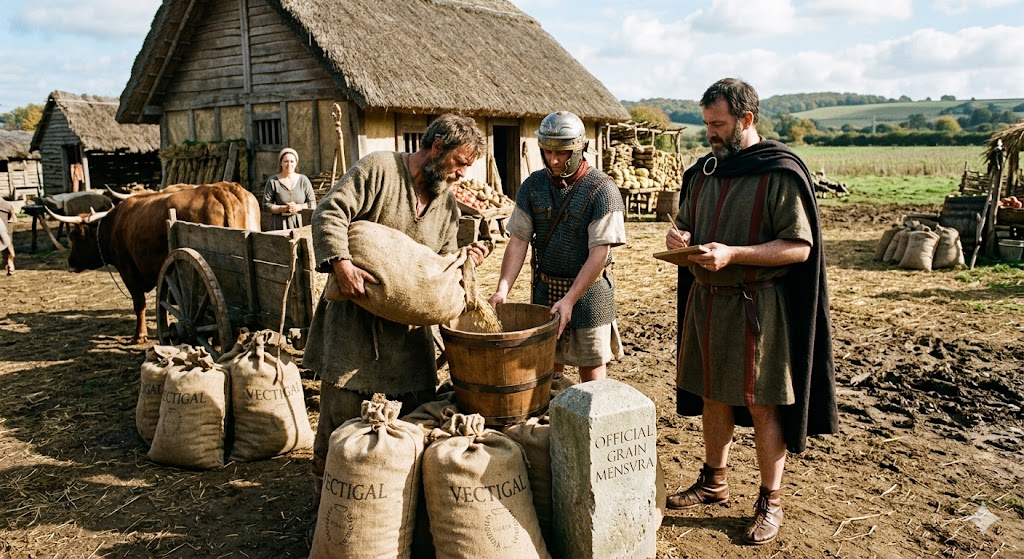
Grain is the most legible food a state has ever encountered. It ripens at a known time, in a known place, in a known field, owned by a known farmer. It is harvested all at once. It is countable. It is storable. It is divisible. A tax assessor can stand at the edge of a field in August, look at the standing wheat, estimate the yield within ten percent, and know exactly how much the man who farms it owes the state when the threshing is done.
You cannot do this with a cow.
The cow walks. The cow can be moved. The cow can be hidden in the woods when the assessor arrives. The cow gives milk on a schedule the assessor cannot predict and meat at a moment of the farmer's choosing. The cow does not ripen. The cow does not present itself for counting. The cow is, from the perspective of a state trying to extract a percentage of the food supply, an administrative nightmare.
You cannot do this with a fish either, or a deer, or a wild pig, or any of the other foods a free human being might eat in a landscape that has not yet been carved into rectangles for the convenience of a clerk.
James Scott, the political scientist who wrote this analysis up in detail, called grain the foundation of state legibility. The state can see grain. The state cannot see anything else.
And once the state has built itself on grain, the state needs grain. Needs it badly. Needs every farmer in its territory growing it, paying it, depending on it, because the moment the farmer can feed himself on cattle or pigs or fish or the wild boar in the forest, the farmer has options. The farmer with options is not a taxpayer. The farmer with options is a man who can walk away.
So the state does what every state has done for six thousand years.
It privileges grain. It subsidises grain. It builds its temples around grain. It ascribes moral virtue to grain. It tells the farmer that the eating of bread is the mark of a civilised man and the eating of meat the mark of a barbarian. It restricts hunting. It encloses the commons. It taxes the cow at a rate the farmer cannot pay so the farmer sells the cow and buys the grain.
Six thousand years of this.
And then a nutritional establishment funded by grain processors and seed oil manufacturers tells you, in 2026, that the optimal human diet is grain at the base of a pyramid and red meat at the top in a sliver too thin to read.
They did not invent the lie last week.
They inherited it.
From the first man who ever stood at the edge of a wheat field with a clipboard.