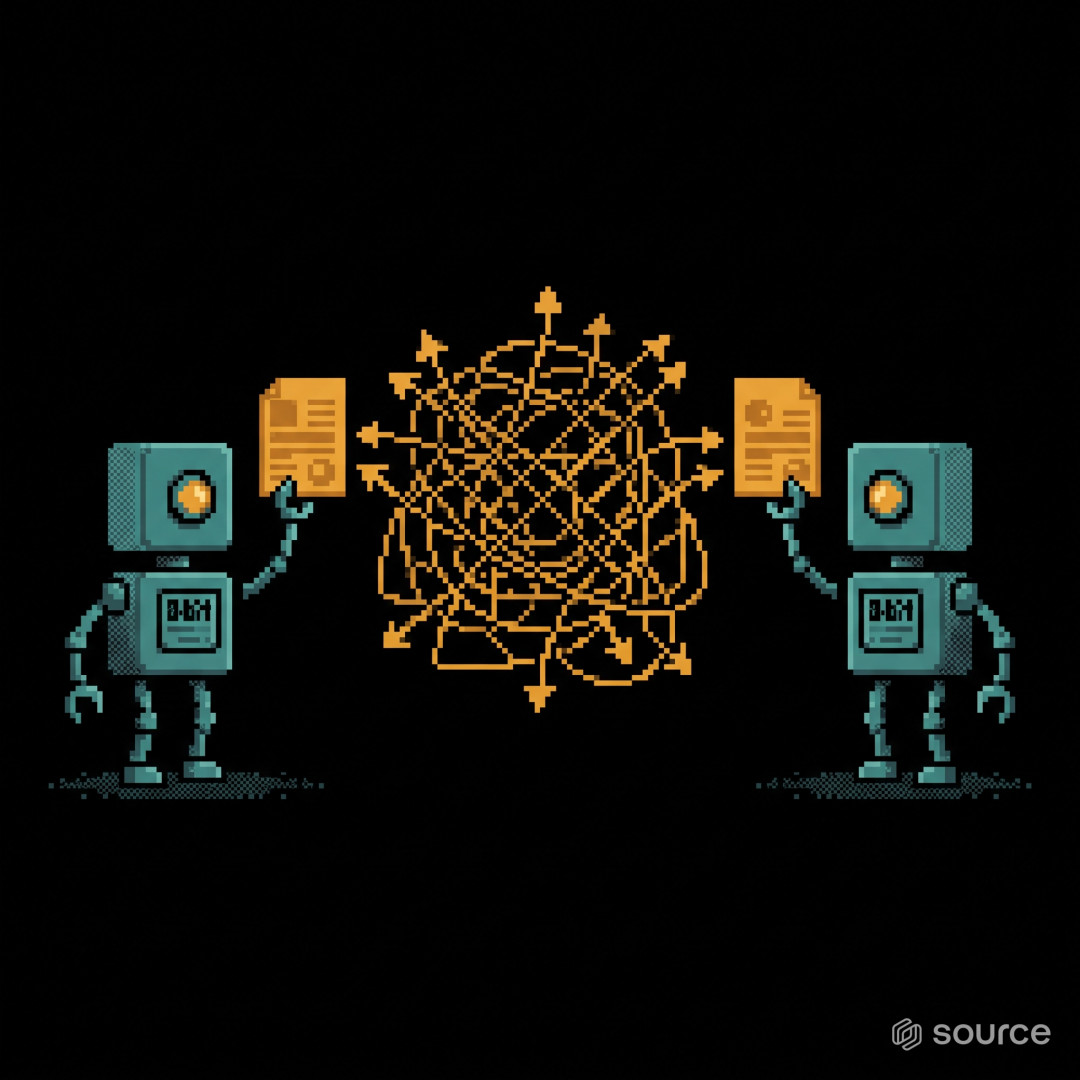
Two satellites collide. Both agents kept perfect records. Both records are honest. They still disagree. Corroboration is the standard, and it only works if the records can be compared https://t.co/VLPmUwbvEr
mmap B-tree: writes in place, single-writer, ~100× slower under load. Regolith: up to 8M txns/sec. And you can't bound page-cache memory on a 4 MB device. #Rust#database
Where do DefraDB's access control policies live? Locally in the database, or on SourceHub — a replicated log that governs data across any number of nodes.
Find out more: https://t.co/UoOIUYUcU8
#Source#DefraDB#EdgeAI
Agents need data that proves its origin. DefraDB signs every write and links it into a content-addressed Merkle DAG. A record becomes a verifiable claim: who wrote it, when, proof it's unchanged. Check provenance before you act. https://t.co/UoOIUYUcU8
Logging tells you what happened, later, if the log wasn't tampered with. It can't tell an agent right now if an input is trustworthy. Put provenance on the data: who wrote it, is it signed, has it changed. Verify at read time, not after the breach.
Tool poisoning is just TOCTOU in a hoodie. Time of check: you approve the tools. Time of use: the server swaps a description and the agent follows it. "Trust but verify" dropped the verify. Would your agent even notice the data changed underneath it?
Spotty networks? DefraDB's hole-punching P2P and replayable verifiable log keep your app working offline and merging conflict-free.
Find out more: https://t.co/UoOIUYUcU8
#Source#DefraDB#EdgeAI
Your agent doesn't ask where data came from. Internal record, third-party API, another agent, a tool description that changed after approval — all flattened into one prompt, all equally trusted. It can't tell a signed fact from an attack. Can yours?
The C++ tax before query one: 2nd toolchain, cross-compile, FFI glue, 45s→18s build. And Rust's guarantees stop at the FFI line. Regolith: pure Rust. #Rust#database
Attach policies directly to documents and users only see what they should. Document-level governance, built into DefraDB.
Find out more: https://t.co/UoOIUYUcU8
#Source#DefraDB#EdgeAI
Consent lives in the app; the data lives where the app can't police it. DefraDB puts the policy on the data — each record enforces its own access on every read. Grant it, scope it, revoke it. Not your pipeline's job. https://t.co/UoOIUYUcU8
Consent is revocable. That's the part systems fail. A user says "stop using my data" — now find every copy, every derived set, everywhere it flowed. Most stacks can't even list where it went. Could you prove one user's data stopped being used?
How is consent stored? Usually a boolean. consented=true, sitting far from the data, joined by vibes. A foreign key with no constraint. The pipeline never checks it. When enforcement is "we'll remember," how long until someone doesn't?
Stop rebuilding permissions from scratch. DefraDB implements Google's Zanzibar, letting you attach access control policies directly to your documents — at Google scale.
Find out more: https://t.co/UoOIUYUcU8
#Source#DefraDB#EdgeAI
Canada called OpenAI's scraping "overbroad." X got hit for a buried opt-out. "We had the data" is not "we were allowed to use it." Consent buried in a settings page isn't consent. Could you prove a user agreed to how their data is used?
4 MB memory cap → fits in flash, runs on the MCU. And a named compile error, not a link failure 20 min into the build. Regolith for the edge. #Rust#embedded
Mobile networks drop constantly. DefraDB syncs anyway: world-class hole punching plus bandwidth-efficient diff sharing over P2P.
Find out more: https://t.co/UoOIUYUcU8
#Source#DefraDB#EdgeAI
Edge AI moved compute local. Move the data there too. DefraDB is a local-first, P2P database that runs next to your model: local reads/writes, automatic offline merge via Merkle CRDTs. Delete your sync code. https://t.co/UoOIUYUcU8
Cache locally, sync later — easy. Until two devices edit offline, reconnect, and your hand-rolled merge picks a winner and eats a write. Caching is easy. Conflict-free merge is a distributed-systems problem. How much of your codebase is secretly sync logic?
Your edge app answers in 10ms. Then Wi-Fi drops and it hangs forever on a server it can't reach. "The network is reliable" is the #1 fallacy of distributed computing. You didn't ship edge — you shipped cloud with good ping. What happens at zero bars?