🎓 Aprende trading con los expertos de la Universidad Atrévete
💡 Clases en vivo, comunidad activa y enfoque práctico
🔗 https://t.co/V2VfBCj6Ve
Usa el cupón EDIMAR y obtén 10% de descuento (aplica al primer pago en suscripciones o planes de pago).
🏴🇧🇷 | Una psíquica brasileña afirma que una nave alienígena aparecerá encima del Hard Rock Stadium el 24 de junio durante el Brasil vs Escocia en la Copa del Mundo para abducir a jugadores y aficionados en el lugar.
La vidente se mostró bastante nerviosa en el vídeo que se hace hecho viral y señala que es la segunda vez que sueña con la misma situación.
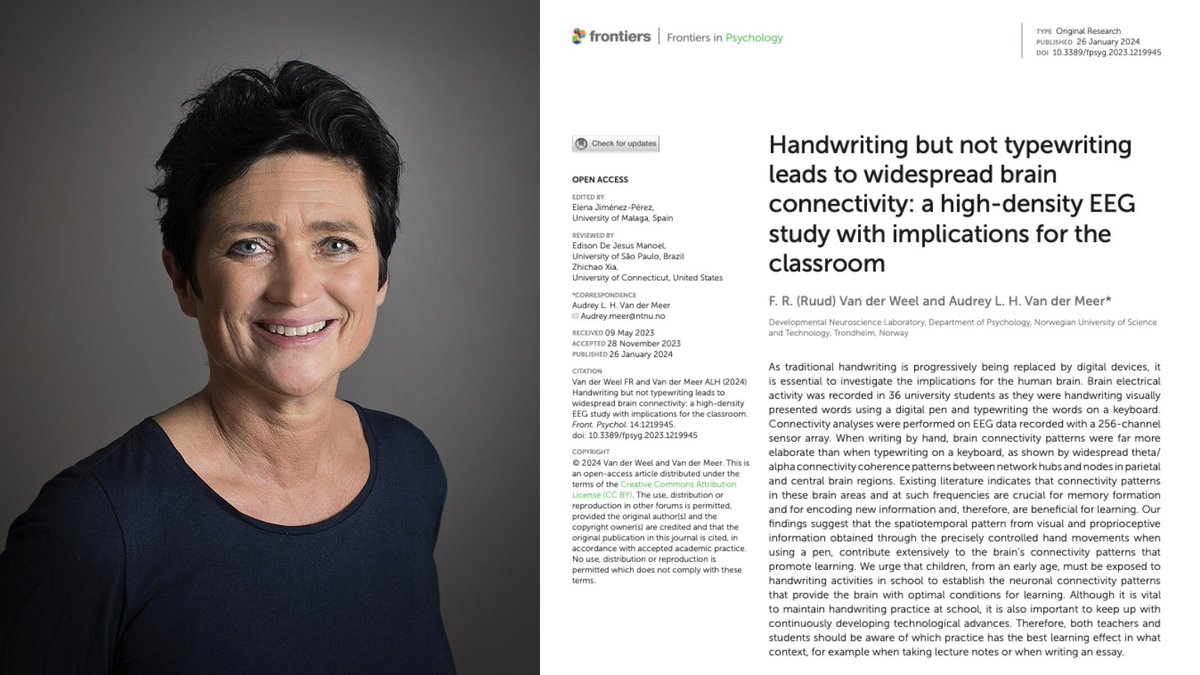
A Norwegian neuroscientist spent 20 years proving that the act of writing by hand changes the human brain in ways typing physically cannot, and almost nobody outside her field has read the paper.
Her name is Audrey van der Meer.
She runs a brain research lab in Trondheim, and the paper that closed the argument was published in 2024 in a journal called Frontiers in Psychology. The finding is brutal enough that it should have changed every classroom on Earth.
The experiment was simple. She recruited 36 university students and put each one in a cap with 256 sensors pressed against their scalp to record brain activity. Words flashed on a screen one at a time.
Sometimes the students wrote the word by hand on a touchscreen using a digital pen, and sometimes they typed the same word on a keyboard. Every neural response was recorded for the full five seconds the word stayed on screen.
Then her team looked at the part of the data most researchers had ignored for years, which is how different parts of the brain were communicating with each other during the task.
When the students wrote by hand, the brain lit up everywhere at once.
The regions responsible for memory, sensory integration, and the encoding of new information were all firing together in a coordinated pattern that spread across the entire cortex. The whole network was awake and connected.
When the same students typed the same word, that pattern collapsed almost completely.
Most of the brain went quiet, and the connections between regions that had been alive seconds earlier were nowhere to be found on the EEG.
Same word, same brain, same person, and two completely different neurological events.
The reason turned out to be something nobody had really paid attention to before her work. Writing by hand is not one motion but a sequence of thousands of tiny micro-movements coordinated with your eyes in real time, where each letter is a different shape that requires the brain to solve a slightly different spatial problem.
Your fingers, wrist, vision, and the parts of your brain that track position in space are all working together to produce one letter, then the next, then the next.
Typing throws all of that away. Every key on a keyboard requires the exact same finger motion regardless of which letter you are pressing, which means the brain has almost nothing to integrate and almost no problem to solve.
Van der Meer said it plainly in her interviews.
Pressing the same key with the same finger over and over does not stimulate the brain in any meaningful way, and she pointed out something that should scare every parent who handed their kid an iPad.
Children who learn to read and write on tablets often cannot tell letters like b and d apart, because they have never physically felt with their bodies what it takes to actually produce those letters on a page.
A decade before her, two researchers at Princeton ran the same fight using a completely different method and ended up at the same answer. Pam Mueller and Daniel Oppenheimer tested 327 students across three experiments, where half took notes on laptops with the internet disabled and half took notes by hand, before testing everyone on what they actually understood from the lectures they had watched.
The handwriting group won by a wide margin on every question that required real understanding rather than surface recall.
The reason was hiding in the transcripts of what the two groups had actually written down.
The laptop students typed almost word for word, capturing more total content but processing almost none of it as they went, while the handwriting students physically could not write fast enough to transcribe a lecture in real time, which forced them to listen carefully, decide what actually mattered, and put it in their own words on the page.
That single act of choosing what to keep was the learning itself, and the keyboard had quietly skipped the choosing and skipped the learning along with it.
Two studies. Two countries. Same answer.
Handwriting makes the brain work. Typing lets it coast.
Every note you have ever typed instead of written went into your brain through a thinner pipe. Every meeting, every book highlight, every idea you captured on your phone instead of on paper was processed at half depth.
You did not forget those things because your memory is bad. You forgot them because typing never woke the part of the brain that would have made them stick.
The fix is the thing your grandmother already knew.
Pick up a pen. Write the thing down. The slower road is the faster one.
Let me explain exactly why every new subdivision in America looks like the top photo, because the math is wild.
A mature tree increases a home's value by 7 to 19 percent. On a $400,000 house, that's $28,000 to $76,000. A single shade tree produces the cooling equivalent of ten room-size air conditioners running 20 hours a day. One tree on the west side of a house cuts energy bills by 12 percent within 15 years. The bottom photo is worth more, costs less to live in, and sells faster. This has been documented by the University of Washington, Clemson, Michigan State, and the USDA. The data is not in dispute.
Removing those trees saves the builder roughly $5,000 per lot. Concrete trucks need twice the dripline radius of every standing tree. Utility trenches need flat ground. A bulldozer flattens 200 lots in an afternoon. Preserving trees adds weeks and thousands per home.
So the developer pockets $5,000 in savings and the buyer eats $50,000 in lost value for the next two decades. The person making the decision and the person paying for it have never been in the same room.
The Woodlands, Texas is the proof of what happens when they are. George Mitchell bought 28,000 acres of Houston timberland in 1974 and preserved 28% as permanent green space. He forced McDonald's to build behind the tree canopy. That McDonald's became one of the highest-volume locations in Texas. The first office building, designed to reflect the surrounding forest so you couldn't see it from the street, leased completely.
The Woodlands median home price today: $615,000. Katy, a comparable Houston suburb that clear-cut: $375,000. Named #1 community to live in America two years running.
Fifty years of data. The trees are worth more than removing them saves. Developers clear-cut anyway because they sell the house once and leave. You live in it for 30 years.
Charlie Munger: "Lots of luck if you're an impulsive person who has to be gratified immediately. You're probably not going to have a very good life.”
"The demand for immediate gratification is the way to ruin — and it may also give you syphilis."
"It's obvious that deferred gratifiers do better over the long pull than these impulsive children who have to spend money on Rolex watches and other folly."
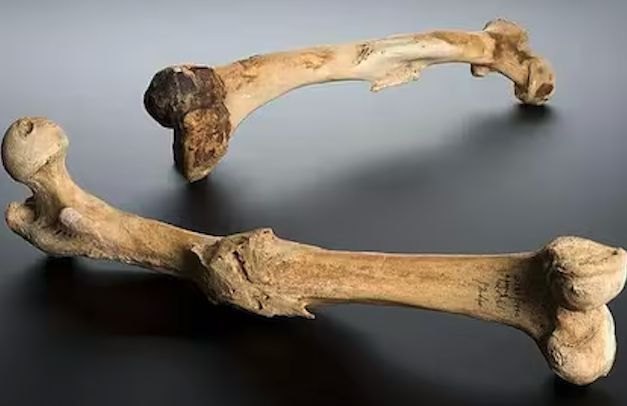
"Hace años, un estudiante le preguntó a la antropóloga Margaret Mead cuál consideraba ella que era el primer signo de civilización en una cultura. El estudiante esperaba que Mead hablara de anzuelos, ollas de barro o piedras de moler.
Pero no. Mead dijo que el primer signo de civilización en una cultura antigua era un fémur que se había roto y luego sanado. Mead explicó que en el reino animal, si te rompes una pierna, mueres. No puedes huir del peligro, ir al río a tomar algo o buscar comida. Eres carne de bestias que merodean. Ningún animal sobrevive a una pierna rota el tiempo suficiente para que el hueso sane.
Un fémur roto que se ha curado es evidencia de que alguien se ha tomado el tiempo para quedarse con el que se cayó, ha vendado la herida, le ha llevado a un lugar seguro y le ha ayudado a recuperarse. Mead dijo que ayudar a alguien más en las dificultades es el punto donde comienza la civilización". (Ira Byock)
En trading, no siempre el mayor riesgo es el mercado.
A veces el mayor riesgo es creer que ya lo entendiste todo.
En este artículo Dru Lozano nos explica qué es el efecto Dunning-Kruger y por qué puede frenar el crecimiento de un trader.
https://t.co/lszgIPMwc1
Warren Buffett: "My dad was always very forgiving of my misbehavior. He'd just say, 'I know you can do better.' That was very powerful stuff — because I could do better. I knew it and he knew it. It's nice to have somebody have faith in you."
Siguen circulando Videos falsos de Arturo Calle @Arturo_Calle buscando estafar a los Colombianos @YouTube debe hacer algo con esos tipos de anuncios.
Prometen pagos de 2.000.000 por día .
Esto es hecho con IA.
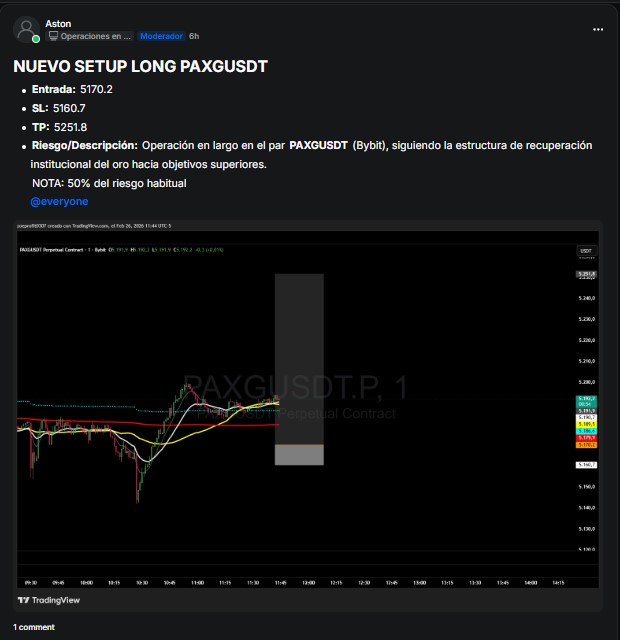
Hoy, en nuestra Sala de Criptos y CFDs, analizamos el oro con el profe Aston y planteamos dos escenarios:
🪙 $PAXGUSDT (cripto) y 🟡 $XAUUSD (CFDs).
Mismo activo, ejecuciones distintas según la activación.
Bybit’s Daily Treasure Hunt rewards your daily trading and engagement with real prizes.
Trade with as little as 10 $USDT, complete simple tasks, earn points every day, and unlock exciting rewards along the way.
#Bybit#CryptoArk
“I hope I've demonstrated that you can face anything, you can face the end of your days, you can face hell with dignity. Fight, girls, and hold your heads high. Billie and Georgia, you are my heart, you are my everything. Goodnight. I love you.
Eric Dane leaves his daughters — and the world — with one final message in Famous Last Words.
Las caídas son inevitables. El pánico, opcional.
Te compartimos un marco práctico para evaluar caídas: causas, fundamentos, horizonte y gestión del riesgo.
Artículo completo: https://t.co/gjCp6lkEK1
¿Vela verde = compras? No siempre.
El delta del volumen te muestra la presión real detrás de cada vela (Ask vs Bid): confirma tendencias, revela divergencias y mejora la lectura en rupturas.
Artículo: https://t.co/FPbsnqdlXi
No permitas que el comentario, la actitud o el comportamiento de otras personas te afecte tanto que te lleve a actuar de la misma manera que ellos. Toma unos segundos antes de reaccionar para pensar en la mejor manera de responder, a veces es preferible no hacerlo.