When's the last time your outbound strategy actually moved your pipeline?
You're still paying for conference booth space, buying contact lists, running spray-and-pray email blasts, relying solely on referrals and calling it a "strategy."
And the ROI on that is a team that's burned out and a CRM full of dead contacts.
It's not 2009 anymore. Your competitors stopped grinding for leads a long time ago.
Instead, they've got systems pulling in qualified leads around the clock without the hustle.
Time to catch up.
I've watched founders physically cringe while reading their own copy to me on Zoom.
One laughed, stopped mid-sentence, and said "I would never talk about my product like this."
He was right. It was also the first thing every buyer saw.
The pattern in B2B SaaS homepages that don't convert:
→ "Own the edge"
→ "Industry-leading, next-generation"
→ "Empowering innovation"
→ "The future of [category]"
Sentences you'd never say at dinner are sitting on the page that decides whether buyers book a call. And buyers can smell it. Two seconds in, their brain files your homepage under "marketing" (which is a synonym for "ignore.")
The fix takes 45 seconds. Pretend you're leaving a voicemail for a warm prospect. Twenty seconds. Tell them what your company does, who it's for, and why they should call you back.
That voicemail is your homepage. Everything else is the reason your pipeline is dry.
Here's @atgarone on the rule that fixes 90% of bad B2B website copy 👇
We covered the full breakdown in this week's video:
→ The three ways a product website quietly becomes a museum
→ The four questions your homepage has to answer above the fold
→ The "second site" move we use to unstick dry pipelines without rebuilding the main site
https://t.co/yB01FELDmv
"Don't look at our website."
I hear this on sales calls every week from founders at companies I genuinely respect.
What's actually happening when a founder says it:
→ Product team shipped v4.0
→ Sales is pitching v4.5 on live calls
→ Website is still describing v2.3
→ Case studies are from a buyer ICP you abandoned 18 months ago
Founders try to solve this with new channels, new SDR playbooks, $50K brand refreshes.
But none of it moves the number.
The homepage is still a memorial to a product you stopped selling.
The fix is a second site.
One clean page with one sharp explanation of what you actually ship today and real proof, then a CTA that doesn't need a human to translate it.
It lives next to the museum, not inside the political mess of rebuilding it.
Ship it in two weeks.
Route warm leads to it.
Watch your AEs stop wasting the first 15 minutes of every call re-explaining the product.
Every week it stays up, another deal walks because the site couldn't speak for you.
Your sales team doesn't understand what they're selling.
(And no, another training session won't fix it.)
The problem isn't your reps. It's that you've never given them the one internal asset that actually matters:
a sales playbook.
Without it, here's what's happening on every single call:
❌ Reps wing it when buyers ask technical questions
❌ They can't handle objections consistently
❌ Every deal becomes a "let me loop in someone else" nightmare
❌ Your competitor closes while you're scheduling another meeting
A real sales playbook gives your team:
✅ Core messaging that actually resonates
✅ Objection responses they can use confidently
✅ Proof points that build trust
✅ A consistent way to guide buyers from first touch to close
Sure, having all the other sales assets is nice...
But those case studies, one-pagers, and blog posts mean nothing if your reps don't even know how to use them.
So don't leave them hanging!
Your leads don't owe you anything.
But you? You owe them everything.
That form fill? It was just curiosity, not commitment.
They downloaded a PDF to skim during lunch. Clicked around your site to prep for tomorrow's meeting. Maybe bookmarked a blog post to sound smart when their boss asks about solutions.
None of this screams "ready to buy."
Yet here you are, unleashing the BDR army the second someone drops an email address.
No wonder they ghost you.
Your leads are 80% through their buying journey before they'll even talk to sales. And if you weren't helping them through that 80%? You're just another vendor in the "ignore" pile.
So stop asking what your leads can do for your pipeline, and start asking what your content can do for their problem:
✅ Give them language to advocate internally
✅ Make them look brilliant to their boss
✅ Answer the questions they're Googling at 10pm
✅ Build trust before you ever get on a call
Because the companies that help buyers win are the ones that actually close deals.
Your prospect just spent 2 hours in your docs at 11 PM on a Saturday.
They're not taking your sales call on Monday. They already decided.
If your getting started guide takes 47 steps, you lost.
If your API reference is auto-generated garbage, you lost.
If searching your docs returns nothing useful, you lost.
The sale happened in your documentation. Your sales team just doesn't know it yet.
If you need help producing content that'll becomes your best closer, we have an entire B2B sales content playlist just for you:
https://t.co/ItL1b3amcm
Content IS the new sales call.
While you're sleeping, your best content is out there closing deals for you.
Your buyers aren't waiting for your next demo slot. They're researching at 11 PM, comparing solutions during lunch breaks, and building internal cases while you're offline.
If your content can't handle objections, explain ROI, and walk them through implementation without you being there...
...you're missing 90% of your opportunities.
Smart B2B companies know this. They create content that works harder than their sales team:
✅ Case studies that handle the "will this work for us?" question
✅ ROI calculators that build the business case
✅ Security docs that eliminate IT roadblocks
✅ Implementation guides that remove fear of complexity
Result? Prospects show up to sales calls already convinced.
This is exactly why we help B2B tech companies build messaging that speaks directly to technical decision-makers.
Content that lands in Slack threads, not spam folders.
If you need help with this, get in touch!
https://t.co/1MIRvWgh7c
Executive lead generation costs are out of control.
The industry average? $300 per lead.
And for marketing teams everywhere, that feels normal. Expected, even.
But one of our client campaigns shattered that assumption.
The result: Executive leads for $65 each.
It's the same quality decision-makers with the same buying intent and same enterprise budgets...
Just a completely different approach.
While agencies blast executives with generic LinkedIn ads and spray-and-pray email campaigns, we did something different:
We created content that actually respects executive intelligence.
✅ Technical depth that shows we understand their stack
✅ Strategic insights they can't find in typical marketing content
✅ Real solutions to problems they deal with daily
The executives didn't feel marketed to. They felt understood.
The difference? Content that positions your company as an obvious choice, not another vendor fighting for attention.
Ready to stop letting competitors steal deals because your reps don't know how to handle objections?
We walk through the entire competitive enablement playbook here:
https://t.co/iBKZKbMOyi
Your competitive analysis is collecting dust in a folder somewhere.
Meanwhile, your sales team is winging it on every competitive deal.
Every other company treats competitive analysis like a yearly board deck exercise: throw some logos on slides, cherry-pick a few Gartner quotes, and call it done.
But here's what actually works:
✅ Living, breathing sales enablement that your reps can actually use
✅ Written context explaining why features matter to different buyers
✅ Pivot strategies for when you're missing a checkbox
✅ Cross-team intelligence that marketing, product, and leadership can act on
Because competitive analysis shouldn't be just a pretty chart with checkmarks and X's.
It's a closing tool that works like magic when done right.
Your technical buyers deserve better than reps who go silent when they ask, "How do you compare to [competitor]?"
So it's time to turn that dusty document into deal-winning ammunition.
Your case studies are likely putting prospects to sleep.
"Company X had a problem. They bought our solution. Now they're 37% more efficient."
Congrats, you just created the business equivalent of Ambien. 😂
Think about it. When your prospects read formulaic lines like those, all they're gonna think is "good for them" instead of "holy crap, that could be me!"
The difference? Story structure.
❌ Wikipedia entry: "Client improved efficiency by 37%"
✅ Transformation story: "How [Client] went from working weekends to closing deals on autopilot"
When you lead with the customer's struggle, paint the journey, and show the transformation...
...your prospect doesn't just read your case study––they see themselves as the hero.
That's when "cool story, bro" becomes "I need to call these people immediately!"
Your sales team is showing up to competitive deals like they're bringing a knife to a gunfight.
And that's a massive problem, because this competitive analysis happens at the most critical moment: right before your prospect makes their final decision.
While your reps are scrambling mid-call, asking "So...what other tools are you considering?" and frantically Slacking for intel...
...your competitor has been in the deal for weeks, spoon-feeding the prospect their positioning.
The result? You're losing six-figure deals you should have won.
Here's what changes everything:
✅ Get ahead of the conversation. Don't wait for them to bring up competitors
✅ Lead with your strengths. Guide discussions to where you excel
✅ Be objective and honest. Prospects spot BS immediately
Always remember that competitive analysis isn't about trashing the competition (that's kinda disrespectful to the prospect anyways...)
It's about controlling the narrative before someone else does it for you.
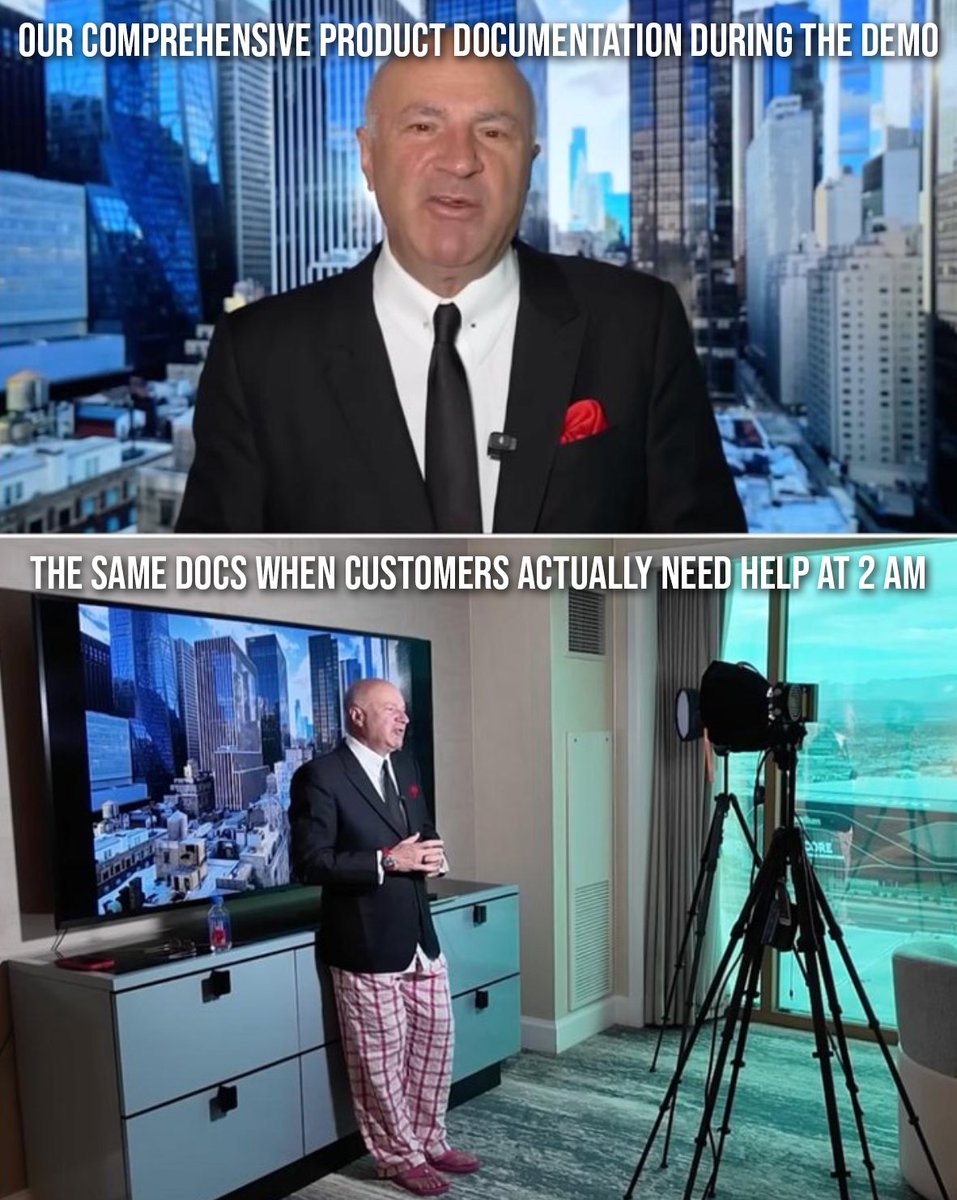
If your docs haven't been updated since 2022, that "seamless post-sale experience" you're pitching is actually a customer retention nightmare waiting to happen.
Nobody renews when they can't figure out how to use what they bought.
(Please. Fix your product docs, folks.)






![EdifyContent's tweet photo. Your case studies are likely putting prospects to sleep.
"Company X had a problem. They bought our solution. Now they're 37% more efficient."
Congrats, you just created the business equivalent of Ambien. 😂
Think about it. When your prospects read formulaic lines like those, all they're gonna think is "good for them" instead of "holy crap, that could be me!"
The difference? Story structure.
❌ Wikipedia entry: "Client improved efficiency by 37%"
✅ Transformation story: "How [Client] went from working weekends to closing deals on autopilot"
When you lead with the customer's struggle, paint the journey, and show the transformation...
...your prospect doesn't just read your case study––they see themselves as the hero.
That's when "cool story, bro" becomes "I need to call these people immediately!"](https://pbs.twimg.com/media/G1iz6lcWAAAXdZS.jpg)