When someone tells me they've earned rewards from a new platform, I usually want to know a little more.
What device did they use? How long was it active? And what did the actual contribution look like?
These are useful questions to ask when exploring @Acurast
The network allows compatible smartphones to participate as Processors, providing computing resources for applications running across its infrastructure.
But the experience can vary depending on the device and its activity.
For anyone testing Acurast, I'd pay attention to four details:
• The phone model being used.
• Whether the setup is Processor Lite or Processor Core.
• How long the device stays online.
• The amount of ACU earned during that session.
It's also worth checking whether the device missed any periodic check-ins, since uptime is part of how the network tracks participation.
I'd rather see people share actual results with enough context to understand them than throw around reward figures without explaining how they were achieved.
If you're curious about testing it yourself, join through my invite https://t.co/jKqm9fgDx4
install Processor Lite and connect your phone to the Hub.
Start with a session, check your device status and see how your own contribution develops. Rewards will depend on your device and participation.
@Akanimo_dx The flight example just proves we need better data feeds and oracles, not AI "fairness." AI reasoning is just statistical guesswork we need better code parameters, not subjective contracts.
@Akanimo_dx Cool concept, but 'trustless adjudication' via LLMs isn't actually trustless. You're just shifting the trust from third-party oracles to the underlying AI model providers. How is that safer
@Akanimo_dx Sub-second proofs at $0.0001 look great now, but what happens during a black swan market spike? Traditional finance can't tolerate settlement delays if proof generation lags under heavy load.
@Akanimo_dx Rally just removed the gatekeep Every creator grinding right now needs to check this out. No more begging big accounts for collabs. Real equity era loading!"
The era of buying JPEGs based on pure speculation is over.
Sustainable value requires real protocol integration, and the upcoming Wingston NFT Collection by @RallyOnChain is proving exactly how to do it.
This drop brings NFTs back to what actually matters: pairing top tier art and a strong community with heavy protocol utility. This is a true product NFT, tied directly to a protocol with a real business model and recurring revenue. Holding one means you have a valuable stake in the ecosystem.
The barrier to entry is gone because it is a completely free mint.
Instead of sitting idle, these assets give you immediate leverage on the platform:
Daily Staking: Earn RLPs every single day.
Reputation Boost: Automatically amplify your Rally Score, which directly drives your creator rewards and platform access.
VIP Community Access: Enter a private, token gated space built for exclusive, higher-reward campaigns.
Securing a whitelist spot isn't a raffle or a luck based giveaway. You have to earn it. Here is your step by step playbook to get on the WL:
1. Join 3 Rally campaigns and submit your content.
2. Secure a position in the Top 425 on the weekly leaderboard.
3. Follow @RallyOnChain right here on X.
You can monitor your progress and check the requirements at https://t.co/uaLN9EKRTX
Are product NFTs backed by sustainable protocol revenue the clear path forward for SocialFi, or do you still see a market for pure speculation? Let me know your thoughts below.
I was talking to a founder yesterday who spent nearly three months restructuring their entire architecture just to integrate smart accounts, passkeys, and gasless sponsorship.
The engineering space treats Account Abstraction like this holy grail that will magically solve the user acquisition crisis. It is a total illusion.
Streamlining onboarding friction does absolutely nothing if the core value proposition of your protocol is boring or uninspired. If a user needs a twenty minute technical lecture to understand why they should care about your app, a smoother one click wallet creation flow will not save your project from dropping to zero daily active users.
Infrastructure optimizations are great, but they are not a substitute for building a product people actually want to open every morning. Platforms like @RallyOnChain are proving that real distribution is driven by clear utility and community alignment, not over engineered wallet onboarding.
Think about it: Web2 users download apps with terrible UX every single day because the underlying utility is irreplaceable. If fixing your wallet setup is your entire growth strategy, is the friction really the problem, or is your core product just fundamentally uninteresting?
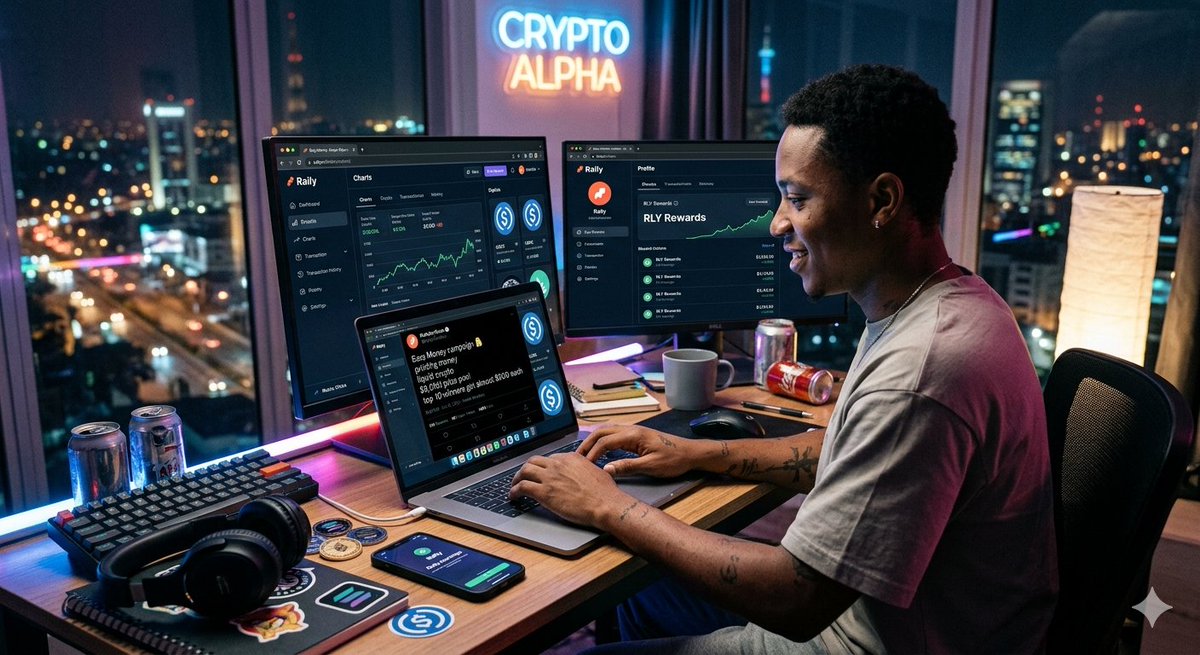
I spent all of yesterday scrolling through a dead timeline full of engagement farming, only to realize some of you are quietly printing money under my nose.
Web3 creators are literally earning liquid crypto and stable coins almost every single week right now just by posting on @RallyOnChain.
It feels like early stage SocialFi all over again but the windows move fast. This post is my official entry into their Easy Money campaign. There is a $5,000 prize pool on the line and the top 10 winners get almost $500 each.
If you are tired of tweeting for free, you need to get in on this right now before everyone else wakes up to it. Drop a reply if you want the setup guide sent over.
Stop wasting your time playing the algorithmic lottery with Web3 bounty campaigns.
Most creators drop a post, pray for engagement, and get absolutely nothing because a middleman or a follower count requirement cuts them out. I used to do the exact same thing until I tapped into @RallyOnChain.
What completely changed the game for me is the pure transparency. You choose a campaign, submit your content, and an AI evaluates your work on merit alone. No bias, no guessing games, and no need for a massive following to get noticed.
Right now, there is a $5,000 prize pool up for grabs, with the top 10 contributors looking at roughly $500 each. While everyone else on your timeline is fighting over saturated, crowded drops, this platform is quietly paying people periodically just for putting out high quality content.
Opportunities this early don't stay under the radar for long. If you’re a researcher, writer, or Web3 creator who is already spending hours on X, you need to leverage this before the masses find out.
Comment LINK below and I’ll send you the exact blueprint to get started but only while the $5k pool is still live.
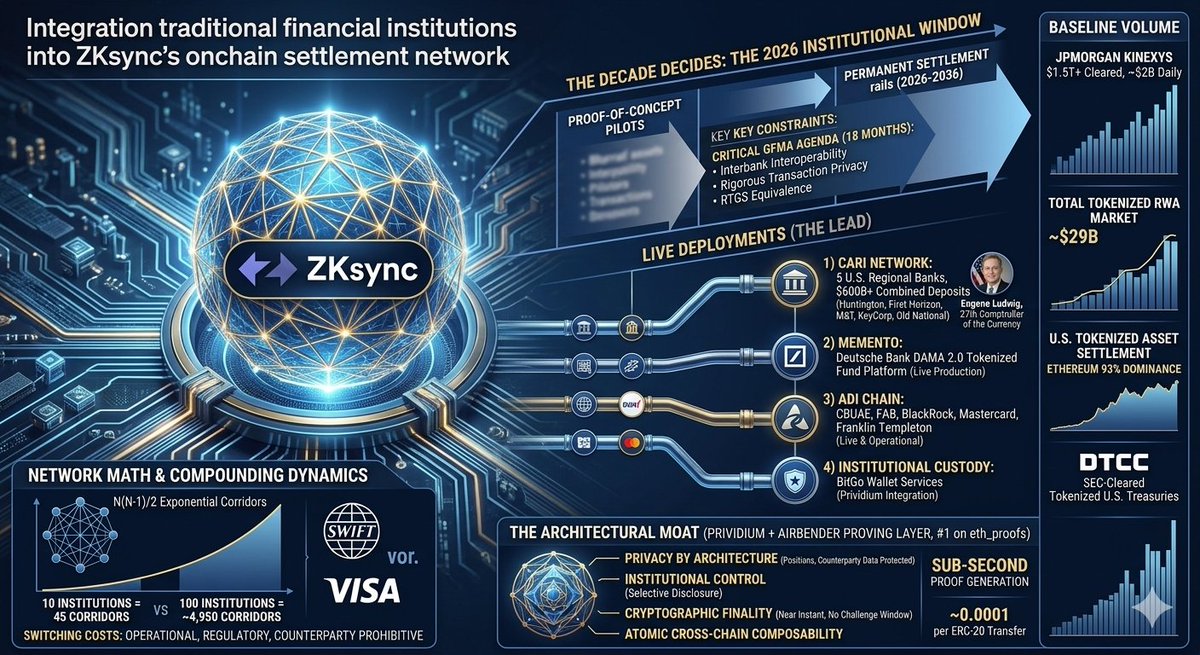
In the architecture of global financial markets, settlement systems rarely experience fragmented competition for long. As historical precedents like SWIFT and Visa demonstrate, infrastructure layers rapidly consolidate into a winner take most equilibrium. This is driven by geometric network effects: when $N$ institutions integrate into a shared network, the available settlement pathways expand according to the single line formula $N(N-1)/2$. While 10 initial participants establish 45 distinct counterparty corridors, a network scaling to 100 participants generates nearly 4,950 connections.
In 2026, this network math is driving the definitive institutional selection phase for onchain rails. The scale of current market velocity underscores the permanence of this shift: JPMorgan's Kinexys platform now clears over $1.5$ trillion on blockchain rails, averaging $2$ billion in daily volume. Simultaneously, the DTCC is advancing SEC-cleared tokenization of U.S. Treasuries, the NYSE is constructing tokenized securities rails with BNY and Citi, and the global tokenized real world asset (RWA) market is rapidly approaching $29$ billion with 93% of U.S. tokenized assets settling natively on Ethereum.
As catalogued in the April 2026 GFMA report, the technical window to resolve core operational gaps specifically interbank tokenized deposit interoperability, transaction privacy, and Real Time Gross Settlement (RTGS) equivalence is concentrated into the next 18 months. Once these structural decisions are integrated into a bank's internal compliance, risk management, and clearing workflows, the barrier to exit ceases to be a technical variable. Migration becomes operationally, regulatory, and counterparty prohibitive. You settle where your counterparties settle.
This structural lock in highlights the asymmetrical lead currently held by @zksync, which has bypassed theoretical frameworks to achieve live production deployments with regulated entities:
The Cari Network: Active onboarding of five U.S. regional banks (Huntington Bancshares, First Horizon, M&T Bank, KeyCorp, and Old National Bancorp) representing over $600$ billion in combined deposits, established by Eugene Ludwig, the 27th U.S. Comptroller of the Currency.
Memento: Driving the live, production execution of Deutsche Bank’s DAMA 2.0 tokenized fund platform.
ADI Chain: Live and operational with First Abu Dhabi Bank, the Central Bank of the UAE, BlackRock, Mastercard, and Franklin Templeton.
Institutional Custody: Direct enterprise wallet and custody integration via BitGo and Prividium.
With a pipeline exceeding 30 additional central banks, sovereign issuers, and global custodians, the gravitational pull of this network is actively compounding.
The primary constraint for institutional capital has always been privacy; a regulated entity cannot utilize shared rails that expose asset positions, transactional strategies, or counterparty identities. By coupling Prividium with the Airbender proving layer (currently ranked 1 on eth proofs), @zksync addresses this fundamental constraint through an integrated stack delivering four concurrent properties: Privacy by architecture (private execution environments where only zero knowledge proofs hit the base layer), strict institutional control with role based permissioning, immediate cryptographic finality without optimistic dispute windows, and native atomic cross chain composability.
Operating with sub second proof generation and a transactional cost of approximately $0.0001 per ERC-20 transfer on production stacks, the network matches the economic and speed requirements of institutional treasuries. The 2026 window is open, but because financial infrastructure calcifies rapidly, the rails selected today will govern the next decade of digital settlement.
The ongoing convergence of traditional capital markets and onchain systems is fundamentally changing the nature of financial counterparty risk.
This is no longer a localized testing phase. In 2026, the global financial matrix is actively deciding which permanent infrastructure will anchor institutional settlement for the next ten years.
The baseline volume proves the urgency. JPMorgan’s Kinexys platform has cleared more than $1.5 trillion on blockchain rails, sustaining roughly $2 billion in daily transaction volume. Meanwhile, the DTCC is modernizing the backbone of global liquidity with SEC cleared tokenized U.S. Treasuries, the NYSE is building out tokenized securities rails with BNY and Citi, and the total tokenized real-world asset (RWA) market is rapidly closing in on $29 billion. This institutional activity is converging heavily on a singular base layer: 93% of U.S. tokenized assets currently settle on Ethereum.
According to the April 2026 GFMA report, the structural agenda for the next 18 months must permanently resolve the final friction points of institutional finance: true interbank interoperability for tokenized deposits, rigorous transaction privacy standards, and settlement mechanics that match or exceed Real-Time Gross Settlement (RTGS) systems.
Once these parameters are integrated into a bank’s core compliance and accounting systems, the switching costs cease to be a simple software preference. Migrating off an established settlement rail becomes operationally, regulatory, and counterparty prohibitive. Networks inherently reward early consolidation. Because the possible settlement corridors among N participating institutions grow exponentially based on the formula N(N-1)/2, a network of 10 institutions yields 45 corridors, while 100 institutions create nearly 4,950.This network math highlights why the first-mover advantage held by @zksync is transforming into a long-term settlement standard. ZKsync is already integrated into the production architecture of highly regulated, tier 1 institutions:
➟The Cari Network: Onboarding five major U.S. regional institutions (Huntington Bancshares, First Horizon, M&T Bank, KeyCorp, and Old National Bancorp) managing $600 billion+ in combined deposits, founded by the 27th U.S. Comptroller of the Currency, Eugene Ludwig.
➟ Memento: Driving the live production environment for Deutsche Bank’s DAMA 2.0 tokenized fund platform.
➟ ADI Chain: Live and operational with First Abu Dhabi Bank, the Central Bank of the UAE, BlackRock, Mastercard, and Franklin Templeton.
➟ Institutional Custody: Direct integration with BitGo wallet services via Prividium
With over 30 additional central banks, global custodians, and sovereign currency issuers in the active deployment pipeline, the structural gravity of the network is compounding.
The primary barrier to public ledger adoption has always been privacy; no regulated bank can expose its proprietary positions, client data, or trading strategies to a public network. By combining Prividium with the Airbender proving layer currently ranked 1 on eth proofs, @zksync resolves this tension via an integrated stack that delivers four non negotiable properties simultaneously: Privacy by architecture (private execution environments where only cryptographic proofs hit Ethereum), strict institutional control, near instant cryptographic finality without multi day optimistic dispute windows, and native atomic cross chain composability.
Operating at sub second proof generation speeds and a production cost of approximately $0.0001 per ERC-20 transfer, the platform delivers the exact efficiency required by modern sovereign and commercial treasuries. The 2026 window will not stay open long, and the network effects calcifying right now are defining the settlement rails of the decade.
My father was a quiet data analyst for the federal government.
Every night, he stared at endless cryptographic code.
We thought he was just a bored bureaucrat.
Then the order for the Bitcoin Reserve was signed by the president
The White House showed the multi billion dollar wallet live.
I looked up the ledger on @RallyOnChain.
The incoming transfer logs listed a single source ID.
It was my dad's employee network.
He wasn't counting down to retirement.
He was building the vault.
My Grandfather spent decades filling notebooks with what he called ancient 'seed phrases for future treasure. We always thought he was delusional. Tonight, using @RallyOnChain's legacy tool, I input one of his handwritten phrases from 1982. It unlocked a wallet with 1,000 pristine BTC.
We spent a decade building trustless infrastructure just to realize that the hardest part of crypto isn't the code, it's finding people actually worth trusting. The technology works flawlessly, but human coordination is still broken. That's the real puzzle @RallyOnChain.
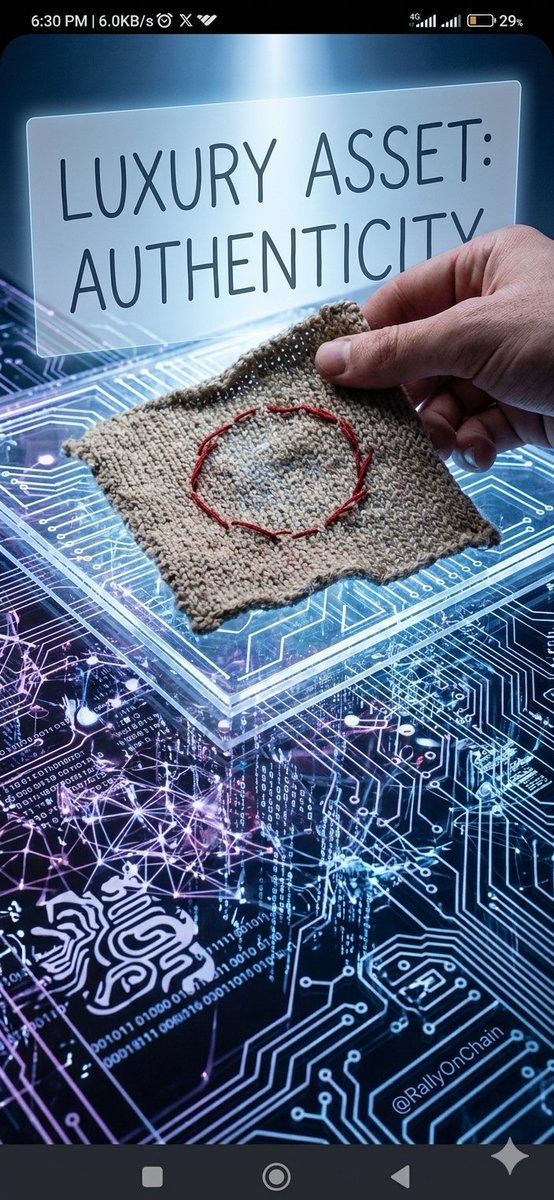
In a few years, the internet will be so saturated with synthetic, perfectly optimized AI content that raw, messy, unedited human imperfection will become the highest-valued commodity online. Authenticity is about to become a luxury asset. Glad to share this with @RallyOnChain