I firmly believe that, talking about doing the thing, isn't doing the thing. Thinking about doing the thing, isn't doing the thing. Only been present doing the thing, is actually doing the thing.
Just as @SantiagoDevRel said it's time we implement those those plans we've made.
Most hardware wallets still rely on seed phrases.
@crossbar_inc said: what if we removed that risk completely?
No seed phrase. No single point of failure. Security built from the chip level.
I looked into how it actually works — and it’s wilder than I expected…
@Eigenwatch Honestly, I love the truth bomb! Numbers are like bikinis😅 – they show a lot but hide the juicy risk underneath . EigenWatch is the real MVPs for digging deeper. Exposure is where it's at!"
Most people choose an operator based on uptime, rewards, or reputation.
But those numbers don’t tell you the full story.
What actually matters is exposure, how much risk your operator is carrying at any given moment.
Every operator isn’t just running one service.
Most people think staking ETH just means locking coins and earning passive income.
But that’s not really what’s happening.
When you stake ETH, you’re helping run the Ethereum network itself.
Your ETH becomes part of a validator’s security deposit.
Validators are responsible for confirming transactions, proposing new blocks, and keeping the network accurate.
Instead of miners using hardware, Ethereum relies on participants putting real value at risk.
That locked ETH works as collateral.
If validators perform correctly, they earn rewards.
If they go offline or act maliciously, part of their stake can be taken away, this is called slashing.
The system is designed so that honest behavior pays, and mistakes become costly.
Every few seconds, validators are selected to verify activity on the network.
This constant process is what keeps Ethereum decentralised and secure.
But here’s the part most stakers overlook:
• You usually aren’t running the validator yourself.
• You’re trusting a staking operator to do it for you.
• That operator runs the infrastructure, manages the nodes, and handles the technical workload often across multiple services and AVSs.
When everything runs smoothly, you earn consistent rewards.
When it doesn’t, the impact shows up in your returns.
Overloaded systems, unstable performance, or poor scaling decisions can lead to missed validations, reduced rewards, or even slashing events.
And by the time traditional dashboards show a problem, the damage may already be happening.
Staking ETH isn’t just passive yield.
Your ETH is actively securing Ethereum and its safety depends heavily on the operator behind it.
Understanding what your operator is doing isn’t optional anymore.
Because when you stake, you’re not just earning rewards.
You’re taking on operator risk, whether you realise it or not.
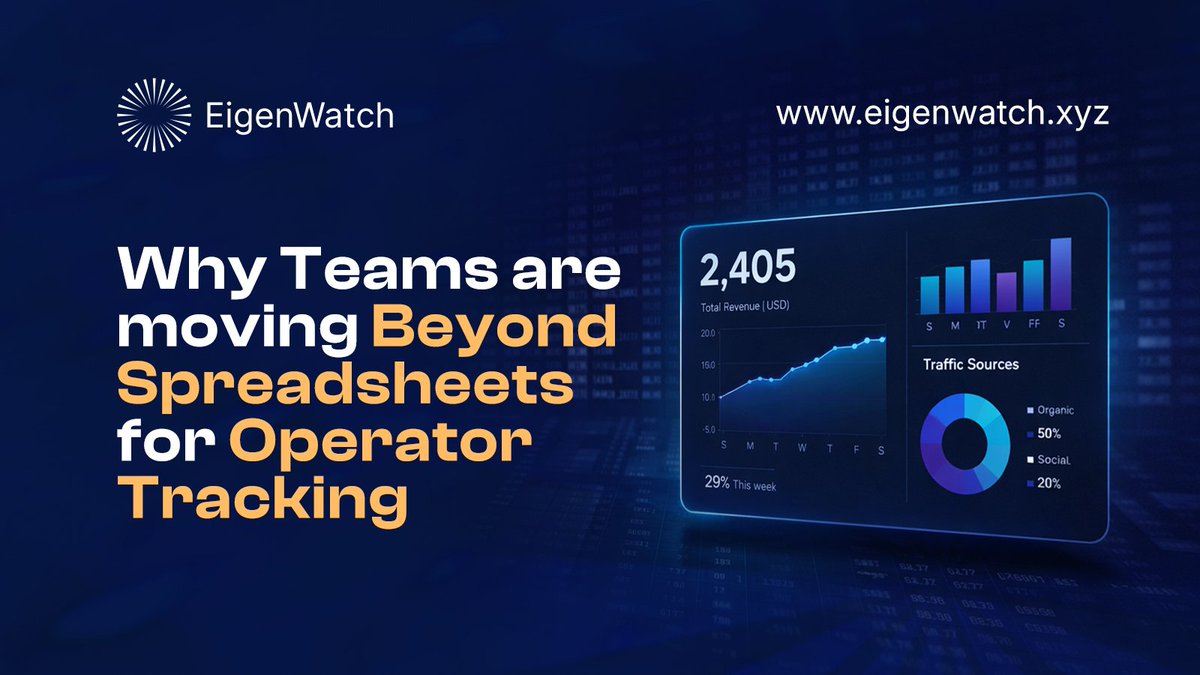
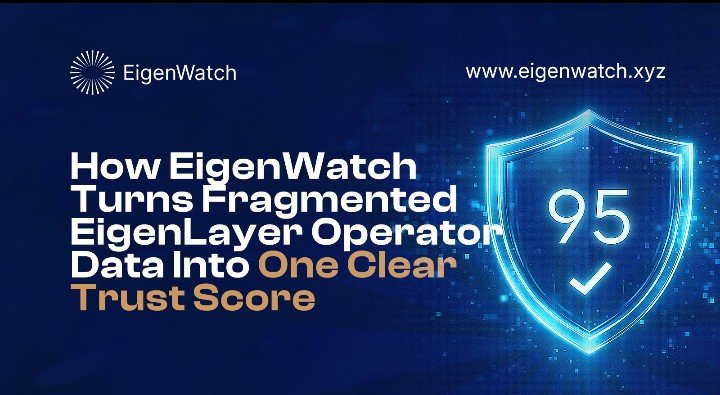
Managing operators in EigenLayer means dealing with data that lives everywhere.
Performance metrics in one subgraph.
Delegation flows in another dashboard.
On-chain events buried somewhere else.
To understand a single operator’s reliability,
Managing staking operators requires a complete view of operator performance.
But when operator data is scattered across five different tools, all you ever see are fragments.
One operator’s metrics live in a subgraph.
Another’s performance data sits in a separate dashboard.
Managing staking operators requires a complete view of operator performance.
But when operator data is scattered across five different tools,
all you ever see are fragments.
One operator’s metrics live in a subgraph.
Another’s performance data sits in a separate dashboard.
For a third, you’re parsing on-chain events manually.
To understand a single operator’s real performance, you’re forced to:
• juggle multiple tools
• align timestamps
• manually reconstruct what’s actually happening
Comparing three operators side-by-side?
The effort triples.
This isn’t just inconvenient.
It’s a real blocker to good operator decision-making.
The data exists and the signals are there.
But operator risk and performance data live in silos that don’t talk to each other.
So what do teams do?
They default to the easiest metrics to check and make decisions based on incomplete information.
Or they spend hours digging through dashboards just to answer basic questions like:
“Is this operator improving or getting worse?”
The core problem isn’t missing data.
It’s that operator monitoring isn’t organized around decisions.
That’s exactly what dedicated operator dashboards are meant to solve.
At @Eigenwatch, each operator has a unified dashboard that brings together:
• performance trends
• risk signals
• behavioral patterns
• AVS-specific context
So you see the full operator story in one place.
Just clear, consistent operator data that makes comparing operators straightforward.
Because better operator decisions come from complete visibility, not scattered signals.
Follow @Eigenwatch to see what operator dashboards should actually look like.
Choosing the right operators for your AVS is slow, frustrating, and scattered with no centralized system to rely on.
Right now, AVS teams have to guess who’s reliable, wait on approvals, and juggle confirmations.....
EigenWatch serves the full restaking stack.
Services and AVSs use it to select and monitor operators.
Operators use it to understand and reduce their exposure.
Delegators use @Eigenwatch to compare operators, track risk, and stake directly from the platform with confidence.