Today we're launching Superposition. An AI headhunter better at finding talent than any human.
We made a short film to prove it. A fictional billionaire finally admits how he built his empire.
Spoiler: it was never about him. It was about the people he surrounded himself with.
Watch it. Then come find your perfect weirdos.
1. They don't vet on the first call. They understand that the first conversation is a sales call from the company to the candidate. If you spend that call asking the candidate to justify themselves, you've wasted the one shot you had to get them excited about your company.
2. They don't spend weeks discussing candidates with their cofounder before moving them forward. That's wasted time. They treat it like a sales pipeline instead.
3. They have weirdly specific operating principles. "Decision frequency is better than decision quality." "No managers, ever, literally ever." Then they derive one killer interview question from those principles that tells them everything they need to know from that candidate.
4. They move absurdly fast. You cannot convince someone to reject a bigger company and join you. But you can get an offer before they even schedule their second round with the other company. Speed is the only axis where a small startup has an advantage over a brand name.
5. They look for people from companies nobody's heard of. If someone's resume says all the right names, everything is priced in. You're paying peak price for a known quantity. The alpha is in the person shipping interesting stuff nights and weekends at a company you've never heard of.
I've helped hundreds of founders hire their first engineer over the last 10 years.
The ones who actually close great people all do the same handful of things differently.
Here's what they all had in common:
I wouldn't have said this two years ago but my best recruiting advice for 2026 is often "don't hire anyone."
A founder came to me looking for a recruiting coordinator. Someone to manage candidate pipelines, send follow-ups, schedule interviews, keep the CRM updated. Standard.
When I was a recruiter, I would have filled it in three weeks and charged 15% of their salary.
Instead I told them to wait.
They spent a weekend building automations and realized none of that work ever needed a person in the first place.
People keep telling me the human side of recruiting will always matter. I used to say that too.
Now I'm building the thing that proves them wrong.
Founders describing the new hire they're looking for: "Smart, strong technical skills, good culture fit."
You just described 40,000 people in your area and none of them have a reason to pick you.
The founders who build absurdly good can tell you exactly why a normal person would hate working at their company. That's the job description. The weird, specific, uncomfortable truth about what your company actually is.
You find your people by knowing precisely and painfully who you are and what you're building.
If your founding engineer would be equally successful at every other startup, you hired the wrong person.
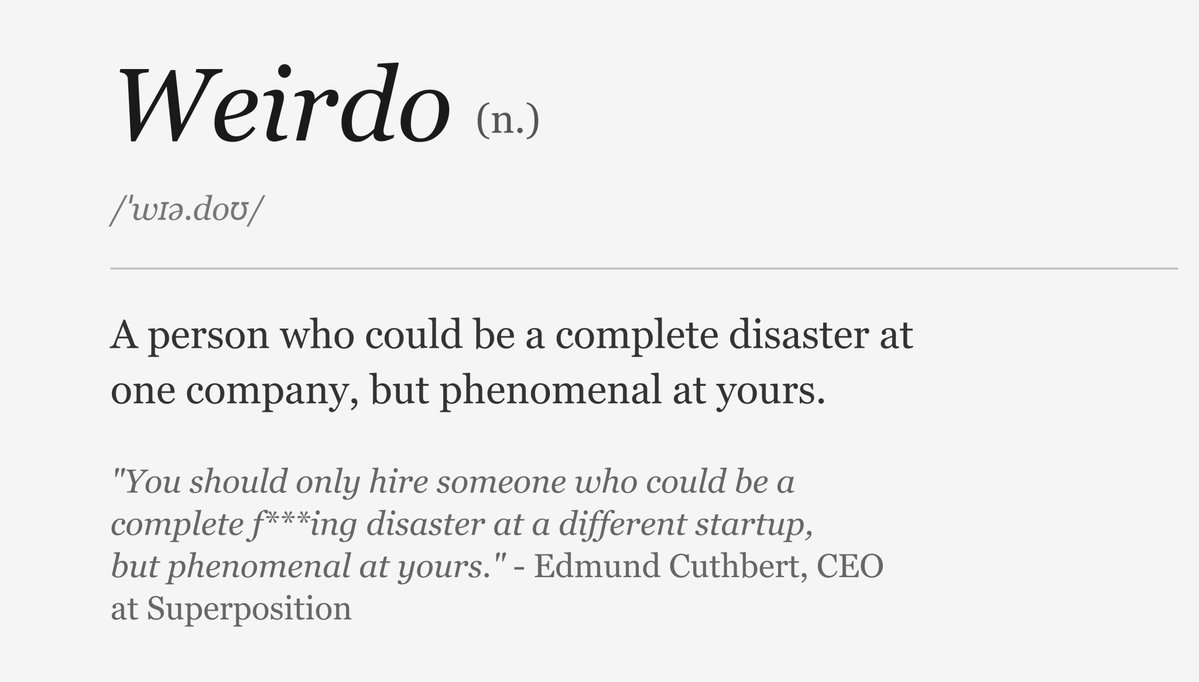
Your best hire should be someone who'd be a total misfit anywhere else but phenomenal at yours. That's the whole point.
Recruiters suck at finding them. They bundle you with 5 other companies and run one generic LinkedIn search.
They're incentivized to fill roles, not to find your perfect hire.
That's why we built Superposition. An AI agent that actually does the search a great recruiter should do but never will.
Hire a weirdo.
I refuse to learn a new web UI for a simple task.
Every tool you use should live inside wherever you already spend your day building.
That's what we built at Superposition, a bidirectional MCP server. Our recruiting agent talks to your agent, your agent talks back. You don't need to switch to our platform.
That's what everyone will build.
"I haven't heard of the startup he worked at."
That's exactly why you should interview him. By the time you've heard of every company on someone's resume, you can't afford them.
We ripped out our entire sub-agent architecture 10 months ago.
One monolithic agent with skills in one context window outperforms a swarm of sub-agents every single time. Sub-agents were a workaround for small context windows. We don't need that anymore.
Most agent prompts read like a corporate HR manual. That's why most agents have the personality of a hotel lobby. Build agents like you'd direct actors. Give them a character, not a checklist.
If someone at a late stage pre-IPO company is willing to leave and take a massive pay cut to be your founding engineer, ask yourself why.
The grittiest people at those companies are leaving to become founders, not employee #3 at yours.
100+ RSVPs for the Superposition film premiere in NYC at @betaworkstudios.
Most startups launch with a product demo and a blog post. We launched with a short film, a party, and a character people can't stop talking about.
He's already the best spokesperson we've ever had.
Link to the short film in the comments👇
Making a film is a bizarre experience of ups and downs, lefts and rights, as you carve out the vision and find the right form factor to share it with the world. I loved living in Roger’s world, proud of this film I wrote and directed for Superposition.
Today we're launching Superposition. An AI headhunter better at finding talent than any human.
We made a short film to prove it. A fictional billionaire finally admits how he built his empire.
Spoiler: it was never about him. It was about the people he surrounded himself with.
Watch it. Then come find your perfect weirdos.