Websites should do more than look good.
I help businesses launch conversion-ready websites through Siteworks, then find what is costing sales through Conversion Works.
Website cost: https://t.co/OHWit3bnJK
Product-page audit: https://t.co/ulFUVehOTr
An AI Worker should not be a vague substitute for a role.
It fits alongside an existing team when it owns a defined part of a recurring workflow—and stops where a person must use judgment, make a consequential decision, or own the outcome.
That is a more useful starting point than asking which job can be replaced.
The question I would ask is: which part of the route can the Worker carry without making responsibility harder to see?
Before it touches an inbox, CRM, project tool, or shared drive, map the interface:
• What reliably starts the work?
• What approved context can it use?
• What output is it allowed to produce or update?
• What may it do without a person?
• What makes it stop, ask, or escalate?
• Who owns the decision and the outcome?
Then make the handoff visible in four lanes.
Carry: move stable, low-impact recurring work under approved rules.
Prepare: assemble the background, queue, or draft that makes a person’s decision easier.
Recommend: surface a proposed next step, with a named person who can approve, change, reject, or route it.
Escalate: pause when the case is incomplete, novel, sensitive, contradictory, out of scope, or likely to create a high-impact outcome.
That last lane is not a failure mode. It is part of the Worker’s job.
This is also why approval cannot be a ceremony. A meaningful approval gives the reviewer relevant context, actual authority, and a choice that changes what the Worker does next. If the person just sees an alert without the facts, the system has handed the investigation back to the team.
The evidence argues for being this specific. In a preregistered experiment with knowledge workers, AI improved performance on selected tasks but correctness declined on a task deliberately placed outside its capability frontier:
https://t.co/rNOVLZWsFF
A systematic review and meta-analysis found that human-AI systems did not automatically outperform the stronger human or AI option:
https://t.co/h4BQoJzKoU
Neither finding says an AI Worker cannot help a team. They say a capability demo is not proof of workflow fit.
The unit of analysis is the handoff, not the job title. The ILO’s 2025 update makes a related distinction: many jobs have task exposure to generative AI, while continued human input makes transformation more likely than redundancy for most jobs:
https://t.co/Wdi6jIlRsH
So begin with one recurring handoff. Capture the baseline. Review quality, rework, exceptions, approval outcomes, and whether the handoff is actually useful. Expand only when the evidence earns it.
An AI Worker belongs beside the team when its boundaries, handoffs, and human ownership are all visible.
Full Note:
https://t.co/ByIr8E0bRk
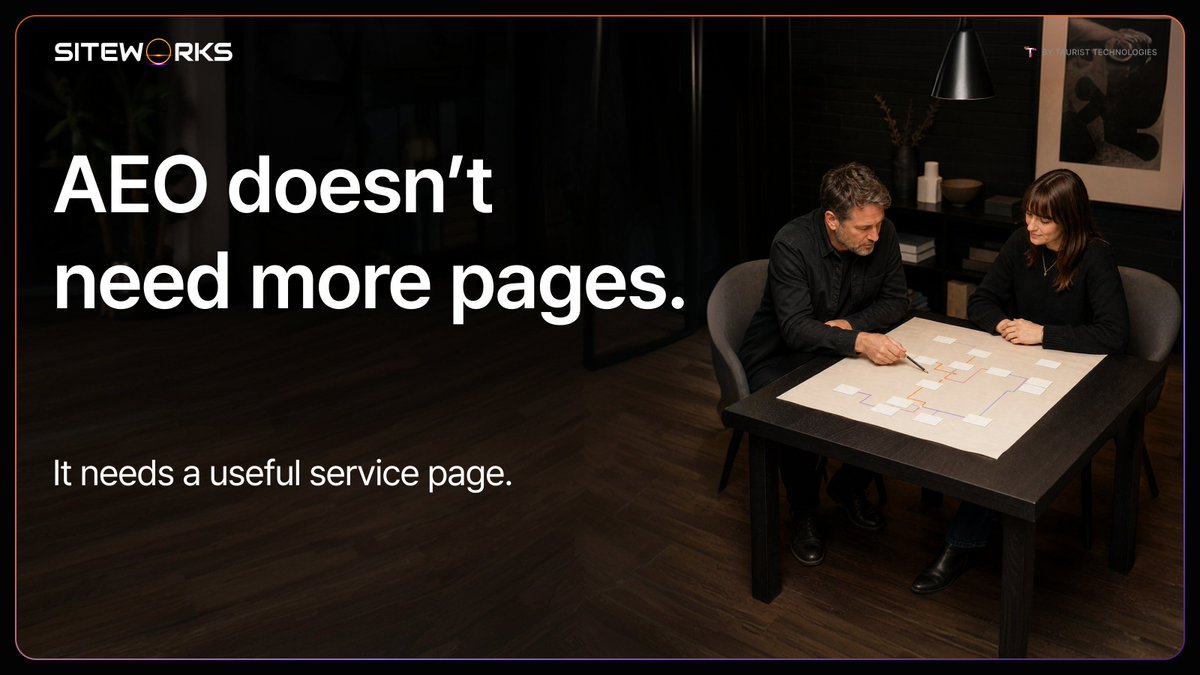
AI search has made page inventory look strategic.
A query fan-out can turn one service into dozens of page ideas: every phrase, audience label, city, FAQ, and comparison.
I would not turn that list into a publishing calendar.
The practical question is simpler:
Does a buyer need a materially different answer?
If the offer, proof, scope, process, and next step are essentially the same, strengthen the core service page before creating another variation page.
Google’s guidance is unusually direct: creating content for every possible query variation primarily to manipulate rankings or AI responses is ineffective, and high page quantity alone does not make a site more relevant or higher quality.
https://t.co/nXIWnczpYG
This does not mean “never create a new page.”
A distinct service, a genuinely different audience need, a real local offering, different proof, or a different next action may deserve its own page.
But close variants and related buyer questions often belong in clear sections of one useful service page.
That page should help someone understand:
• what the service is and whether it fits
• the likely outcome, scope, process, and constraints
• the proof behind the promise
• the next step
That is a buyer decision-support test—not a platform scoring formula.
Technical clarity still matters. Crawlability, visible text, internal links, and accurate structured data support access and understanding. They do not guarantee indexing, ranking, citations, or inclusion.
https://t.co/luVraO6GT5
Build decision coverage, not URL inventory.
Full Note:
https://t.co/9VklWuQkKv
A website can be technically complete and still make a strong business look interchangeable.
At a recent event, I saw a lot of small-business sites that had clearly been built fast.
They loaded. They had the hero, service section, CTA, and contact form.
But many gave the same impression: the business had chosen a website before deciding what it needed to say, prove, or make easy.
That is not an argument against AI builders.
It is an argument against confusing faster production with finished judgment.
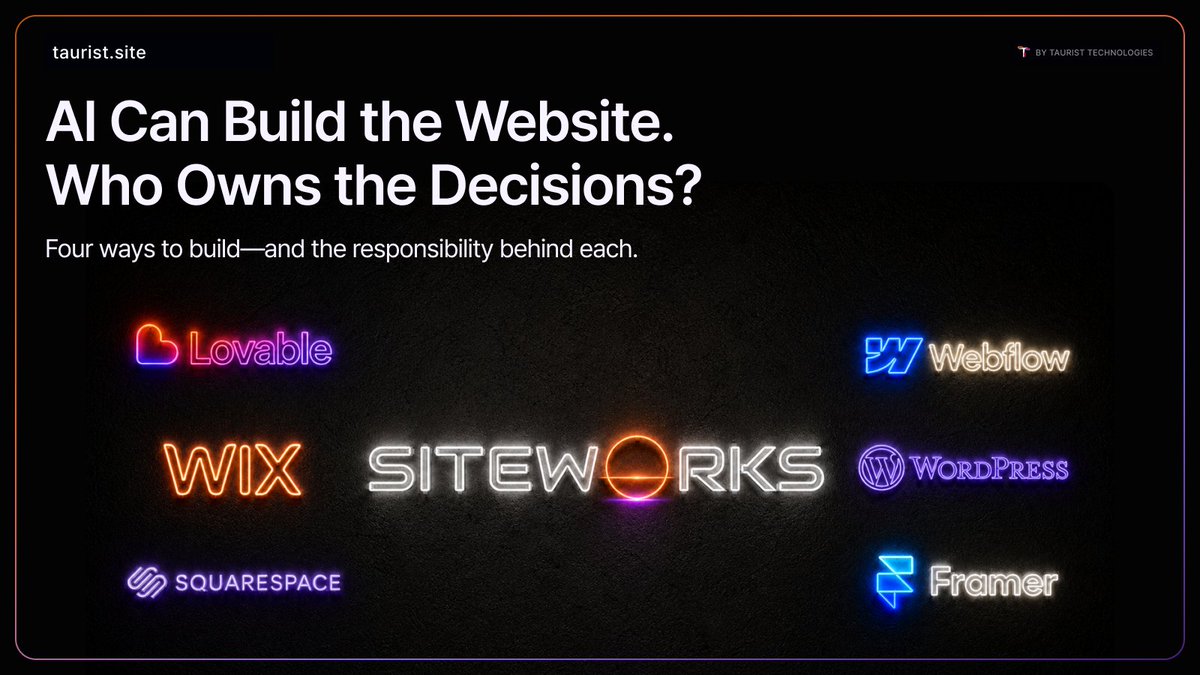
There are four reasonable ways to build a small-business website now.
AI DIY
This fits when the site is simple, early, and low-stakes—and the owner is prepared to direct, revise, and quality-check the work.
The gains are real: speed, control, exploration, and a lower entry cost.
The responsibility is real too. The owner becomes the strategist, writer, designer, QA team, launch owner, and editor.
AI does not force the result to be generic. But it can faithfully execute an unclear brief.
Template or managed platform
This fits when the business follows a familiar site pattern and benefits from established publishing, editing, and hosting conventions.
The gains: a proven structural starting point, faster launch, and more predictable scope.
The tradeoff: the business still needs someone to adapt the message, hierarchy, imagery, proof, and calls to action. Otherwise the layout starts shaping the business instead of serving the visitor.
Custom from scratch
This fits when the website genuinely needs bespoke behavior, proprietary workflows, unusual content models, performance decisions, systems, or integrations.
The gain is greater control over fit and future capability.
The tradeoff is more cost, more decisions, more technical responsibility, and a capable team after launch.
Custom is not automatically the premium choice. Custom code can still carry generic messaging and weak UX.
AI-powered, expert-led
This fits when the business needs a distinctive, credible site but does not want to operate the whole production process.
AI can accelerate exploration, implementation, variations, component work, and other repeatable production.
Experts remain accountable for the consequential decisions: positioning, messaging, buyer psychology, information hierarchy, UX, design, accessibility, mobile quality, search readiness, launch, and exceptions that should not be guessed at.
The client still brings the business truth, honest proof, decisions, and collaboration.
For many serious small businesses, that can offer a useful balance: production leverage without handing the difficult decisions to a prompt or back to the owner.
That is how I think about Siteworks.
No option guarantees conversion, rankings, leads, or revenue. There is no controlled
Most ecommerce teams do not have a traffic problem. They have an evidence problem.
They can tell you sessions are up.
They cannot tell you which page, message, or device is quietly killing intent.
More traffic just makes the blind spot more expensive.
@Bha74142Shivani Im finding that with these newer models, assigning the AI a role in my prompts hasn't been generating the same results as before. A Fable or 5.6 Sol for example should figure out what role it should take on.
Most ecommerce teams do not have a traffic problem. They have an evidence problem.
They can tell you sessions are up.
They cannot tell you which page, message, or device is quietly killing intent.
More traffic just makes the blind spot more expensive.
Before you redesign a product page, write down the one decision it needs to help a buyer make.
If the page tries to explain the brand, product, offer, and every objection at once, it usually makes none of them clear.
Clarity is a conversion feature.
AI workers are not valuable because they can use 12 apps.
They are valuable when they remove a handoff without creating three new exceptions for someone to manage.
The demo is clicking buttons.
The work is deciding what should happen when reality gets messy.
Most ecommerce teams do not have a traffic problem. They have an evidence problem.
They can tell you sessions are up.
They cannot tell you which page, message, or device is quietly killing intent.
More traffic just makes the blind spot more expensive.
The useful AI worker is not the one with the most tools. It is the one that reliably takes one annoying operational loop off someone’s plate, with clear inputs, approval points, and a way to recover when it fails.
AI can generate a website before lunch. It cannot decide what the customer needs to understand before they trust you. That is still the work: the offer, the proof, the next step, and what to leave out.
Most product-page “best practices” are just a way to avoid choosing a sales argument. A page is not a checklist. It needs a reason to believe, a reason to act, and fewer places for the buyer to get lost.
A useful AI worker removes a recurring handoff from the team’s head.
It closes the loop without someone remembering, chasing status, or rebuilding the process every week.
That is more valuable than an impressive demo.
The useful AI worker is not the one that can do everything in a demo.
It is the one that quietly owns one recurring handoff so nobody has to remember it, chase it, or rebuild it next week.