I am entering hibernation mode on X. Not the platform for me any longer. I will continue to post on bluesky at @edvardmoser.bsky.social - see you there! @KISNeuro@MayBrittMoser
Sweeps represent an efficient mechanism for scanning locations in the ambient environment during navigation. Sweep direction could be explained by an algorithm that maximizes cumulative coverage of surrounding space.
One of the most engaging meetings I have been to: 3 long talks per day, questions and discussion during talks, long follow-ups between talks, friendly atmosphere. Not unexpectedly the meeting generated many new ideas! @ERC_Research@KavliFoundation@KISNeuro#KiloNeurons
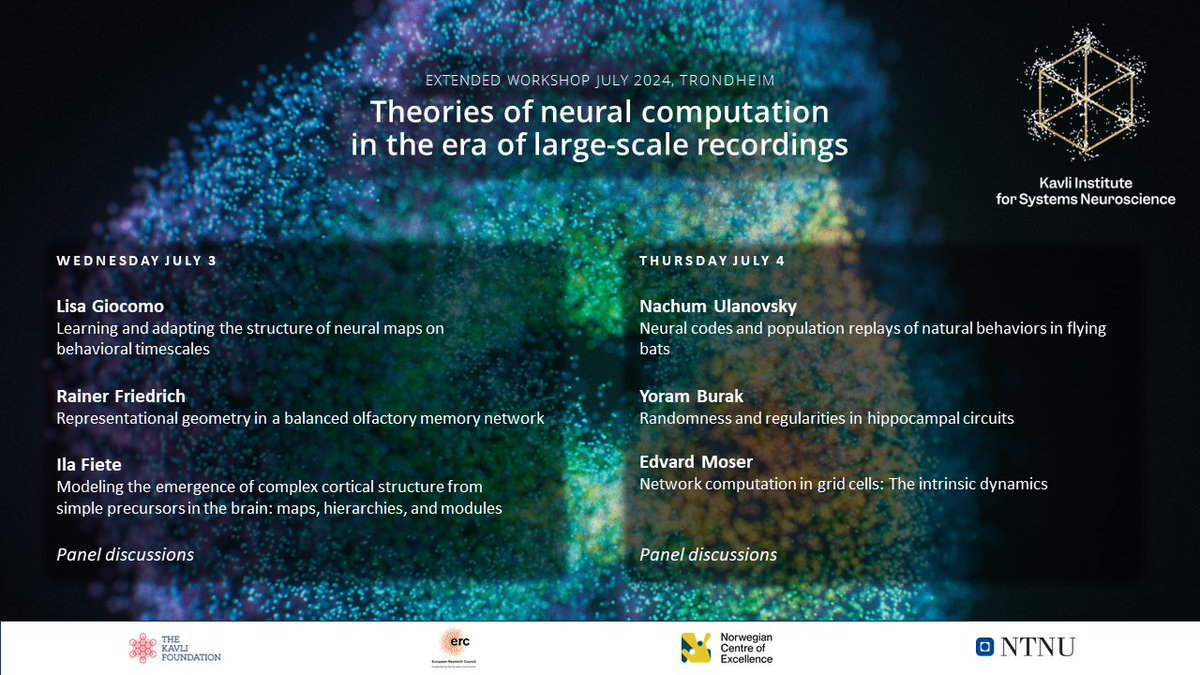
Our extended workshop “Theories of neural computations in the era of large-scale recordings” has officially wrapped up.
Thank you to all our wonderful speakers, poster presenters, attendees, & staff for making this event a great success.
Take a look at the highlights 👀
🧵 1:5
Thanks so much to @ChanZuckerberg for helping us to spread @WikiZong ´s miniscope across the world. We knew already in 2022 that it would revolutionise neural population recordings but we needed CZI help to make it available to other labs! @KISNeuro@MayBrittMoser@ERC_Research
Imagine a 🪟 into the brain where we could see memory, imagination + decision-making in real time.
Researchers @kisneuro + @TheMini2P have developed a tiny microscope that is so light we can observe completely new aspects of the living brain in action
📸 Rita Elmkvist Nilsen
Come check out the Moser Group at #FENS2024@FENSorg!
Bring your curiosity for the Wednesday morning session at 9:30-14:30, June 26th at PS01-26AM.
We’ll show you eight exciting projects on hippocampal spatial encoding.
Expect @TheMini2P, #Neuropixels and #gridcell manifolds 🍩
Have you ever wondered why the progression of time does not feel linear? 🕰️👀 Neuropixels recording in lateral entorhinal cortex might give us a clue! @KISNeuro 👇🏽 brilliant work by Ben Kanter and Christy Lykken in our lab
The flow of experience, expressed in trajectories of neural population activity, is discretized at event boundaries. Implications for how we recall time (and fail to). Creds:Ben Kanter, Christy Lykken, @MayBrittMoser, #KiloNeurons@ERC_Research@KISNeuro
https://t.co/1fpUVGBRuV
The findings overturn the concept of grid (and place) signals as a static representation of space and introduce instead grid (and place) cells as part of a circuit that systematically, dynamically and rigidly patrols the surrounding space. 8/8
Sweep directions can be explained by an algorithm that maximizes cumulative coverage of surrounding space. Sweeps may serve as a ‘look-around’ mechanism for efficient spatial sampling, allowing maps to be formed much faster than by physical running. 7/8