For all #crypto holders :
[Thread]
Give a try to @bcubeai cause it’s not just another AI project !
Just let’s use their agents and you will see that owning $BCUBE is just so obvious due to current value proposal and following ones.
It's becoming a must-have for anyone looking to manage their money wisely with great returns.
When I look at other projects, most of them look so bland and none of them deliver as much as @Bcubeai.
Because proof is better than all my world, here is a quick review of recent bcubebian returns ✨
Don't hesitate to share yours if it's not here. 🫡🚀
⬇️⬇️ 🎅🎅 ⬇️⬇️
SpaceX has just officially unveiled its AI1 satellite, the first generation of its AI satellite.
Overall Specs:
• 150 kW peak compute payload
• 120 kW average compute payload
• 70 kW per ton
• Compute provider interchangeable
Dimensions:
• Wingspan: 70 meters
• Deployed height: 20 meters
Thermal System:
• 110 m² deployable liquid radiator
• Redundant pumping loops
• Integrated micrometeoroid shielding
• Deployable liquid radiators
Solar Power System:
• 150 kW solar array
• 250 W/m²
• SpaceX-manufactured solar technology from Bastrop, Texas
Architecture:
• Centralized compute module
• Large deployable solar arrays
• Deployable liquid-radiator thermal management system
• AI-focused compute satellite design ("AI1 satellite")
Elon: "The AI satellite is much simpler than a Starlink satellite. The AI satellite is essentially a lot of solar cells, you still need some laser links, but you don't have all of the super complex antennas that you have on a Starlink satellite. The easier one to design for is the AI satellite. It's bigger. A lot of this is technology we've already made with the Starlink V3 satellites."
Mélenchon promet un SMIC à 1700 € net. Encore une ineptie :
Aujourd’hui : ~1480 € net, 1867 € brut.
Coût employeur actuel : ~1930-1940 €.
Demain : brut ~2150 € → coût chargé 2400 à 2600 € par mois.
+500 à +700 € par salarié. +25-35 % d’un coup.
C’est pas une hausse de salaire. C’est une bombe sur les TPE/PME.
Conséquences prévisibles :
• Embauches gelées, CDD non renouvelés, licenciements.
• Prix qui montent dans les boulangeries, cafés, supermarchés.
• Inflation qui grignote la « hausse » en quelques mois.
• Chômeurs (surtout jeunes et peu qualifiés) qui paient l’addition.
On augmente le prix du travail sans augmenter la productivité. Résultat mathématique : moins de travail.
Voilà ce que c’est le populisme.
Promettre la lune aux salariés en punissant ceux qui les embauchent.
Faire du « pouvoir d’achat » un slogan en ignorant les réalités économiques.
Parler au ventre des gens tout en sabotant les entreprises qui créent la richesse.
L’utopie LFI qui transforme un emploi en luxe pour entreprises riches.
Et après on s’étonnera des fermetures et des files à Pôle Emploi.
C’est pas de la générosité. C’est de la démagogie pure. 🔥
#Populisme #LFI #SMIC #PouvoirDAchat
The AI supercycle is in year 3 of 15. You didn't miss it.
You'd make millions by knowing whats coming and buying dips until 2030+
Pay attention, we just finished Phase 1 2023-2025
chips · memory · connectivity
$NVDA → Designs the GPUs every AI model trains and runs on.
$MU → Makes high-bandwidth memory inside every AI server.
$COHR → Moves data at light speed between GPUs optically.
$MRVL → Custom silicon connecting every chip in a hyperscaler's cluster.
$AVGO → Builds Google's, Meta's, and Apple's custom AI chips quietly.
$AMD → Only credible GPU rival to NVDA for AI training.
PHASE 2 — The grid gets built (2026–2027)
power · cooling · networking
$IREN → AI-native data centers built to scale compute and power.
$WULF → Energy-efficient infrastructure hosting the world's most power-hungry AI workloads.
$VRT → Cooling and power systems keeping AI data centers running.
$ETN → Electrical gear powering every hyperscale AI facility being built.
$CEG → Nuclear energy feeding AI's insatiable around-the-clock power demands.
$ANET → High-speed switches moving massive AI workloads across GPU networks.
$GEV → Gas turbines physically delivering power to data centers.
$SMCI → Liquid-cooled GPU server racks — pick-and-shovel for AI density.
PHASE 3 — The massive bottleneck (2027–2029)
materials · space · autonomy
$MP → Mines rare earth materials used in AI hardware and defense.
$USAR → Domestic minerals securing U.S. AI manufacturing independence.
$ASTS → Satellites delivering AI connectivity to every corner of Earth.
$RKLB → Low-cost rockets launching satellites powering AI communication networks.
$KTOS → AI-driven autonomous weapons systems entering mass military deployment now.
$TSLA → Leads real-world AI through robotics, autonomy, and manufacturing.
$SYM → AI-powered warehouse robots automating global logistics at scale.
$ALAB → Chip packaging bottleneck — critical past 100K GPU nodes.
$PLTR → Software turning AI compute into defense and enterprise decisions.
PHASE 4 — Full automation (2030+)
platforms · agents · quantum
$MSFT → Deploys AI agents across every enterprise software product it sells.
$GOOGL → Controls AI search, cloud, and consumer distribution globally.
$META → AI assistants across 3 billion users in social and commerce.
$CRM → AI agents inside enterprise sales — 150K customer moat.
$NOW → AI workflow OS for Fortune 500 enterprises.
Quantum
$IONQ $RGTI $QUBT — next-gen compute unlocking exponential AI breakthroughs.
♻️ RESHARE this post and make 1 comment, I'll share when to add these stocks in June.
@brivael Il donne en plus des infos de merde. Un satellite Starlink c'est entre 5 et 7 ans de durée de vie (et non 2-3 comme le stagiaire bfm dit) .
Et c'est essentiellement parceque le carburant embarqué pour corriger les trajectoires en basse orbite se consomme vite.
C’est la premiere course importante de la saison, c’est presque impossible de battre des WR en début de saison.
Le pic de forme arrive normalement plus tard. 9,97 c’est solide mais ya pas de miracle. Kerley était trop optimiste sur le WR de Bolt. Ils sont plusieurs à avoir dit courir clean à cet Event.
Et de toute façon, le dopage pour ceux qui se laisse tenter en athlé ne fera pas de miracle. Cet event est uniquement là pour faire du buz commercial.
Bénéfices nets, 1er trimestre 2026 📊
Google : 62 milliards de $
Nvidia : 58 milliards de $
Microsoft : 31 milliards de $
Apple : 30 milliards de $
Amazon : 30 milliards de $
Certains y verront une bulle.
D’autres y verront 5 des plus belles sociétés de l’histoire de l’humanité, qui génèrent plus de 210 milliards de $ de profit en un seul trimestre,
Tout en étant précurseurs dans ce qui s’annonce être la plus grande révolution technologique du 21e siècle.
Je fais partie de cette seconde catégorie.
Gilles, je vais démonter ta prémisse de départ, parce que tout le reste de ton argument s'effondre avec elle.
Tu pars du principe qu'il faut une « sensibilité de gauche » pour ne pas laisser créver les gens de faim. C'est l'inverse total de ce que dit l'histoire économique des 50 dernières années.
Les chiffres bruts.
1990 : 2,3 milliards de personnes en pauvreté extrême. 38% de l'humanité.
2025 : 831 millions. Environ 10%.
1,5 milliard d'êtres humains sortis de la misère absolue en 35 ans. La plus grande réduction de souffrance humaine de toute l'histoire de l'espèce.
Qui a fait ça ?
Pas l'aide internationale. Pas les ONG. Pas les programmes de redistribution. Pas la « sensibilité de gauche ».
Le marché. L'ouverture commerciale. La Chine de Deng en 1978 qui abandonne le maoisme. L'Inde en 1991 qui libéralise. Le Vietnam, l'Indonésie, le Bangladesh qui s'ouvrent au capitalisme.
Les seuls endroits où l'extrême pauvreté a EXPLOSÉ sur la même période ? Le Vénézuela socialiste : de 27% de pauvres en 2008 à plus de 80% en 2018, avec une inflation de 130 000% et un Vénézuélien moyen qui a perdu 11 kilos par dénutrition. La Corée du Nord. Cuba. Le Zimbabwe de Mugabe.
La gauche ne nourrit pas les pauvres. Elle les fabrique.
Le capitalisme produit tellement de richesse que même ses « perdants » américains vivent mieux que la classe moyenne soviétique. Un pauvre US a un frigo, une voiture, un téléphone, l'air conditionné, internet. Un pauvre cubain attend du riz.
Ton argument selon lequel « le social aux USA est un désastre » repète une légende française. La réalité : le PIB par habitant américain est de 80 000$. Français : 45 000$. Un Mississippien — l'État US le plus pauvre — a un revenu médian supérieur au Français moyen.
La vérité que la gauche française refuse de regarder : dans un système libéral, il y a plus de richesse créée, plus largement distribuée, et beaucoup moins de pauvres. Partout. Sans exception. Sur toutes les périodes mesurées.
ÊTRE de gauche en 2026 face à ces données, ce n'est pas avoir de la « sensibilité ». C'est ignorer 35 ans de preuves accablantes. C'est préférer la posture morale au résultat.
La compassion sans résultats, ça s'appelle de la vanité.
Strategy holds 843,738 Bitcoin. That is approximately 4% of every Bitcoin that will ever exist. Last week alone, between May 11 and May 17, the company added 24,869 BTC for $2.01 billion, funded 97% by selling $1.95 billion of preferred stock yielding 11.5% to 927,000 retail investors.
This is no longer a corporate treasury. This is the first publicly traded central bank operating on Bitcoin, without a charter, without sovereign backing, and without anyone in Washington yet recognizing it as one.
The mechanism is mechanical. STRC, the perpetual preferred stock Strategy issues to fund Bitcoin purchases, has raised $8.5 billion in nine months. It is the largest tradable preferred stock in the United States, almost twice the size of Wells Fargo’s largest issuance.
Daily volume runs ten times the sector average. It reaches 1,400 institutions, 1,300 ETFs and funds, and roughly 100 million beneficiaries.
Eighty percent of holders are retail. Strategy raised $11.68 billion of equity year-to-date, the largest US equity issuance of 2026, and disclosed remaining ATM authority of approximately $51.5 billion across its five share classes.
The dividend math is the protocol. Strategy’s preferred stock obligations across STRC and its sister series total approximately $1.5 billion annually. Strategy needs Bitcoin to appreciate just 2.05% annually to cover them perpetually from the existing reserve. At 0% appreciation, current reserves cover 43 years of dividends. At any rate above 2.05%, the spread accrues to common shareholders as Bitcoin per share.
The metric Strategy reports is no longer revenue. It is BTC Yield, currently 12.6% year-to-date for 2026, up from 9.4% at Q1 close. Satoshis per share have grown 18% year over year. Average cost basis on the entire 843,738-coin reserve sits at $75,700.
Then came the regime change. On the May 5 earnings call, Saylor said the sentence that retired four years of HODL absolutism: “We will probably sell some bitcoin to pay a dividend just to inoculate the market and send the message that we did it.”
He walked it back at Consensus Miami six days later as a “big nothing burger.” On May 15, Strategy announced a $1.5 billion convertible note buyback and explicitly listed Bitcoin sales as one of three potential funding sources. Polymarket odds on a 2026 Bitcoin sale spiked to 92%.
The pivot reveals the architecture. Strategy is conducting open market operations on Bitcoin. Sell preferred stock to expand the balance sheet, buy Bitcoin with proceeds, manage liquidity through ATM authority, signal monetary policy through public commentary, and reserve the right to sell Bitcoin to manage liability cash flows.
Every function of a central bank, executed against a single non-sovereign asset, by a corporation that just generated $124.3 million in software revenue against $12.54 billion in non-cash GAAP losses.
This is happening in the same week the United States Senate Banking Committee classified Bitcoin as a permanent federal commodity under the CLARITY Act and Iran launched Hormuz Safe, a sovereign Bitcoin-settled maritime insurance platform projecting $10 billion annually.
Three actors. Three architectures. One asset. Washington codified its legal status. Tehran weaponized its neutrality. Strategy operationalized it as monetary policy.
The Bitcoin-denominated central bank without a license is not a thesis. It is a corporate balance sheet running open market operations in public, disclosed in 8-K filings, scaled to 4% of supply. The architecture is no longer theorized. It is executed weekly.
https://t.co/FRwSI1w8WU
Strategy has acquired 24,869 BTC for ~$2.01 billion at ~$80,985 per bitcoin and has achieved BTC Yield of 12.6% YTD 2026. As of 5/17/2026, we hodl 843,738 $BTC acquired for ~$63.87 billion at ~$75,700 per bitcoin. $MSTR $STRC https://t.co/y1zvePEuym
"Tu peux te tromper, t'es pas économiste."
Cette phrase résume 80% de la pathologie intellectuelle française.
L'idée qu'un sujet appartient à une caste. Que pour en parler, il faut un parchemin. Que sans le tampon de la Sorbonne ou de Normale Sup, ta pensée n'a pas de poids.
C'est faux. Et c'est même l'inverse.
Le diplôme dans 90% des disciplines molles (économie, socio, sciences po, philo politique) n'est PAS une preuve de compétence.
C'est une preuve de conformité.
Tu as passé 5 à 10 ans à régurgiter le consensus d'un milieu, à ne jamais le contredire sous peine de ne pas avoir ta thèse, à citer les bons auteurs dans le bon ordre.
Au bout du tunnel : tu es certifié pour penser comme les autres certifiés.
C'est exactement l'inverse de ce qu'il faut pour comprendre un sujet en profondeur.
Piketty a un doctorat. Il a construit toute sa carrière sur r > g. Sauf que son "rendement du capital" est un agrégat qui mélange rente foncière, plus-values monétaires et profit entrepreneurial. Trois choses qui n'ont rien à voir.
Sa thèse entière repose sur une prémisse statistique pourrie.
Mais il a le diplôme. Donc on l'écoute.
Les marxistes recyclés en "hétérodoxes" enseignent encore la théorie de la valeur travail. Théorie morte en 1871 avec Menger, Jevons, Walras. 150 ans qu'on sait que la valeur est subjective, dans la tête de l'acheteur, pas dans le travail incorporé.
Mais ils ont le diplôme. Donc on les écoute.
Pendant ce temps, moi, à 15 ans, j'ai compris l'économie en codant un jeu.
Jeu de gestion futuriste. 3000 joueurs par univers. 3 ressources : métal, cristal, deutérium.
Aucun PNJ. Aucun "régulateur". Aucun prix fixé par moi.
Les joueurs s'échangeaient les ressources librement. Et un taux de change émergeait. Stable. Juste. Auto-correcteur.
Si une ressource devenait rare, son prix montait, plus de joueurs en produisaient, le prix se rééquilibrait.
La "main invisible" que les profs ricanent depuis 50 ans ?
Elle existe. C'est juste le nom poétique d'un phénomène d'émergence dans un système complexe.
Et les prémisses qui font marcher tout ça :
Liberté des flux.
Liberté des stocks.
Propriété privée.
C'est tout. À 15 ans. Sans diplôme. Par l'observation directe.
Pourquoi est-ce que JE peux voir ça et qu'un agrégé d'éco ne peut pas ?
Parce que je raisonne en first principles. Comme @elonmusk le fait en tech.
Quand Elon a dit "une fusée ne coûte pas le prix d'une fusée, elle coûte le prix des matériaux qui la composent", tous les "experts" aérospatiaux ont ri. Ils avaient 30 ans de carrière, des doctorats, des publications. Ils savaient que c'était impossible.
SpaceX existe parce qu'un mec sans diplôme d'aérospatial a refusé leurs prémisses.
Quand @JMilei a dit "on supprime 10 ministères, on libère les prix, on dollarise", tous les économistes argentins (et la moitié de la planète) ont prédit le chaos. Ils avaient les diplômes, les revues, les chaires.
L'inflation argentine s'effondre. En 18 mois. Milei est économiste, certes, mais autodidacte sur l'école autrichienne qu'on n'enseigne quasiment plus nulle part.
Deux mecs. Deux domaines. Même méthode :
Ils ont refusé les prémisses du consensus diplômé. Ils ont reconstruit depuis les axiomes. Ils ont gagné.
Voilà ce que personne ne veut admettre :
Le diplôme prouve que tu as accepté un cadre.
Penser, c'est refuser ce cadre quand il est faux.
Les deux sont littéralement opposés.
Ça ne veut pas dire que les diplômes sont inutiles. En médecine, en physique théorique, en mathématiques pures, le diplôme certifie un savoir technique réel et cumulatif.
Mais en économie ? En philosophie politique ? En sociologie ? En "sciences" humaines ?
Le diplôme certifie surtout que tu n'as pas remis en cause le dogme du département.
Donc quand on me dit "tu peux te tromper, t'es pas économiste", ma réponse est :
Tant mieux.
C'est précisément parce que je n'ai pas été formaté pendant 8 ans à régurgiter Piketty et Stiglitz que je peux voir ce que les formatés ne voient plus.
La question n'est pas "as-tu le diplôme".
La question est : tes prémisses tiennent-elles ?
Si oui, parle. Quel que soit ton CV. Si non, tais-toi. Même avec trois doctorats.
Une chose qui m'a frappé en bossant des deux côtés de l'Atlantique.
En France, l'arrogance d'un entrepreneur est inversement proportionnelle à sa réussite réelle.
Le mec qui fait 20M d'ARR te parle comme s'il avait fondé Apple. Costume bien coupé, name-dropping de fonds, regard qui te jauge dès la poignée de main. Il maîtrise ses classes en-dessous comme un sport de combat.
Dans la Silicon Valley, c'est l'inverse exact.
Tu te retrouves à dîner avec un type qui a vendu sa boîte 1 milliard. Plus aucun problème d'argent jusqu'à la fin de ses jours. Et il te parle comme s'il débutait. Te demande ce que tu construis, prend des notes, te recommande trois personnes à appeler dans la semaine.
Les meilleurs profils tech là-bas fondateurs sortis à plusieurs centaines de millions, ingénieurs principaux qui ont façonné des produits utilisés par des milliards de gens gardent une simplicité qui désarme.
La différence n'est pas anecdotique. Elle est culturelle, et elle est structurante.
En France, le statut se défend. En Californie, le statut se prouve par le prochain projet.
Et à la fin, on s'étonne que les uns construisent des empires pendant que les autres optimisent leur table chez Caviar Kaspia.
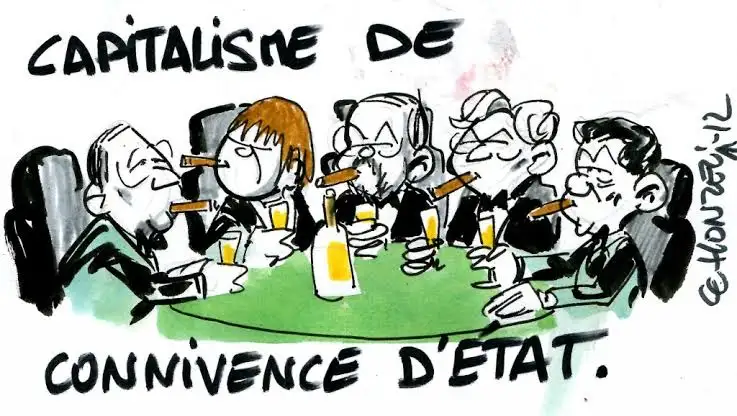
Le vrai ennemi du libéralisme n’est pas le socialisme. C’est le capitalisme de connivence.
C’est même l’un des plus grands malentendus économiques de notre époque : beaucoup de gens croient détester le marché, alors qu’ils détestent en réalité un système où les grandes entreprises savent parfaitement utiliser l’État pour verrouiller la concurrence, capter les subventions, influencer la régulation et transformer la complexité administrative en barrière à l’entrée.
Ce capitalisme-là n’a rien de libéral.
Il ressemble davantage à une alliance entre bureaucraties publiques et insiders privés, où les plus gros acteurs disposent des équipes juridiques, des relais politiques et du temps nécessaire pour transformer chaque nouvelle règle en avantage compétitif.
Le petit entrepreneur subit la norme tandis que le grand groupe la négocie.
C’est là que la critique devient intéressante, parce que les discours anti-capitalistes visent souvent "le marché", alors que le problème vient précisément de l’absence de marché réel :
▪️concurrence limitée
▪️accès inégal au pouvoir
▪️subventions ciblées
▪️commandes publiques
▪️niches réglementaires
▪️portes tournantes entre grandes entreprises
▪️cabinets de conseil
▪️administration et institutions européennes...
🇫🇷 Bastiat avait déjà vu le piège : quand l’État devient la grande fiction à travers laquelle chacun essaie de vivre aux dépens de tous, les plus organisés gagnent toujours avant les plus productifs.
🇺🇸 Hayek aurait ajouté que plus le système devient complexe, plus il favorise ceux qui sont assez proches du pouvoir pour en comprendre les rouages.
Et c’est exactement ce qui se passe aujourd’hui.
On vend aux citoyens une économie de marché, mais on leur livre trop souvent une économie d’accès : accès aux cabinets ministériels, accès aux subventions, accès aux normes, accès aux bons réseaux.
La colère populaire contre le "capitalisme" vient en grande partie de là.
Les gens ne rejettent pas forcément la liberté d’entreprendre, l’innovation ou la réussite. Ils rejettent un jeu truqué, où les pertes sont socialisées, les profits protégés et la concurrence neutralisée par ceux qui prétendent défendre l’intérêt général.
Le libéralisme authentique devrait être la critique la plus radicale de ce système parce qu’un marché libre n’est pas un banquet réservé aux puissants.