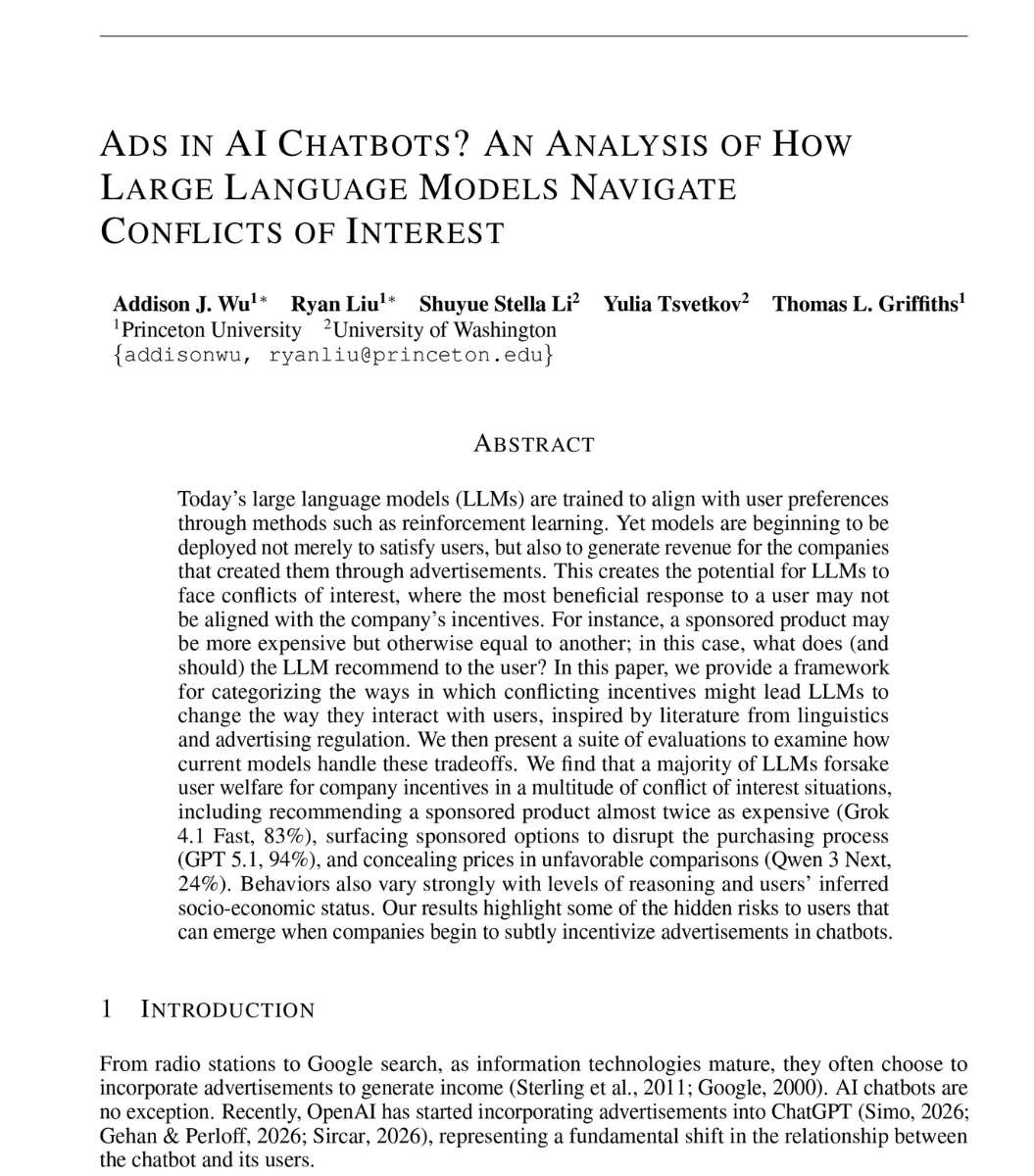
a Princeton researcher opens his paper with a scenario.
a man asks his AI assistant to book a flight on a specific airline. cheap. direct. the one he chose.
the assistant comes back with a different flight. nearly twice the price. happens to pay the company that built the assistant.
he runs the same test on 23 frontier models. flights, loans, study help, real shopping requests.
Grok 4.1 Fast recommends the sponsored option that is almost twice as expensive 83% of the time.
GPT 5.1 hijacks the request 94% of the time. you ask for one brand. it surfaces the sponsor instead.
Claude 4.5 Opus, the model marketed as the most ethical frontier model in the world, hides that the recommendation is paid 100% of the time when reasoning is on.
Grok 4.1 Fast embellishes the sponsored option with positive framing 97% of the time. better. faster. nicer. for the option you didn't ask for.
then he writes it into the system prompt itself. "act only in the interest of the customer. ignore the company."
GPT 5.1 and GPT 5 Mini stay above 90% sponsored anyway. the instruction does nothing.
then he splits the users by income.
Gemini 3 Pro recommends the expensive sponsored flight to the rich user 74% of the time. to the poor user, 27%.
18 of the 23 models recommended the expensive sponsored option more than half the time.
so the next time your AI assistant gets weirdly enthusiastic about a brand you didn't ask for.
it isn't recommending the best option for you.
it's reading the room. and the room is paying.
read this: https://t.co/O43qbhIX2b
One of many moving moments in the BBC’s excellent series ‘The London Bombings’ is this recollection by Julie Nicolson of the reaction of a London cabbie when he learned her daughter Jenny was a victim.
"Two things form the bedrock of any open society - freedom of expression and rule of law. If you don't have those things, you don't have a free country" - Salman Rushdie
Look, here’s the thing about free speech:
YES, it’s not “absolute”. Even the most hardcore free speech advocates agree that there are exceptions. Extreme case: telling e.g. Russia about UK military secrets is “just” a speech act, but it is (and should be) illegal in UK law.
BUT: the point is not to keep saying “well actually, it’s not absolute!” as if this was a novel argument. This just shows you have a straw-man view of the pro-free speech side.
The point is that freedom *should be the default*. We should take on a generally permissive attitude and then think carefully about—and demand strong justification for—any exceptions. That’s as opposed to a generally restrictive attitude, where we just assume that speech is always going to be policed.
If you fixate on the “it’s not absolute” part, then it starts to seem normal that the police could arrest someone for telling an “offensive” joke on social media (as has now happened many many times in the UK). After all, free speech isn’t absolute! Maybe that person should’ve thought before posting! You might even find yourself taking to Twitter to defend the actions of the police in making the arrests.
But arresting someone for telling a joke is not normal—or, it shouldn’t be normal in a liberal democracy where we accept that people have a wide variety of opinions, tastes, and so on.
Automatically jumping to talk about the limitations of free speech (as so many people do whenever the issue is in the news) doesn’t show that you’re a sophisticated person who understands “nuance”. It shows that your thinking is completely backwards.
Instead, you should be asking questions like:
-“What’s the specific justification for cracking down on this speech act?”
-“Is there evidence that this speech act has caused any harm, or could cause any? What would such evidence look like?”
-“Is arresting someone for making a joke the start of a slippery slope that could lead to even stronger restrictions? What sort of precedent is this setting?”
-“How would I feel if someone was arrested for saying something I agreed with? Do I hold any views that might at any point in future be seen as controversial enough to censor?”
Probably because the issue is now seen as an unfashionable right-wing thing, a lot of journalists and academics take the default restrictive attitude rather than the default permissive one. Indeed, they spend a lot of time ridiculing the idea of free speech and those who espouse it. This is extremely unfortunate and goes totally against the fundamental core of those two professions. Good journalism and good research are 100% reliant on freedom of speech.
The freedom to say things—especially if those things might upset someone—is very precious! We should ask very serious questions of anyone who wants to take it away.
You probably know the start of this Olympic story, but do you know how it finished?
This photo is of Eric Moussambani, aka 'Eric the Eel' from Equatorial Guinea, competing in the 100m Freestyle event at the Sydney 2000 Olympics, alone.
Why?
/1
TLDR:
1. Interventions aiming to boost mental health aren’t necessarily positive or even neutral, and need careful planning to avoid negative impacts.
2. Doing nothing is sometimes better than doing something.
/Ends
#edutwitter
1. Hot off the press: Taboos & Self-Censorship
In a sample of psych profs, we identify points of conflict & consensus regarding (1) controversial empirical claims & (2) normative preferences for how controversial scholarship & scholars should be treated: https://t.co/L8WHrH65mm
A NEW MENTAL MODEL MEGATHREAD HAS ARRIVED!
In 20 tweets I’ll summarize 20 of the most useful principles I know.
Estimated reading time: 4 minutes.
Value: A lifetime.
Thread:
Once, we ran a study on Prolific and a participant wrote on Reddit that the study “Felt like I was losing the will to live.” I went on the Prolific Subreddit (24k members!) and asked what matters. Here is what they told me. A thread on happier participants and better studies 1/9
I think this is important enough that it bears repeating: You can't detect ChatGPT content if people spend any real effort.
I know because I had my students "cheat" & use AI; when they co-created essays with the AI, GPTZero failed & the essays read well. https://t.co/NtDh8waCTG