You can finally see a warning when you use suspendCoroutine. This is good, because the right way to suspend a coroutine is to use suspendCancellableCoroutine. suspendCoroutine should be forgotten, as it does not support cancellation. suspendCancellableCoroutine is a low-level API rarely used in application code, but often used by libraries that support suspending calls.
These “recipes” are a taste of what we do in Coroutines Mastery. https://t.co/lMy0ysrNj5
The synchronized block is popular for synchronizing non-suspending functions, but it can also be tricky. Without proper understanding, developers make mistakes, which leads to mistakes that are hard to find.
🚨 Is Your Network Client Sabotaging Performance? 🚨
Coroutines promise fewer threads and better efficiency—but are your libraries secretly blocking threads? 🤔 Discover how popular Kotlin network clients like Retrofit, Ktor, and Fuel really manage threads. Your app’s performance might depend on it! 💥https://t.co/8CY5DQkMYq
If this kind of deep dive helps, we cover it end-to-end in Coroutines Mastery. https://t.co/RDEdMUCwNF
Make Compose UI consistent, modern, refined.
Join Polished Compose to learn how strong Android products improve visual quality through better theming, cleaner layouts, motion, and polish.
Lats moment to join!
Enroll now -> https://t.co/alSSXqV6Fr
Kotlin Coroutines are simple only until you need to clearly remember what launch, async, runBlocking, runTest, coroutineScope, or withTimeoutOrNull actually do.
That is exactly why I prepared this cheat sheet. Leave your email and download it.
Good baseline for team standards: where scopes live, what dispatchers mean, what to avoid. Download Kotlin Coroutines Cheat Sheet here 👇
You probably know already that the first programmer was a woman, but did you know she was the daughter of a mad poet? This is a story of Ada Lovelace, who presented a sequence of instructions to calculate Bernoulli numbers on the difference engine. This is considered the first computer program, and also the first computer algorithm. Ada’s father was Lord Byron, a famous romantic poet with a notable history, numerous publications, and a rich legacy. Was he really mad? Historians suspect bipolar affective disorder, but it you know his history, that seems like the tip of an iceberg 😉
Modifier builders or resources that are used for many composables can be extracted for better performance. Why making something many times, if you can create it only once 😎
A practical Flow reference, made for Kotlin developers.
This cheat sheet by Marcin Moskala covers flow, callbackFlow, collectLatest, debounce, combine, stateIn, shareIn, and the key differences between SharedFlow and StateFlow. Download it here: [link]
If Flow is part of your daily toolkit, this is the kind of reference that pays back every week.
One of the greatest possible sins in Compose is reading and writing to a state in a composable. ☠️
Just writing is already problematic, but reading and writing lead to an endless recomposition circle - read sets the listener to recompose on value change, write triggers value.
Dropwizard is a Java framework for developing ops-friendly, high-performance, RESTful web services. Apparently, there was no project showing how to use it together with Kotlin coroutines. This has changed thanks to Rui Pinto, who implemented a simple demo application that showcases how to use coroutines in Dropwizard. It even includes performance benchmarks.
👉 https://t.co/8N2l8N30gX
#coroutinesmasteryproject
Could a UI framework that started on Android become a serious challenger beyond mobile?
This article looks at Compose as a multiplatform declarative UI framework written in Kotlin, and why it is starting to appear not only on Android, but also on iOS, desktop, and the web.
It covers:
- how Compose differs from DOM/CSS-based frontend approaches
- why previews, testing tools, and animation APIs matter in practice
- how teams use Kotlin across backend and clients, and why that makes Compose attractive
A useful perspective for developers watching the future of UI development across platforms.
👉 https://t.co/6JcLpgVRDz
#Kotlin #Compose #UI #Multiplatform #AndroidDevelopment #WebDevelopment #SoftwareDevelopment
2. Your UI works. Make it polished.
Your UI works. Make it polished.
Polished Compose is an advanced course for Android developers who want to improve visual quality, consistency, motion, and UX details in Jetpack Compose.
Starts 8 June 2026.
Enroll now -> https://t.co/j3wHxF9SUb
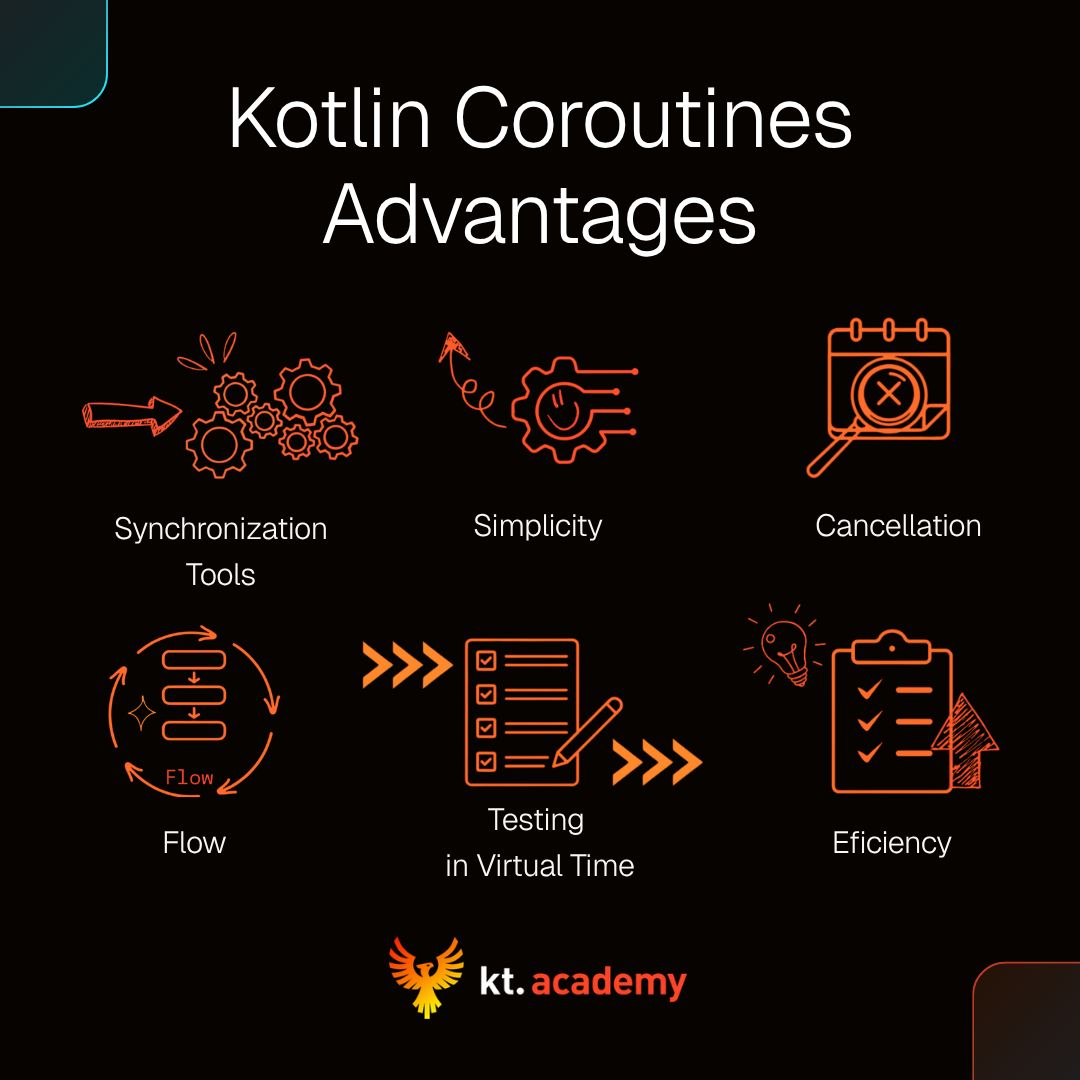
Developers often grumble about all the complexity that Kotlin Coroutines hide under the carpet. But this library also hides its best advantages; we often benefit from them without even knowing about it. So let’s explore the key advantages of Kotlin Coroutines.
If you work with Flow, here is a simple challenge:
Can you look at a pipeline and predict what really happens —
without running it?
That is the skill this game is designed to train.
Play here: https://t.co/CjjWHfwwIQ
When you use by keyword after a property, you delegate getter to getValue and (if var) setter to setValue from the delegate. Those functions can be extensions, like in State, where they only read or write value property.
If you strip composables from all the layers of abstraction, you will see that everything is just Layout and modifiers. Practically everything you see drawn on the screen is drawn by modifiers.
Confused about which Kotlin workshop is right for you? 🤔 Whether you're a beginner or an expert, there's a perfect fit. At Kt. Academy we’ve got you covered. Curious? Discover the best choice for your skills! 📚 https://t.co/GpNQfFuws0
Build premium Compose UI
Polished Compose is a 2-week advanced course for Android developers who want to improve theming, responsive layouts, animations, and visually polished UI in Jetpack Compose.
Learn how to structure interfaces that stay consistent, scalable, and production-ready as your app grows.
Starts 8 June 2026 Enroll now → https://t.co/OLQhkSOv59











![ktdotacademy's tweet photo. A practical Flow reference, made for Kotlin developers.
This cheat sheet by Marcin Moskala covers flow, callbackFlow, collectLatest, debounce, combine, stateIn, shareIn, and the key differences between SharedFlow and StateFlow. Download it here: [link]
If Flow is part of your daily toolkit, this is the kind of reference that pays back every week.](https://pbs.twimg.com/media/HIVq-4sWkAAdmR2.jpg)