Oh I agree (just look at Project 2029's child care choice guarantee- that's *massively* different from Clintonian or even Obama/Biden child care policy!), I'm saying that I've seen some well-known pundits (Noah Smith, e.g.) respond to OP basically saying 'yep, 1992 forever is cool' and I disagree with that assessment.
https://t.co/dLTdiLxrO5
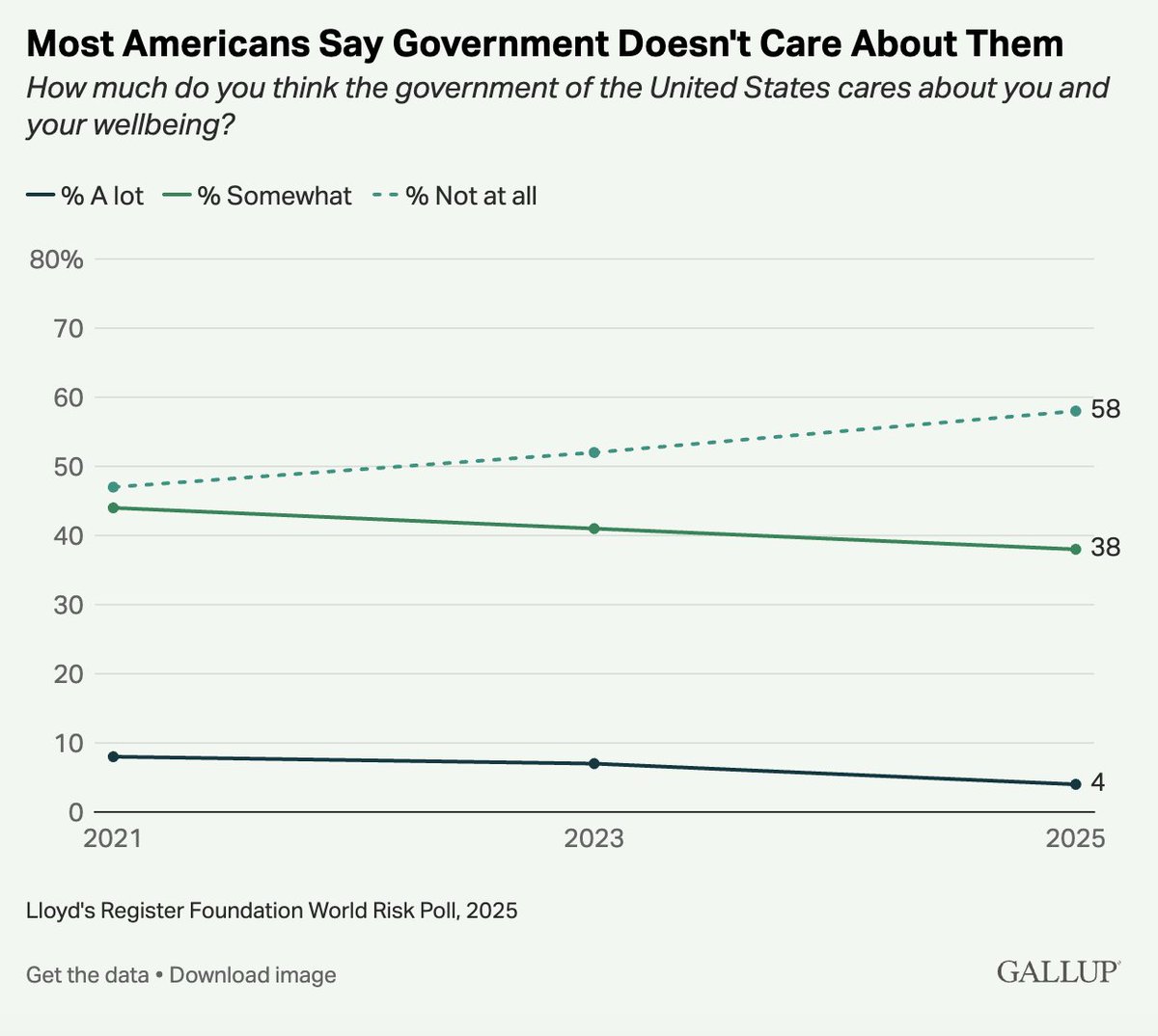
I found the linked article interesting on that point of the liberal approach (or lack thereof) to soulcraft.
My critique is that Clintonian liberalism ('forever 1992') has not yet done enough to establish the enabling conditions for that search for meaning and purpose, and there is far more to be done to unlock that potential-- which is going to require new ideas and new approaches, rather than simply a doubling-down.
https://t.co/BxB2AcS4om
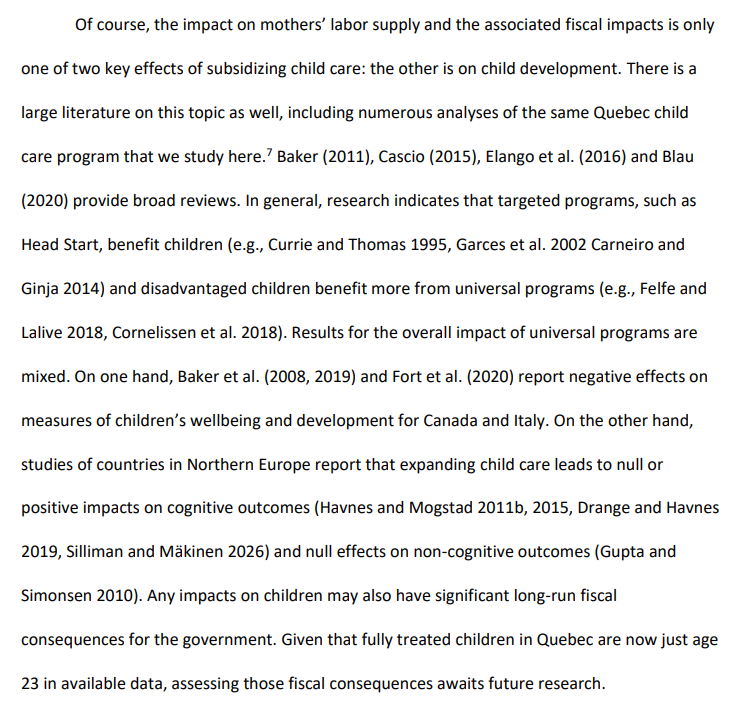
New paper: The same authors who reported negative impacts of Quebec's publicly-funded child care system find (while now saying that, accounting for international studies, "Results for the overall impact of universal programs [on child development] are mixed") BIG jumps in maternal employment and earnings by the time the moms who benefitted from the subsidized child care hit age 50-- employment rates boosted by as much as 12 percentage points (a 16% rise over baseline) and 27% higher earnings, equaling nearly C$15,000 more a year compared a world where there was no subsidy. They conclude that in the long run, the program does in fact more or less pay for itself on the basis of maternal employment and earnings alone.
New paper: The same authors who reported negative impacts of Quebec's publicly-funded child care system find (while now saying that, accounting for international studies, "Results for the overall impact of universal programs [on child development] are mixed") BIG jumps in maternal employment and earnings by the time the moms who benefitted from the subsidized child care hit age 50-- employment rates boosted by as much as 12 percentage points (a 16% rise over baseline) and 27% higher earnings, equaling nearly C$15,000 more a year compared a world where there was no subsidy. They conclude that in the long run, the program does in fact more or less pay for itself on the basis of maternal employment and earnings alone.
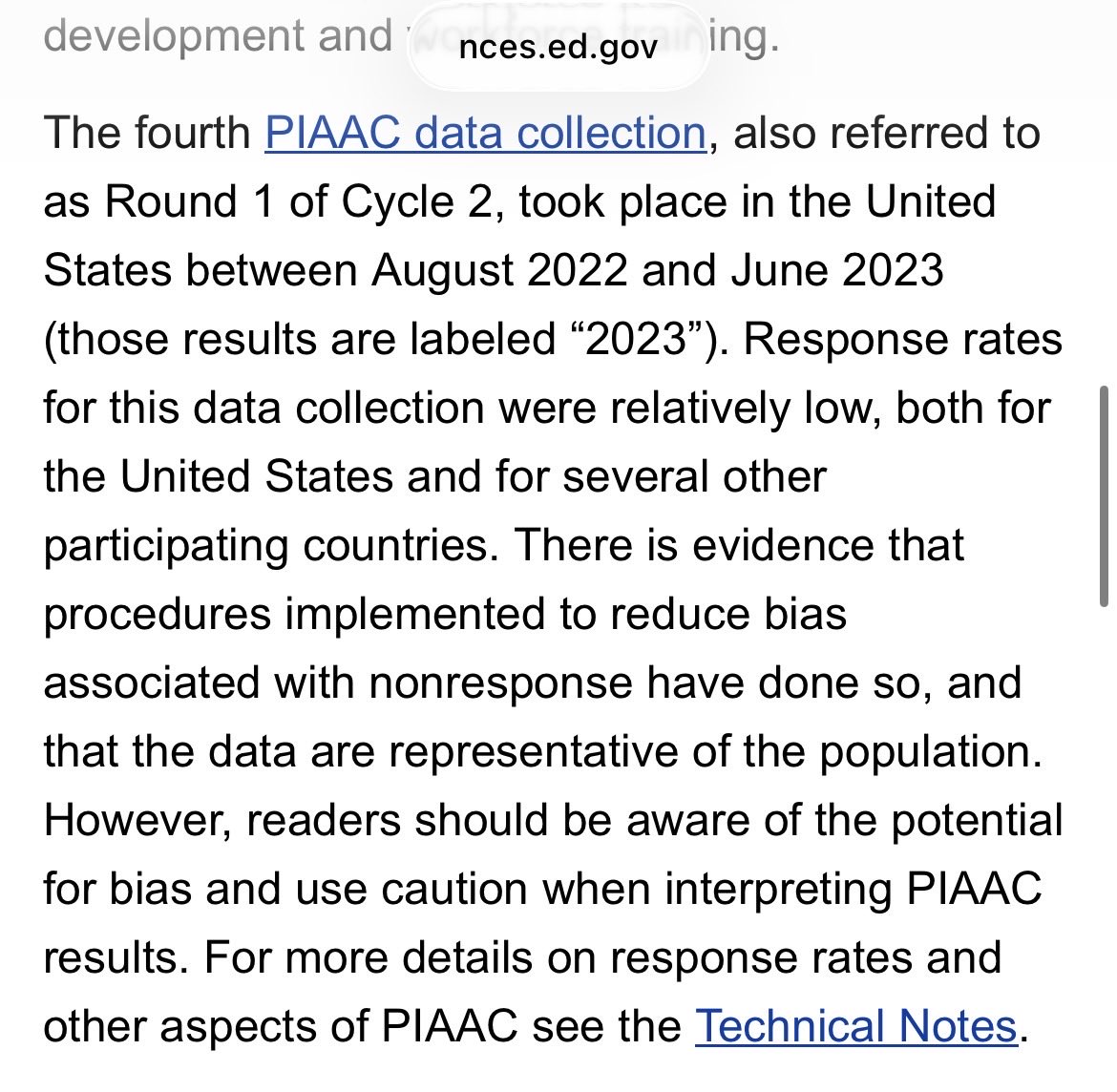
@marcportermagee Agreed, I bring it up b/c I think we probably need another round of PIAAC that is further away from pandemic-era sampling issues (and uses the same new format as 22/23) before we can confidently say there’s a trend here
@marcportermagee Worth noting that PIAAC changed formats between 2017 and 2023, plus we had participation rate issues in the latest round, so it’s not exactly an apples to apples longitudinal comparison.
Childcare is a must-have for working parents, not a cash cow for Wall Street shareholders.
My new bill stops private equity firms from buying up local daycares, raising tuition, and driving down quality. It’s time to put our families ahead of corporate greed. https://t.co/HEyc3gsbPs
You can bookmark this one for the next time a senior administration official baselessly claims that states "just take your word for it" and "don't even check" when people apply for SNAP.
https://t.co/0wwnTXnzZm
🚨NEW: In the 9 months after last year’s reconciliation law enacted unprecedented SNAP cuts, the number of people receiving SNAP fell by more than 4.5 million. Based on available data, we estimate that at least 1.5 million fewer kids are receiving SNAP.
https://t.co/HUPBlPSUTa
As far as ambitious healthcare proposals go, MediKids would be vastly more affordable than Medicare for All.
Total national spending on children's healthcare is about $330B. But $115B of that is through Medicaid, which already covers ~half of kids.
While I am fully in agreement that fewer families can lead to worse services in a vicious cycle, there's no real evidence that's what's happening here. YMCAs in many cities (Denver, e.g.) are still offering robust child watch hours. It's equally likely this is about bad economics in high COL cities. I'm open to the idea this is a demand issue, but we should be clear that assertion is entirely speculative.
Honest question: Do we have any actual evidence that these closures / hours reductions are related to changes in birth rates or changes in child care pattern usage, vs. vagaries of local economies?
For instance, YMCAs in both of the last two cities I've lived in - Richmond VA and Denver - have robust child watch options that haven't changed.








![ehaspel's tweet photo. New paper: The same authors who reported negative impacts of Quebec's publicly-funded child care system find (while now saying that, accounting for international studies, "Results for the overall impact of universal programs [on child development] are mixed") BIG jumps in maternal employment and earnings by the time the moms who benefitted from the subsidized child care hit age 50-- employment rates boosted by as much as 12 percentage points (a 16% rise over baseline) and 27% higher earnings, equaling nearly C$15,000 more a year compared a world where there was no subsidy. They conclude that in the long run, the program does in fact more or less pay for itself on the basis of maternal employment and earnings alone.](https://pbs.twimg.com/media/HOQeaMuaIAA9Hsf.png)