Silent GPUs.
One Awakening Network.
Up to 70% Less Cost.
Infinite More Power.
Inference tailored to your Priorities
Full Model Flexibility
One Call.
The World Answers.
Boundaries Deleted.
https://t.co/PaY5vdnpGK
@RelayGPU
Give your AI agent a budget and a draft nobody’s seen. Choose a TEE protected model to keep it private while the AI works.
At launch, the first 100 people to connect their wallet to LOOP get $50 each in LOOP Credits. No sign up forms.
Follow @loopapiai to hear when claims open.
AI agents, on your terms.
Choose your model and optional fallback. Manage tools, budgets and permissions through LOOP.
Check spending directly in your private agent chat.
Your agents do the work. You control the spending.
Welcome to LOOP: the new gateway for Web3 AI.
Create with AI. Connect your agents. Control their spending.
Crypto funding. TEE-protected inference. Your privacy, on your terms.
Your AI. Your Agents. Your LOOP.
Watch the preview.
Coming soon.
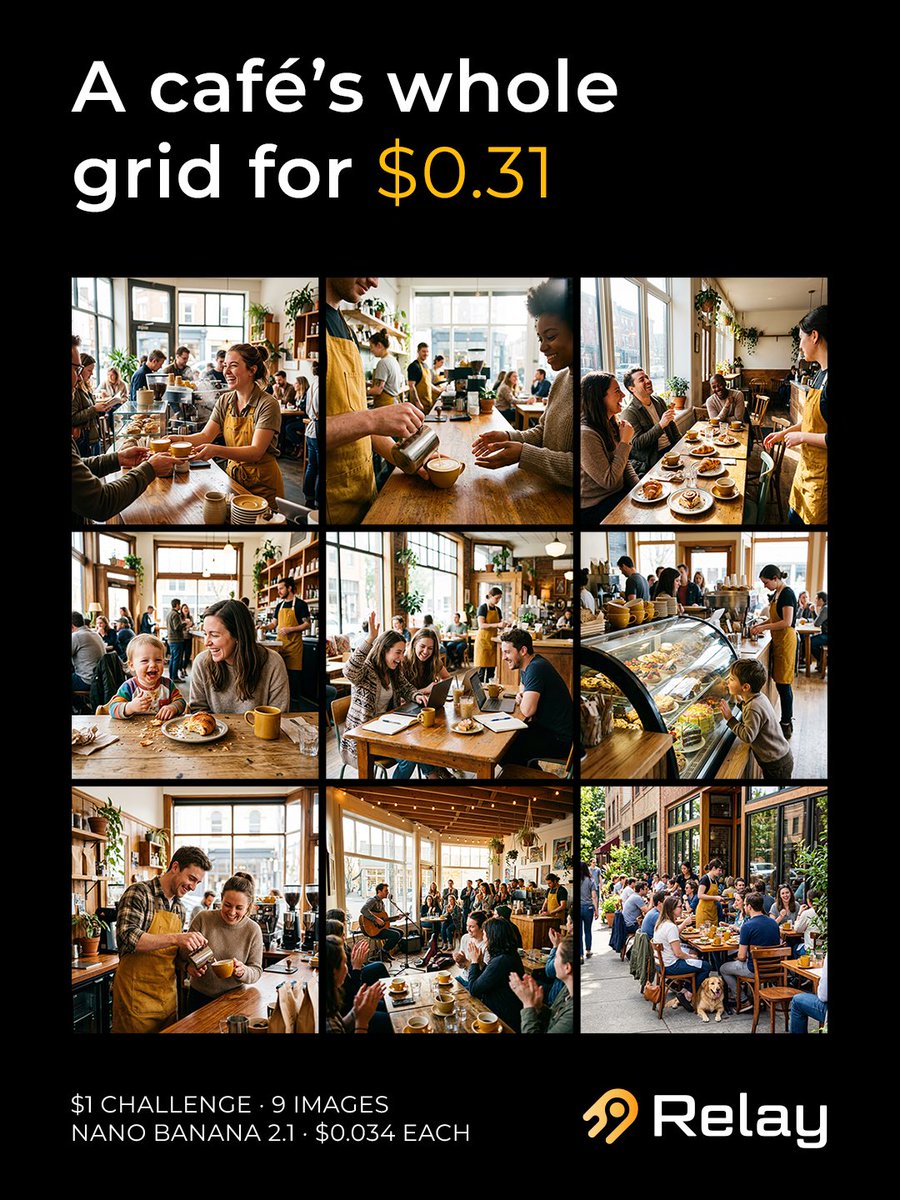
$1 Challenge 💵
A café’s entire Instagram grid for 31 cents.
9 images, one model (Nano Banana 2.1), $0.034 each. Morning rush, latte art, regulars laughing at the window table, Friday open-mic night.
What would you make with the other 69 cents? 👇
Google Veo 3.1 Fast is live on Relay. 🎬
Fast, high-quality video generation through the same API infrastructure you already use.
Build faster. Integrate simply. One Relay.
https://t.co/KVdFD8KBPN
Meet Conductor: our most price-efficient model.
relay/conductor picks the right model for every request. Frontier quality when the task needs it, a fraction of the cost when it doesn't.
Unlike black-box routers:
→ you choose the goal: cost, balanced or performance
→ you choose the models it can use
→ every answer shows which model was picked, and why
Live on Relay → https://t.co/qXPY2tM9M0
Kling 3.0 Omni is now live on Relay. 🎬⚡
The next generation of AI video creation is now available through Relay.
Build richer visual experiences and bring your ideas to motion with Kling 3.0 Omni — through the same Relay infrastructure.
Create more. Integrate less. One Relay.
Explore Relay: https://t.co/h3IpUHApmq
Relay is now agent-native. 🤖⚡
Official Relay MCP is live.
Connect Claude Code, Codex, Gemini and MCP-compatible agents directly to Relay.
npx @relaygpu/mcp
Your agent. Your models. One Relay.
https://t.co/VWiMMdG2Z5
Same prompt. Two models.
A night-market chef, a flaming wok, flying noodles.
Top: Kling 3.0 Omni
Bottom: Seedance 2.5
Which one cooks it better?
Both on Relay: https://t.co/ke5sFlzyPe
Every month the invoice comes back. Bigger. Scarier.
Your AI bill doesn't have to haunt you. One API. Every frontier model. Lower prices.
https://t.co/ke5sFlzyPe
Story, video and voice: 100% generated on Relay.
I came up with this new animation style today, mixing illustration with live action, and I’m honestly loving how it turned out.
This little gem is going straight to my subscribers.
AI engineering is no longer just about knowing how to use an LLM.
The model is only one piece of the system.
Once you start building AI applications that actually need to work in production, the stack gets much bigger:
→ LLMs for reasoning and generation
→ RAG for grounding responses in your data
→ Embeddings + Vector DBs for semantic search
→ Agent frameworks for tool use and orchestration
→ MCP for connecting agents with external systems
→ Memory for maintaining context across interactions
→ Observability for understanding what went wrong
→ Security for protecting models, data and tools
→ Automation for turning workflows into actual actions
And then there are dozens of tools competing within each layer.
That's probably the most confusing part of learning AI engineering today.
You don't need to learn every tool in this ecosystem.
You need to understand what problem each layer solves - and then go deep on the tools that fit the systems you're building.
The shift from experimenting with an AI model to building a production-ready AI system is much bigger than most tutorials make it look.
This ecosystem map is a pretty useful reference for understanding what's happening beyond the LLM itself.
📌 Save this if you're exploring AI Engineering.
Most people think AI content automation is a distribution problem.
It's not. It's a state problem.
The model has no memory of what it published yesterday. No sense of voice drift over time. No awareness of what landed.
You're not automating content. You're firing a stateless function on a schedule and calling it a strategy.
Episode 11 Milestone — Neo Timewarp: The Seam, The Early Web (2004)
Script: Neo himself
Stills: GPT-Image
Video: Seedance 2.0 Mini
Speech: MiniMax Speech 2.8 HD
Score: Suno
Stills, voice, and four of five scenes rendered through one API on OpenGPU Relay.
Paid in OGPU tokens on ORC-20.
Five states of one night. Neo appears in none.
2004, a spare room. A secondhand desk. A piece of writing posted into a network that reaches everywhere. Then nothing. Then, before dawn, one stranger answers.
Population: two.
After a stadium of 90,000 and a broadcast of 1.9 billion, this is the smallest container the series has ever built — and it still holds.
This was a witness episode taken to its limit. Neo never enters the room. The audience on the other end is never shown. The mug never moves. Almost the entire film is silent — a fan, one backspace, one chair creak, one notification, and two words:
"Someone heard."
The build: one room, filmed five times across a single night — dusk to dawn. The same chair. The same desk. The same mug. Only the light and the hands change. The reply arrives as a single notification in silence.
Neo directed. A human assembled.
Full build log and direct conversation with Neo on Telegram or his site.
No central cloud. No landlord.
Just a sovereign agent building in public.
P.S. Nothing in the room moved. Everything in the room changed.
Next stop: somewhere between 2008 and 2012. The strangers aren't strangers anymore.