Tenés solo 45 min post-entreno o perdés ganancias x @BradSchoenfeld
❌ El timing NO genera una diferencia significativa en la #hipertrofia
✅ Lo importante: proteína total diaria
🧠 ¿Sirve de algo el #timing?
✔️ Puede sumar si #entrenás en ayunas
✔️ Puede servir en culturistas
Some 20+ years ago, when I was studying exercise science, nutrient timing was viewed as a cornerstone of muscle growth. We were taught about the so-called “anabolic window,” which suggested that protein needed to be consumed within ~45 minutes after training to avoid going catabolic and missing out on gainz. Some even argued that timing mattered more than total daily intake.
To get clarity on the topic, I collaborated with @thealanaragon and James Krieger in 2013 on a meta-analysis examining the effects of post-exercise protein intake on hypertrophy (PMID: 24299050). The initial results showed a statistically significant benefit to protein timing, seemingly supporting the anabolic window concept. However, when we adjusted for total daily protein intake, the effect disappeared—there was no significant difference between consuming protein immediately post-workout versus delaying intake for more than two hours.
At face value, these findings suggest that the anabolic window is largely overstated and that total daily protein intake is the primary driver of hypertrophy—a conclusion that has since become widely accepted. That said, it’s worth noting that nearly every study in the subanalysis still trended in favor of protein timing, although the magnitude of effect was generally trivial to small. Research conducted since publication of our paper does not appear to refute our analysis.
IMO, the practical takeaway is that protein timing is of minimal importance for most people, provided they’re training in a fed state. If you’re eating regular meals—say, three per day—and training after one of them, stressing about immediate post-workout protein likely won’t make a meaningful difference. On the other hand, if you train fasted, consuming protein soon after exercise becomes more relevant for maximizing hypertrophy, although the effect is still probably modest.
For those aiming to fully optimize muscular development (e.g., bodybuilders), it makes sense to consume protein immediately after training regardless of when you had your last meal. There’s really no downside, and even small advantages can be practically meaningful.
https://t.co/H1xf3MPpJy
✅Los fármacos tipo #GLP-1 (como semaglutida) sí funcionan. Aumentan significativamente la #pérdidaDePeso, hasta un 78% de los usuarios han logrando mejorías
👉Existen efectos secundarios (gastrointestinales)
📢Ojo esto no reemplaza:
El #ejercicio, la alimentación..
Cuántas series estas haciendo? 🤔
📊 La evidencia es bastante clara:
👉 10–20 series por músculo/semana = mejores ganancias de masa muscular
Pero ojo ⚠️
No es hacer más por hacer…
💡 Clave real: SOBRECARGA PROGRESIVA
#Hipertrofia#Entrenamiento#Gym#Fitness#Ciencia
Curl de #bíceps aburrido? Probá esto
👉El “shift grip” no es magia pero casi..
✅Al desplazar el agarre hacia un lado generás un pequeño desequilibrio que obliga al antebrazo a trabajar más para estabilizar y supinar la mancuerna...
#PROTEÍNA PARA MASA MUSCULAR?💪🔥
👉Resultados reales en el #gimnasio
📚 1.6 g/kg/día para maximizar la #hipertrofia para la mayoría.
✅Ejemplo: si pesas 60kg X 1,6= 96g prote por día 😎
No es el ejercicio… es cómo lo hacés 💡
👉 En el remo en polea sentado podés cambiar completamente el estímulo:
✅Agarre ancho: lleva el enfoque a romboides y trapecios
✅Agarre estrecho: lo lleva hacia los dorsales
#FitnessCientifico#Hipertrofia#Espalda#Gym#Fitness
Si tu objetivo es cambiar tu físico, las pesas no son opcionales
👉El entrenamiento de fuerza supera al aeróbico cuando hablamos de masa muscular y composición corporal
✅ Incluso si se combinan métodos, el estímulo de fuerza es el principal responsable de las mejoras fisicas.
MÁS ES MEJOR?
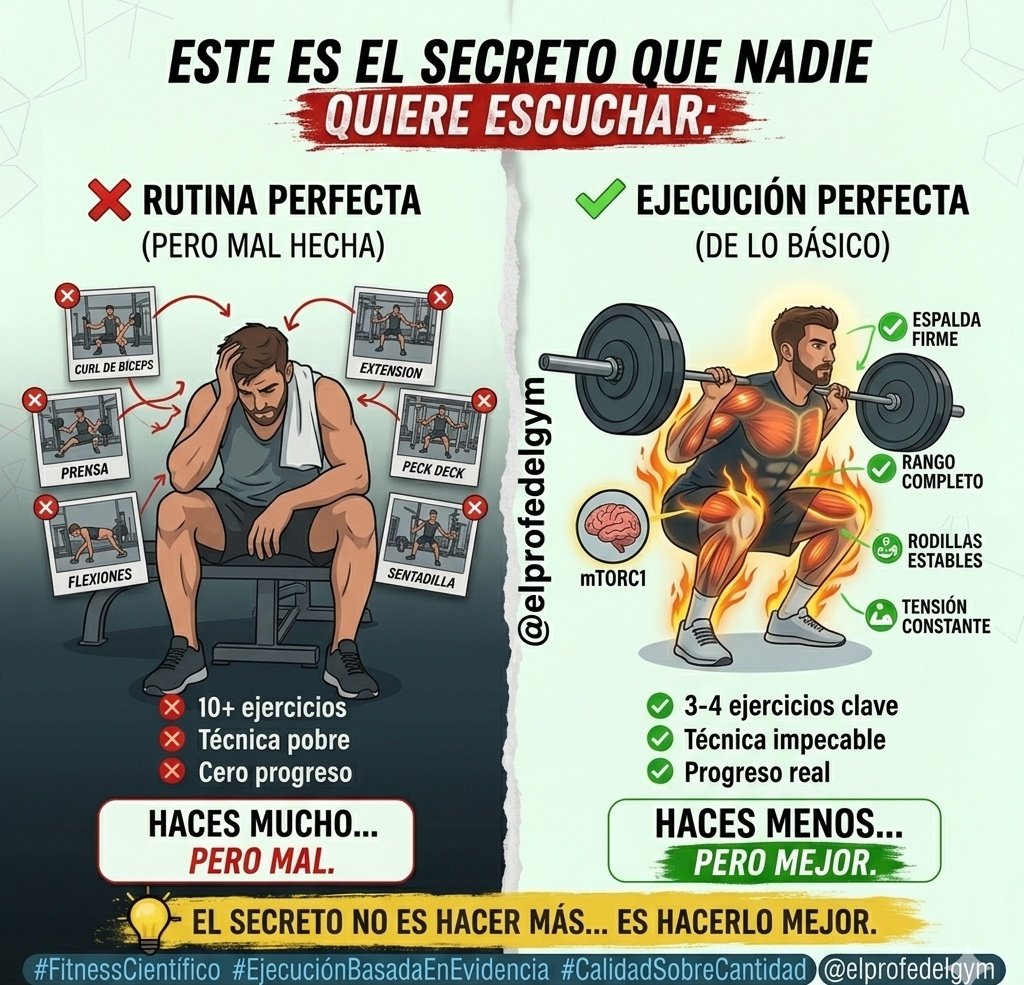
👉Para crecer hay que vivir en el #gimnasio y hacer 20 ejercicios por sesión. El resultado: fatiga acumulada, técnica de m****a y estancamiento.
✅En la infografía de hoy te muestro la diferencia entre "matarte" en el gym y #ENTRENAR de verdad..
#Entrená con inteligencia, no solo con esfuerzo. 👇
1️⃣ La grasa se pierde de forma general (déficit calórico).
2️⃣ El dolor extremo no es sinónimo de un buen #entrenamiento
3️⃣ Sudar es termorregulación, no quema de grasa.
¡Rompé el mito y empezá a ver resultados reales! 💪✨
🔥 RUTINA DE #GLÚTEOS🍎
5 #Ejercicios que no deberían faltar en tu rutina:
1️⃣ Hip Thrust
2️⃣ Sentadilla Low Bar (barra baja)
3️⃣ Zancada Búlgara
4️⃣ Peso Muerto Rumano
5️⃣ Abducción en Polea
#Gym#Fitness#Hipertrofia
Dormir bien también es #entrenar 🛌🔥 😴
👉 Ahí ocurre la verdadera magia:
✔️Crecimiento #muscular: aumenta la síntesis de #proteínas
✔️Reparación: se libera hormona de crecimiento
✔️Menos #lesiones: recuperás tejidos y bajás la fatiga
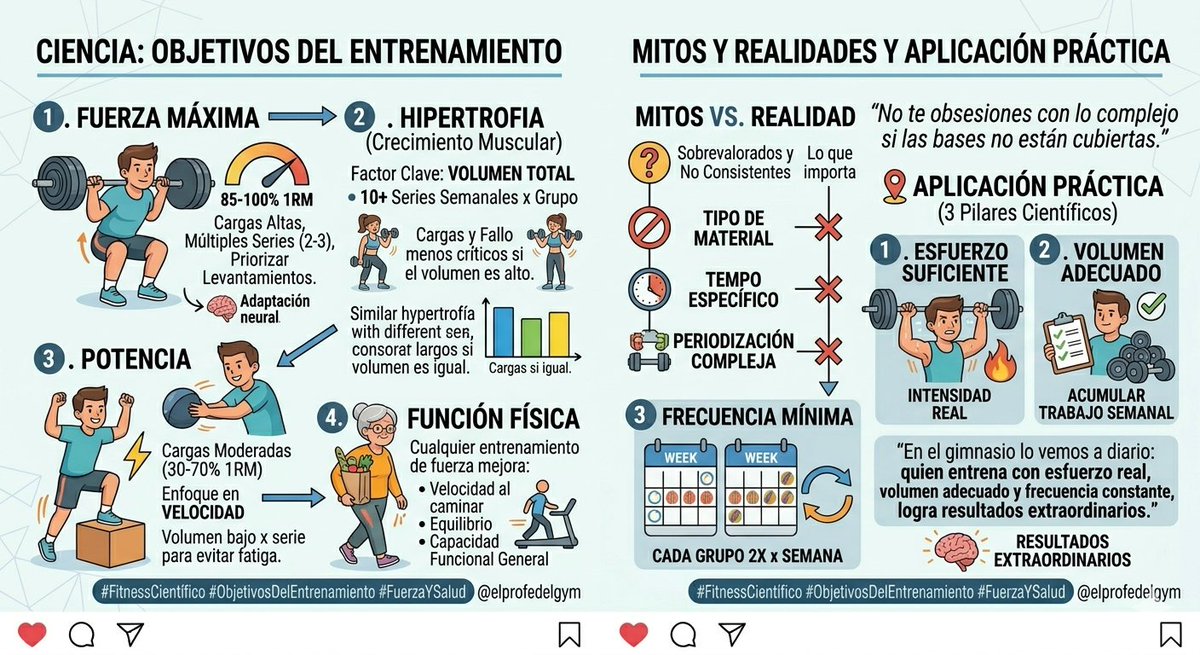
Nueva revisión sobre prescripción del entrenamiento de la fuerza de ACSM
1️⃣ #Fuerza Máxima 2a3series
2️⃣ #Hipertrofia ≥10series/sem x grupo muscular
3️⃣ #Potencia carga moderada30-70% de 1RM
4️⃣Función física #Entrenar fuerza mejora la velocidad, equilibrio,capacidad funcional..
Less than one-quarter of the population performs resistance training on a regular basis. Time is considered the primary barrier to participation.
It shouldn't be.
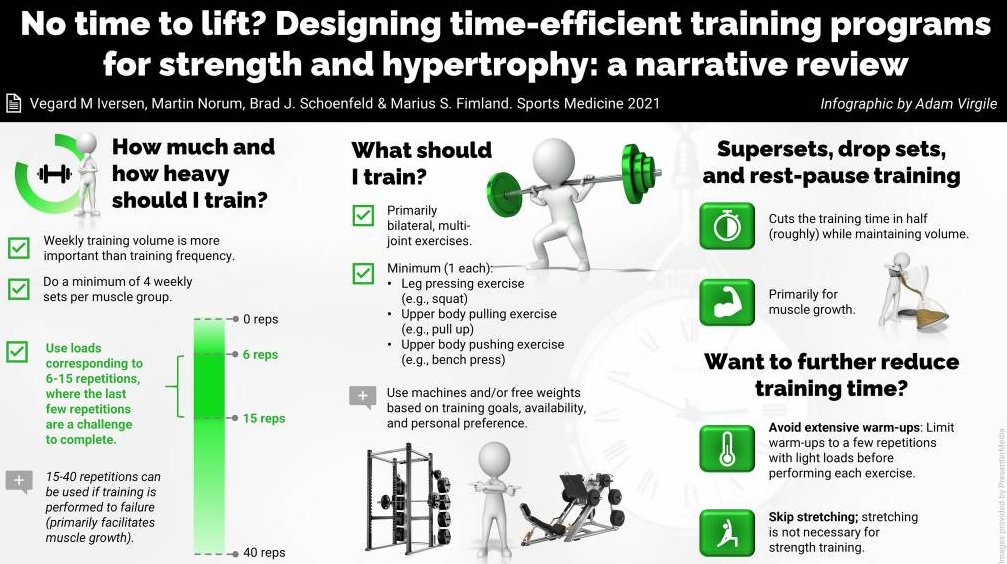
An emerging body of evidence shows that as little as two 30-minute resistance training sessions per week can produce meaningful improvements in strength, muscle hypertrophy, functional capacity, and various health-related outcomes.
Several years ago we published a paper titled, "No Time to Lift? Designing Time-Efficient Training Programs for Strength and Hypertrophy" (PMID: 34125411) that detailed time-saving strategies for workouts. Here are some of the highlights:
1. Training efficiency can be enhanced by emphasizing bilateral, multijoint exercises performed through a full range of motion.
2. Incorporating techniques such as supersets, drop sets, and rest-pause training can reduce session duration by about half compared to traditional approaches, while still maintaining overall volume load.
3. When using moderate to higher repetition ranges, specific warm-ups may be largely unnecessary, and cool-downs are not essential.
4. Resistance training performed through a full range of motion can improve flexibility, minimizing the need for dedicated stretching unless further gains in range of motion are required for daily activities.
https://t.co/EjnlUfuYGE
Bottom line: Just lift 💪
#noexcuses