Mark my words.
The BJP is not coming back to power at the Centre in 2029.
This time, Hindu vs Muslim, India vs Pakistan, Congress, Nehru, temples, or emotional slogans will not be enough to win a national election.
I do not know what will happen in the states, but at the national level, I think the BJP is heading for its biggest defeat yet.
And before anyone starts calling me a Congress supporter, I am not. I do not support the BJP or the Congress. This is simply my political prediction.
What do you think will decide the 2029 Lok Sabha election?
IT Stocks: 2021 vs Today!
Let’s see how some popular Indian IT shares have performed from 2021 to now
🔹 TCS: 3500 ➡️ 2600
🔹 Infosys: 1714 ➡️ 1266
🔹 HCL Tech: 1153 ➡️ 1332 ✅
🔹 Wipro: 341 ➡️ 200
🔹 Tech Mahindra: 1806 ➡️ 1441
🔹 LTIMindtree: 7200 ➡️ 4500
🔹 Coforge: 1139 ➡️ 1200 ✅
🔹 Persistent: 2300 ➡️ 4600 🚀
🔹 Cyient: 1150 ➡️ 955
🔹 LTTS: 5500 ➡️ 3200
🔹 Naukri: 1465 ➡️ 1020
📉 Correction phases create opportunities for patient investors.
📈 Wealth is created by conviction, not by chasing momentum.
What’s your view on the IT sector for the next 3–5 years? 🤔
🚨BREAKING: China just crushed India’s “internal matter” narrative on Kashmir.🇵🇰🤝🇨🇳
Beijing openly backed Pakistan’s stance and called Kashmir a “historical unresolved dispute” under UN resolutions. 👀
Modi’s 2019 Article 370 dream? Shaking badly right now.😰
For the first time in years, India is facing diplomatic pressure from TWO nuclear powers together. 🔥
The message from Pakistan & China is clear:
Kashmir’s future will NOT be decided in Delhi alone. 🇵🇰⚔️🇨🇳
#Kashmir
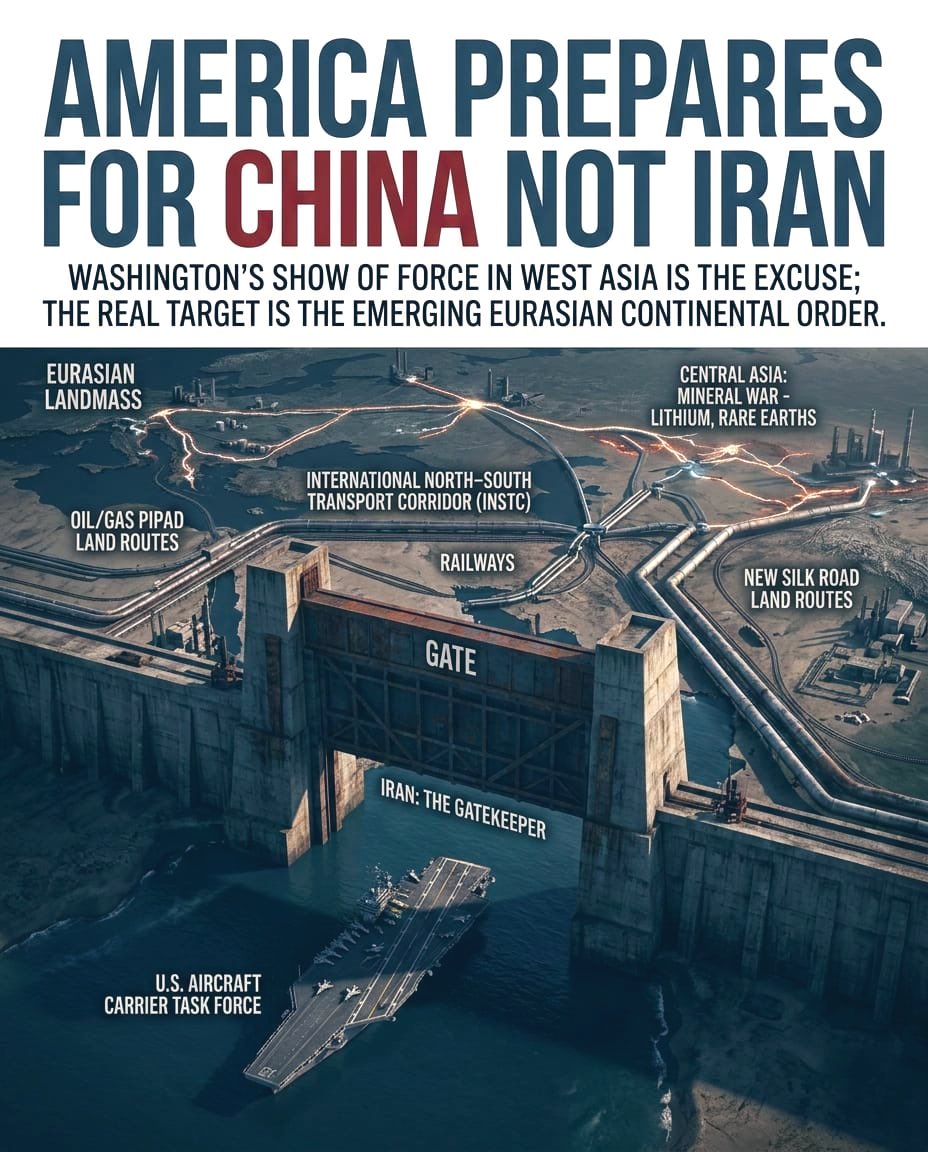
𝗔𝗠𝗘𝗥𝗜𝗖𝗔 𝗜𝗦 𝗣𝗥𝗘𝗣𝗔𝗥𝗜𝗡𝗚 𝗙𝗢𝗥 𝗖𝗛𝗜𝗡𝗔, 𝗡𝗢𝗧 𝗜𝗥𝗔𝗡
It is becoming increasingly clear that the United States is restructuring its global military posture not primarily for Iran, but for a long-term strategic confrontation with China.
Iran is the justification.
China is the calculation.
Washington has done this before. After 9/11, the “War on Terror” enabled a vast redeployment that entrenched U.S. power deep inside West Asia, not just to fight terrorism, but to sit astride the world’s energy arteries, mineral basins, and continental crossroads.
Today, a similar repositioning is underway under the banner of deterrence against Tehran.
But great powers do not reorganize global force posture for secondary threats.
You cannot contain a peer competitor from thousands of miles away.
You cannot shape the balance of Eurasia while anchored in Europe alone. Strategic gravity lies further east, where trade routes, pipelines, resource basins, and land corridors determine the flow of power.
For more than a century, American primacy has rested on command of the seas: controlling chokepoints, shipping lanes, and maritime trade.
China’s grand strategy aims to neutralize that advantage by activating the continental mass of Eurasia.
Railways, pipelines, and overland corridors cannot be blockaded by aircraft carriers.
If Beijing succeeds in building fast, secure, and inexpensive continental routes, modern Silk Roads, the strategic value of U.S. naval dominance declines sharply.
Sea power matters less when the world’s commerce, energy, and supply chains move by land.
This is why Central Asia and its surrounding zones are pivotal.
The region is not only a transit hub, it is a vast reservoir of critical minerals essential for advanced technologies: rare earths, strategic metals, and energy inputs required for semiconductors, batteries, aerospace systems, and next-generation weapons.
Control over these resources means control over the industrial foundations of future power.
Denying them to rivals is as important as securing them.
Equally decisive is the emerging north–south axis centered on Iran.
Overland routes running through Iran allow Russia to access the Persian Gulf directly, faster, cheaper, and beyond vulnerable maritime chokepoints.
This corridor compresses distance between northern Eurasia and warm-water ports, reshaping trade geography.
If China integrates into this network by land, a continuous Eurasian system emerges linking East Asia, Central Asia, Russia, and the Gulf.
In that scenario, American sea control becomes strategically insufficient.
The United States would face a continental bloc able to trade, transport energy, and move goods across Eurasia without reliance on maritime routes dominated by the U.S. Navy.
Control of West Asia therefore achieves multiple objectives simultaneously:
- Secures critical mineral basins and energy reserves
- Dominates key transit chokepoints• Blocks east–west continental integration
- Disrupts north–south connectivity linking Russia to the Gulf
- Positions forces at the intersection of three continents
- Prevents the formation of a self-sufficient Eurasian economic sphere
In this framework, Iran is not the endgame, it is the gate.
What appears as regional crisis management is in reality great-power positioning.
The struggle is not about one country, one conflict, or one nuclear program.
It is about whether the 21st century will be shaped by maritime empires or continental powers.
If China succeeds in activating the land while Russia gains southern access through Iran, a vast integrated Eurasian system could emerge, one largely insulated from maritime pressure.
America would still command the oceans, but no longer the world system.
The battles in West Asia are not the main war.
They are the deployment phase for the one that matters.