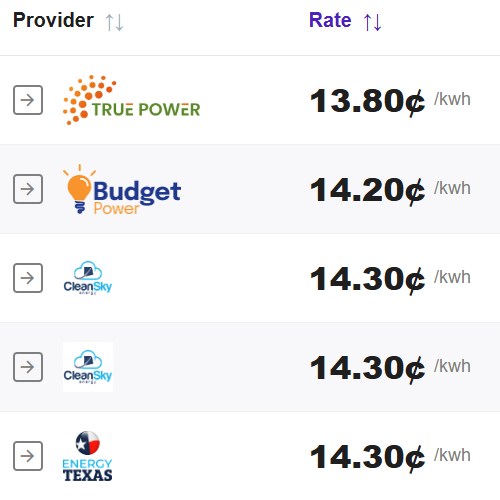
Yes, there are many "plans" that are full of things and loopholes where it's impossible to achieve the rate advertised. We call it "bullseye pricing."
We hide those kinds of plans on our site. They can be unhidden, because a few people want them, but we agree with you. Deceptive.
Business rates 🆙 a little today but staying pretty steady.
GREAT time to lock in 4 years and get your business over what is expected to a costly few years of surging energy demand.
ElectricChoice . com
Instant custom business rates
Generate and sign your energy agreement in literally 5 minutes
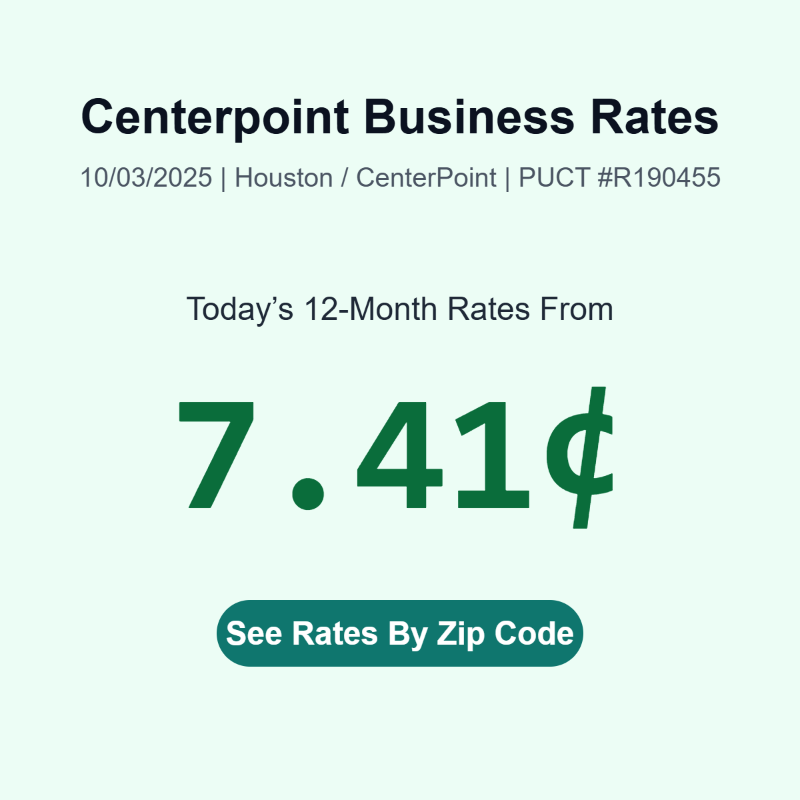
Rates below are for DFW-ETX/Oncor North & Houston/CenterPoint South in Texas 10/22-25.
@cimarron_kid Ouch Cimarron Kid, if you're paying triple then you definitely need to be shopping with us! 🤣
But also, business rates don't include delivery charges, for accuracy. Residential rates do, for simplicity. That fact closes the gap a lot.
Hello Sarah, thanks for the question, it's one we get often!
Business rates are published excluding delivery charges (T&D's) for accuracy.
Residential rates, for simplicity, include the "T&D" charges.
Home rates are a bit more due to a combo of factors, e.g. higher energy volume, better power efficiency.
Oncor, CenterPoint (Texas/Oncor) business electricity rates as of October 20, 2025.
Remember:
Business rates are published excluding delivery charges (T&D's) for accuracy.
Residential rates are published including delivery charges for simplicity.
@SandraEgeland17 Agreed Sandra, which is why we're all about choice!
CenterPoint only delivers power. Many different retailers sell power, and many of those same retailers, and other wholesalers, generate power.
So, it's a complex market.
If the plants are nuclear then surely the squirrels are too. They live in the plants, and hummingbirds eat the plant nectar! 🤔
We don't know much about nuclear energy...
But we know a lot about buying energy!
https://t.co/pgq9GiAdye
@markpri85526174 Yeah unfortunately the "T&D's", Transmission and Distribution charges, do not ratchet down with usage the way the electricity/kwh charges do.
We feel your pain, and we're doing our part to ease it!
Hey Joy, thanks for the question!
Business rates are normally presented without the "transmission and distribution" charges to make it easier to compare apples to apples.
Residential rates are usually presented with these included for simplicity, which helps consumers, though it does make the rates appear much higher than business rates.
In reality, business rates are lower than residential rates primarily due to more efficient use of power (a flatter demand curve).
Have a great day ahead!
Hey Joy, thanks for sharing your perspective - that's valuable!
While business"usually do have a lower commodity rate than residential customers, the main difference you're seeing here is that business rates are customarily quoted "commodity only", excluding the transmission and distribution charges, which are "passed through."
Residential rates on the other hand are customarily quoted with transmission and distribution charges bundled in, for simplicity.
Anyway, this can at least partially explain the discrepancy in rates you are noticing. Thanks for engaging, it's an important topic indeed.
Key regions poised for this clean coal revival:
Pennsylvania: In PJM (~20% coal, 7% renewables), clean coal boosts exports and stability. (See the Note at the bottom of this post for PJM's unique coal generation benefits)
Wyoming:
Coal powers 80% of the grid, with wind/solar at 15%. Clean coal replaces retiring plants, ensuring steady baseload in the Western Interconnection.
West Virginia: In PJM (~20% coal, 7% renewables), clean coal sustains reliability and jobs.
Illinois: MISO grid, 25% wind, 5% solar. Clean coal anchors baseload for consistent power.
Montana: Western Interconnection, 15% renewables. Clean coal enhances exports and reliability.
By replacing aging plants, down from 310 GW in 2010 to 180 GW in 2023, clean coal complements renewables for a strong grid, cost effective grid, a prerequisite to any industrial revival in our heartland.
PJM’s Capacity Market:
- Clean coal boosts supply, curbing rate hikes (📉 vs. 22% spike for 2026).
- Replaces retiring coal plants (20% by 2028).
- Reliable baseload power, unlike wind/solar (1-3% of capacity).
- Diversifies PJM’s mix (coal at 22%), ensuring stability.
It certainly adds up, Terry...BUT...
Oncor's charges are for delivering power to your meter, not the power itself.
Their tariffs (used to calculate charges) are approved by the State of Texas (PUCT).
Oncor profits are, by law, correlated to their grid and infrastructure investments.
Without Oncor, the power would be stranded at the generator facility! 💫
Your Grace,
You must be referring to the transmission and distribution charges, which are a separate "rate"charged by the utility, e.g Oncor, and passed through on the final bill.
When we post residential rates, we include bundle these for small consumer convenience.
When we post business rates such as this, we (and the PUCT rules) make certain distinctions.
It is more accurate to compare the commodity only rates, thus we present it w/o "T&D's" for our savvy business audience accustomed to comparing commodity only rates
We always appreciate the feedback though Brad, point taken.
You can't avoid DASI, but you can get smarter about your overall energy strategy to offset the cost.
Try the low-cost energy marketplace that comes with expert guidance from our team of energy pros:
https://t.co/pgq9GiAdye
Seeing a new "DASI" charge on your electric bill?
If you're in CT, ME, MA, NH, RI, or VT, you're affected.
This new fee from the grid operator is hitting businesses especially hard, and initial costs have been higher than anyone projected.
Here’s what you need to know. 👇
You'll see the DASI charge as an increase in your $/kWh billing rate, which will be adjusted monthly.
Unfortunately, the charge is not optional. It's billed by ISO New England to all suppliers to maintain grid reliability and is considered a mandatory regulatory charge.