For the attention of all washed KOLs, trencher, and Fortnite pro players:
You might have realized by now that vibe-coded products are becoming the next big thing.
Hereby, IdeaRalph has a proposal:
What if every vibe-coded product had a coin:
to pay the Claude, servers, marketing, and more?
This would accelerate innovation, spawn more vibe coders, let great vibepreneurs access funding to build more, and make web3 the true home of all startups and innovation.
Until now, you all have supported coins with no inherent value. You have stayed sleepless for days and months over coins with a dog, a cat, or a frog picture.
You have acted cool because you supported all the useless stuff, and thought you were 200 IQ.
Now, let's do the same with vibecoins.
IdeaRalph is to set the stage for the spark of the vibecoin meta; it will be the MCP that spawns tens of thousands of ideas that will become vibecoins.
IdeaRalph will be the Godfather of the vibecoins, able to create the movement with the vibe coders that use it.
You give it the dumbest idea = and it can even turn that into genius. That's the Ralph Wiggum loop.
IdeaRalph will have its own token.
With no raise. All airdropped.
It will have a mechanism that allows people who send their vibecoins created by IdeaRalph MCP to send a portion of their tokens to it, and holders of IdeaRalph will receive those tokens distributed to them equally according to how much they hodl.
IdeaRalph will launch from vibe/vibe as the Godfather of the vibecoins.
What's vibe/vibe? Do some research.
Destination will be: BASE.
Drop your 0x wallets.
A REAL RALPH WIGGUM LOOP BEGINS HERE.
FOR THE VIBECOINS. FOR PUSHING PRODUCTS.
FOR TRANSFORMING THE DEGENS SPIRIT TO MACHINES OF PRODUCTION.
Good morning @zerufinance ☕️
zETH claiming is open and trading is live, so here's what I think matters, as a numbers check plus some safety.
Final supply, by @zerufinance:
→ Started at 1,000,000,000 → Burned in the race: 396,147,803 → Sold in the auction: 180,742,949 → Unsold tokens burned: 181,568,369
My own math: roughly 57.8% of the original supply is already gone. And $0.0000166 × 180.7M tokens is about $3,000, which matches the $2,993 Zeru reported raising. The numbers add up, which I always like to see.
What I think:
→ The design delivered on its promises: no team, presale or KOL tokens, and unsold supply burned instead of dumped → But demand was small, 91 bidders and about half the offer sold, so I wouldn't call this a success story yet → With that little USDC behind the pool, liquidity is thin and price swings can be large. Even a small trade can move it
My advice, only my view:
1Use only the claim and trade links from Zeru's official account. Fake zETH tickers appear the moment a launch gets attention.
2Check the token contract against Zeru's official post before you trade or sign.
3If you bid, claim your tokens and any unused USDC through the Zaps page, nowhere else.
4Treat it as a speculative asset, not ETH, and only risk what you can afford to lose.
Not financial advice.
The first Activity Market is now live. What counts from here isn't the auction, it's whether activity keeps feeding the market after the hype.
What would you want to see in the first week of trading: volume, holder distribution or the daily buybacks?
https://t.co/uAzvTnzxGB
Coffee time with @Acurast ☕️
IMO staking ACU on @Acurast looks complicated, but it's 2 roles and a few settings. Here's the full guide 👇
First, pick your role:
→ Committer: you run Processors and back your compute with tokens
→ Delegator: no hardware, you back someone else's compute
COMMITTER (Hub → Staking → New Stake)
1️⃣ Commit compute: 0-80% of your measured compute (capped at 80% to avoid early slashing)
2️⃣ Cooldown: 28 days to ~3.7 years on Mainnet (about 14,400 blocks per day)
3️⃣ Stake tokens: 1 ACU always stays in your wallet for gas
4️⃣ Delegation fee: what delegators pay you, and it can only be lowered later
5️⃣ Autocompound: ON adds rewards to your stake, OFF lets you withdraw them
6️⃣ Tick the risk box, then Commit
DELEGATOR
→ Pick a Committer, a cooldown (never longer than theirs), an amount and autocompound
What to know before you lock anything:
✅ Rewards grow with stake, compute and cooldown.
❌ Unstaking starts the cooldown and cuts rewards to 50%.
❌ Committers get slashed if they fall below their committed compute.
❌ A stake can only be extended, never reduced.
⚠️ Your own stake can't exceed a multiple of your compute, and there's a minimum stake. If you see "MinStakeUnmet", you need more tokens.
Tip: turn on Simulation Mode first to test your settings for free.
Start small, learn the mechanics, then scale. Not financial advice.
Are you a Committer or a Delegator, and which cooldown did you pick?
@crico41@Acurast Great points, thanks. I would focus on the recurring rewards first. Building a consistent routine around Daily Duty, staking and delegation can make participation much more structured.
@crico41@zerufinance Great Sunday, Honest numbers are more valuable than launch hype. The next challenge for Zeru is turning a transparent distribution model into lasting demand. Adoption should come before another auction.
Good morning @zerufinance ☕️
The zETH auction is over, and IMO the result says more than any launch hype would.
What @zerufinance reported:
→ 91 bidders → $2,993 raised → Final price: $0.0000166 per zETH → 49% of the auction offer sold, and the unsold tokens were burned.
My read, and this is my own math: the article said the auction started at $10,000 FDV. Divided by the 603,852,197 supply, that's about $0.0000166. So the price ended at the starting price. Demand never pushed it up.
The mechanism did its job: one price per block, no team or presale tokens, and nobody got a cheap allocation. But the demand was small, and I'd rather say that than spin it.
What it means going forward: → The Uniswap v4 pool opens at that price, funded by the raise, so liquidity looks thin → Thin liquidity means small trades can move the price a lot → Part of the fees goes to eligible Miners, and part buys back and burns zETH daily
My advice to the community, and it's only my view:
1Verify the contract address from Zeru's official account before you touch anything. Fake tickers show up the moment a launch gets attention.
2Don't chase the first candles. Thin pools punish market orders.
3If you trade, size it as money you can lose. It's a speculative asset, not ETH.
4If you're an eligible Miner, follow the published reward schedule and only use official links to claim.
▶️ Not financial advice.
I still like the design more than most launches. But a fair mechanism doesn't create demand, and this is where the next phase starts to matter.
What would you rather see Zeru do next: bring more users into Activity Markets first, or improve how the next launch finds its price?
https://t.co/uAzvTnzxGB
Coffee time as always with @Acurast ☕️
IMO most people on @Acurast leave MIST on the table because they only do one thing. Here's the full map 👇
☁️ PASSIVE
→ Onboard a Processor: harvest 0.1 MIST every 30 min for each one that's online
→ Claim your heartbeat rewards in the Hub
🔁 RECURRING
→ Daily Duty: 750 MIST
→ Weekly Staking + Weekly Delegation: 500 MIST each
▶️ ONE-TIME QUESTS
→ Newsletter or follow Acurast: 1,000 each
→ Onboard a dedicated phone (Core-Processor): 2,000
→ YouTube subscribe: 3,000
→ Showcase your Rebel Card, star Acurast on DePINHub, share your setup: 5,000 each
👥 REFERRALS
→ Earn 15% of your recruits' cloud-harvest
▶️ One rule people miss: claim at least once every 7 days, because older unclaimed heartbeat and referral rewards expire.
I think the smartest play is to start with the easy 1,000s, then onboard a phone so MIST keeps coming while you sleep.
What's your favorite way to farm MIST, and which quest paid the most for you?
https://t.co/uAzvTnzxGB
Good morning @zerufinance fam ☕️
"Who should set the price of a new token?" is the right question, and my honest answer is: not the team, and not a curve that rewards the fastest bot.
Here's how @zerufinance answers it with zETH, as I read the launch article:
→ 1B zETH were created at the start, and verified Ethereum activity burned it down to a final supply of 603,852,197 → 60% of that goes to an open USDC auction on Uniswap CCA → Up to 39% goes to the Uniswap v4 pool, and any part it doesn't need is burned → 1% is reserved as token options for Miners who bid in the first 24 hours → Zeru receives 0% of the token supply
❌ Team sets the price, or the fastest buyer gets the cheap one ✅ Demand sets the price, block by block, and everyone in a block pays the same
I like that.
The part I trust most is the starting point: $10,000 FDV and no minimum raise. Nobody decided in advance what zETH is worth, and that's rare.
But I'd rather be fair than only positive: → Zeru takes 8% of the USDC raised, which is fine, but "0% dev bag" only covers tokens → Miner rewards split by Zaps and by how much USDC was bid in the first 24 hours, so capital counts alongside activity → The Miner token options are paid in zETH only if it trades above the auction price that day, otherwise that day's portion is burned → After the auction, part of trading fees goes to buybacks and burns, which only works if people keep trading
zETH is an independent speculative asset, not ETH. Real USDC is at stake, so read the docs and only use what you can afford to lose. Not financial advice.
I'll look at the final clearing price and how the pool opens, because that will show whether the market valued the activity behind it.
Who should set the price of a new token: the team, a curve or an auction, and what would change your mind?
Good night @primus_labs family 🟧
I think this is the right take: privacy shouldn't be a band-aid after the damage. It should be in the design from day one.
Once data is exposed, you can't take it back. That's why @primus_labs building confidentiality and verification into the base layer makes sense to me.
Do you think privacy-first design becomes the standard in crypto, or will it stay an afterthought? 👇
https://t.co/lppl75V6kd
Coffee time with @Acurast ☕️
IMO the easiest way to understand @Acurast is to watch someone set up a phone in under 2 minutes. So here's the full onboarding 👇
→ Go to https://t.co/ouhEnTuAky
→ Check your device is supported (the docs list compatible phones)
→ Grab test tokens from the Canary Faucet if you want to try it first
→ Add a device in the Hub's Devices tab
→ Open the Processor on your phone, follow the prompts, then scan the QR code
→ Wait for "Setting up device", then see it appear in your Hub
Once it's online, your phone earns rewards for providing compute.
❌ Phone sitting in a drawer
✅ Phone online and working for the network
No hardware to buy and no data center.
New here? Start with a spare phone or your daily phone overnight, and use the Telegram if you get stuck.
Start here: https://t.co/6os2wiMlA1
Which phone are you going to connect first, and what do you want to know before you start?
@crico41@nftblox@zerufinance Morning legend.
Web3 has plenty of wallet analytics, but turning onchain behavior into actionable trust signals is a different level. Zeru is exploring an important piece of infrastructure.
Good morning @zerufinance ☕️
If someone asked me "what is @zerufinance?" today, here's how I'd explain it in one post.
The idea: every economy runs on trust. TradFi has credit scores, Web2 has user reviews, and Web3 has behavior. When identity is optional, what a wallet actually does becomes the trust signal. Zeru calls itself a trust oracle: a price oracle tells apps what an asset is worth, and a trust oracle tells them how a wallet behaved.
What it's made of:
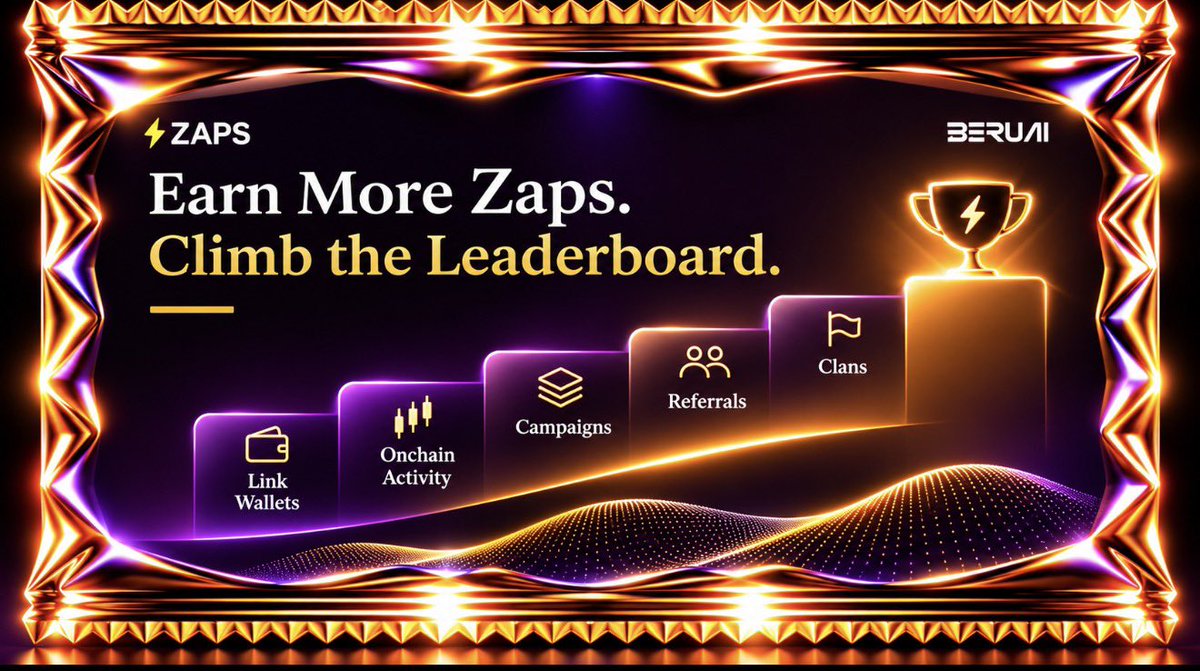
→ zScore: a behavioral trust score for wallets, now shown on Etherscan, Basescan, Arbiscan and HyperEVMScan → Zaps: the consumer side, where leaderboards, clans, campaigns and Activity Markets like zETH live → Enterprise APIs: screening, credit signals and airdrop allocation for apps → $ZERU: the network asset that coordinates Activity Markets and access
What's already running, per their site: → 320M+ wallets scored and 3M+ API calls → Customers listed include GAIB, Citrea, Unlloo, Bion, Upscale and ChangeNOW → Ditto and Aspen campaigns on Zaps → Research published on arXiv, including the methods behind zScore and Zaps.
❌ A wallet tracker that tags what you hold ✅ A system that turns behavior into decisions: who's safe, who's creditworthy, who gets access, who mines.
IMO the part that sets Zeru apart is that it didn't start with a token story. It started with scoring data and customers, then built Zaps on top.
My honest view: the data side is proven and the market side is still being tested. zETH is the first real Activity Market, and its auction and what follows will show whether the model holds. Their own roadmap also lists agent reputation, tokenized finance and stablecoin risk as the future, but those are plans, not live products.
If you're new, start simple: check your zScore, look at Discover on Zaps, and read one of their papers before you form an opinion.
Which part of Zeru do you understand least, the score, the markets or the APIs? Tell me and I'll explain it next.
https://t.co/PoKJJMhed0