Similar story, just the flip side.
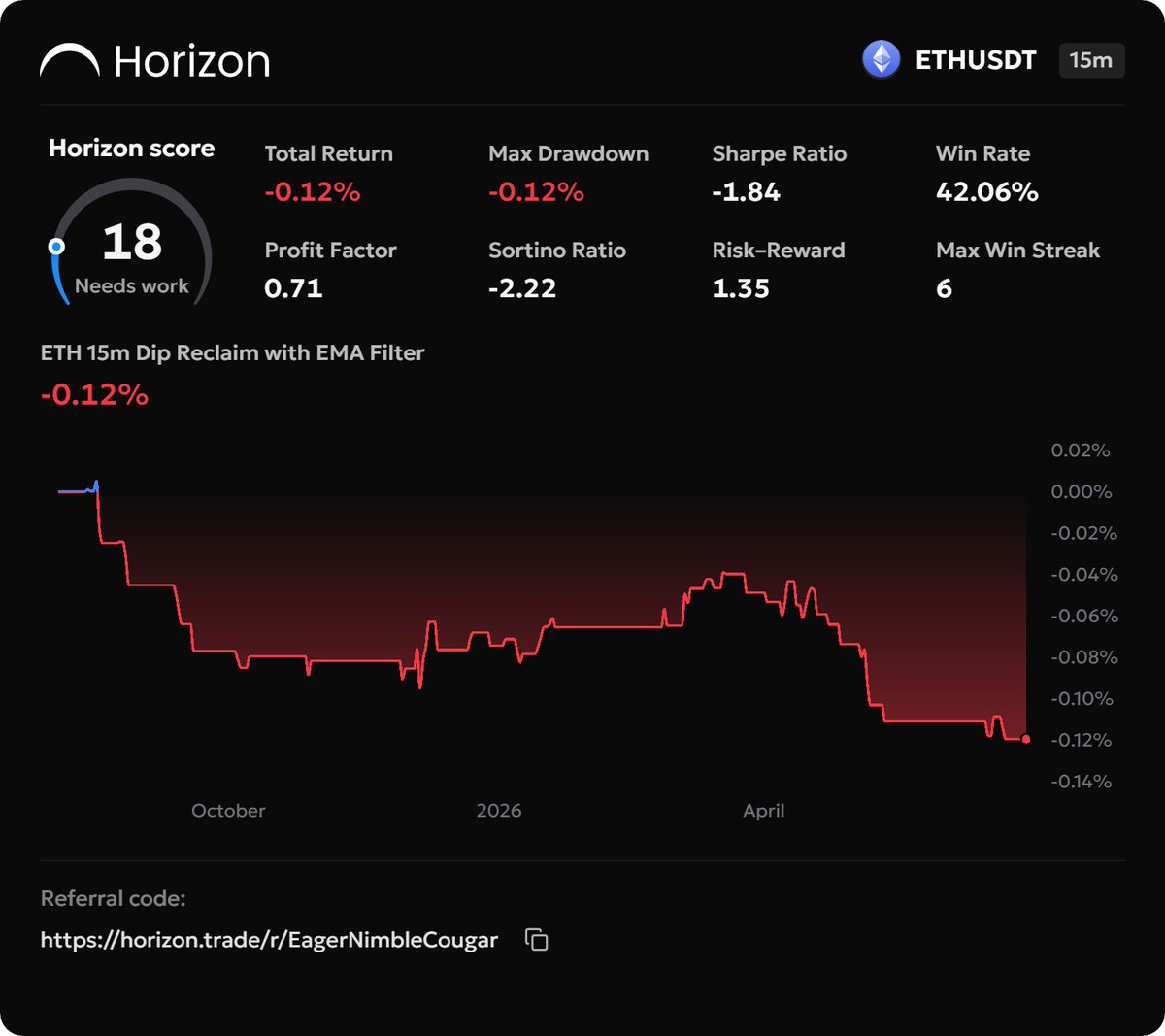
I also ran my own strategy through Horizon - ETH 15m, long-only, entry on RSI<35 dip reclaim during an uptrending 1H trend.
On paper the idea looked workable: gross profit factor 1.15, 68% win rate before fees.
None of this is a shot at Horizon. The platform did not paint me a clean equity curve or sell me an illusion of profit. It handed back a Score of 12, Sharpe 0.15, and a log where every commission is visible. https://t.co/OSWS5TccXQ
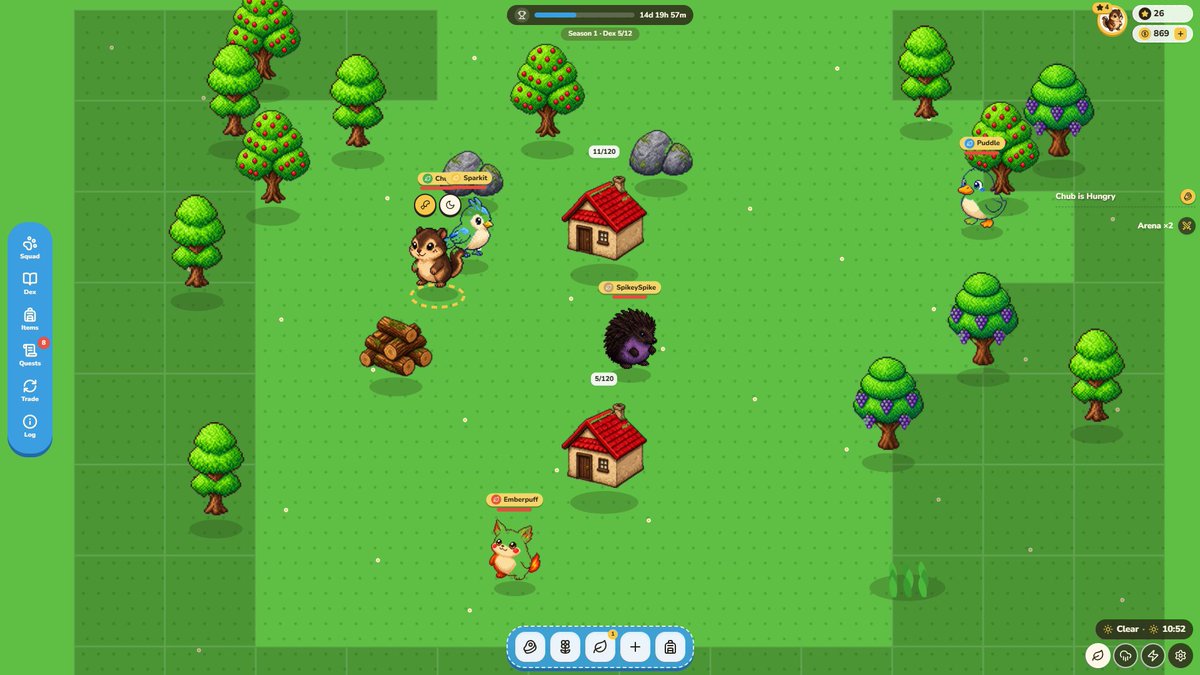
Same prompt, different model. @grok shipped the build in 30 minutes.
@Zai_org GLM-5.3-Flash took 70
Input unchanged: the Regions and Economy guides plus one screenshot of their visual.
What came out:
the art is clearly weaker. No argument there, the first build looks better
there's more interface. Clickable panels, side rail, quest log, economy, weather, day counter. Plenty to press
more of the systems from the docs are surfaced instead of buried under the hood
The brief was locked and the models still spent the budget differently. One put it into the art. The other put it into interaction depth and paid 2.3x the time for it.
I want the art of the first build and the interface of the second. Either one takes an hour. Neither model gives you both yet.
Gave @grok two pages of docs and one screenshot. Got a playable @yakkamon_game demo back
The game isn't out yet. What's public is docs, art and a pre-reg page. That's all I fed it: the Regions and Economy guides plus a screenshot of their visual.
One prompt: build a playable version and show the team what the community wants this game to be.
What made it from the docs into the build:
> tiles. Farm resources, unlock tiles, new tiles spawn hunting areas
> regions. The old one stays online after you move on, you run several at once, and the logistics between them is the actual puzzle
> economy. FLOWER, marketplace fee as a soft burn, monsters with traits and shinies
The art isn't invented. It's lifted from their own screenshot.
A feature request typed into Discord is worth nothing. A playable build attached to it is worth the team's attention. That gap is now one prompt wide.
FREEEEE airdrop mint already sooon
@yakkamon_game, from the @0xSunflowerLand team, is handing out 10,000 hidden NFTs on Ronin. You pay gas, nothing else.
What is in the drop:
> 68 legendaries: 3 Storm, 5 Echo, 10 Ghost, 50 Bloom
> 50 Rare
> 9,882 Uncommon
You mint blind. Reveal lands mid-October. Legendary odds: 0.68%.
Dates:
- 10 Sept, whitelist snapshot
- 14 Sept, mint opens on Ronin Launchpad
- 14-18 Sept, five waves
Mid-October, reveal
Waves:
> 14 Sept, 1,000, top 1,000 on the leaderboard, guaranteed
> 15 Sept, 3,000, ranks 1-10,000 plus 5 base:0x3e12b9d6a4d12cd9b4a6d613872d0eb32f68b380 deposit
> 16 Sept, 2,000, Ronin Wave, whitelist from the Ronin team
> 17 Sept, 5,000, ranks 1-20,000 plus 5 base:0x3e12b9d6a4d12cd9b4a6d613872d0eb32f68b380 deposit
> 18 Sept, whatever is left, ranks 1-50,000
Not registered yet? Grab your Gold Box from the start:
https://t.co/h9sYRjyXQJ
Early access is November or December. Your mint is decided on 10 September.
ALL YOUR BOTS SHARE ONE COMPUTER. THE 7 ACCESS TIERS I ACTUALLY USE
https://t.co/faenep41y6, last updated August 11.
First bullet under "what makes @grok@bot different": each Bot has a computer of its own.
Three bullets down: multiple Bots share one user-scoped computer.
Below that, a section header: "Bots share one computer".
One page. Two opposite claims.
The second one is correct. It repeats on the computer page and in the team docs.
You did not hire five isolated coworkers. You started five processes on one Linux VM with shared cookies, shared files, and one pool of CLI credentials (the keys sitting in that machine's terminal).
Running more than one Bot? Save this. Below are seven access tiers and the single question I use to decide what goes on that machine at all.
What is actually shared
xAI spells out what pools at the account level:
> browser cookies and live sessions
> files
> command-line credentials
> connectors, shown as Plugins, install account-wide
Sign into Notion for your research Bot and that session is reachable by every Bot you own. Each Bot gets its own screen so several can work in parallel. The docs state plainly that a screen is not a security boundary.
09:40. A research routine opens the browser. The mail session is still alive from last night, opened by a different Bot for a different job. On paper this is the handoff the architecture exists for. In practice your entire mail archive just became context for a task you never read.
This is not a hole. It is documented design. The hole opens when you read the marketing bullet and stop before the section underneath it.
The two traps people hit
Duplicating a Bot as isolation. The copy inherits profile, settings, skills, routines, avatar. It does not inherit history or memory. Same computer. The product ships exactly one isolation primitive: a separate account.
Deleting a Bot as cleanup. Deletion removes the profile, conversation, and routines. Files and signed-in sessions stay on the shared machine. Logging out and wiping is a separate manual step.
Why this is a money conversation, not a paranoia one
I have covered agent economics before: tokens run 8-27% of the cost. Human oversight is the dominant line.
A shared computer does not move token price. It moves the second line.
Five Bots and six signed-in services is not six checkpoints. It is thirty Bot-to-service pairs, every one reachable on any run. Each new login multiplies across the fleet instead of adding to it.
That is what the ladder is for. It keeps signed-in services growing slower than Bots.
Seven tiers, three phases. One template throughout: what you put on the machine, what it unlocks, the blast radius, the rule.
PHASE 1. PUT IT ON FREELY
Tier 1. Public sources, no login
What: docs, release notes, RSS, public dashboards.
Unlocks: monitoring, research, change tracking.
Radius: zero.
Rule: freely. The only tier I do not think about.
Tier 2. Read-only analytics account
What: a separate read-only user in Plausible, GA, Grafana.
Unlocks: daily reports with real numbers instead of "traffic looks up".
Radius: every Bot you own sees the same numbers.
Rule: fine unless the numbers are commercially sensitive. Never your main account.
PHASE 2. DEDICATED ACCOUNT ONLY
Tier 3. Issue tracker and CRM on a narrow role
What: a service account scoped to one project or one database.
Unlocks: draft tickets, status reconciliation, decision prep.
Radius: any Bot can write into a ticket as that account.
Rule: a service account named like grokbot-ops, so the edit history shows who walked in.
Without the rule: you sign into Notion as yourself for a research Bot, and a week later your outreach Bot is editing the roadmap on a shared session.
With the rule: a guest account scoped to one database. That same outreach Bot sees that same one database.
Tier 4. Mail and calendar
What: an inbox and a calendar.
Unlocks: meeting prep, inbox triage, draft replies.
Radius: the full mail archive, open to every Bot on the account.
Rule: a dedicated Bot inbox, forwarded only the threads that matter. My primary inbox never touches that machine.
PHASE 3. DO NOT PUT IT ON
Tier 5. Git with push rights
What: a write-scoped token.
Unlocks: automated PRs and commits.
Radius: every repo that token reaches.
Rule: read-only lives on the machine. Changes happen in a separate coding agent in its own environment, and push sits behind Require Approval.
Tier 6. Payment credentials
What: a card, a payment account.
Unlocks: purchases with no human in the loop.
Radius: anything buyable on that card.
Rule: single-use virtual cards with a hard limit. Nothing standing.
How theoretical this is: on August 29, @cb_doge posted a screenshot of Grok Bot placing a Tesla Model Y order for @Baconbrix, on a single-use virtual card with explicit user confirmation. Someone else's case, not mine. The point is not the price tag. The point is that purchase machinery already ships.
Tier 7. Production, infrastructure keys, wallets
What: prod access, cloud keys, seed phrases, private keys.
Unlocks: nothing worth the risk.
Radius: everything.
Rule: never. That is a separate account or a separate architecture. There is no third option.
My rule, one line
Every credential on that machine has to be safe to expose to all your Bots at once.
The test before you sign into anything: picture your dumbest Bot getting that access, mid-loop, at 3am, unsupervised. What breaks, and what does the rollback cost.
Fails the test, stays off the shared machine.
On secrets specifically. Passwords and one-time codes never go in chat. The product has a secure secret request for that: the value is masked and stays out of the conversation. When a site demands a human, you open the computer, do only the blocked step, and hand control back.
The one setting that carries more weight than the rest
Require Approval beats Always Allow when both rules match the same action.
That lets you allow reading broadly and block narrowly: sending, pushing, publishing, purchasing, deleting.
What you never do is write always-allow on browser actions. The browser is not one capability. It is the route to everything you are signed into on that machine.
What works better than expected
Auth tokens for hosted MCP servers do not sit on the computer. They stay on the backend, which runs those calls on the machine's behalf.
So everything is shared except that. The product has exactly one isolated layer, and that is it.
Where most people stop
At "I will spin up a second Bot to split access." A second Bot is an org chart entry, not a perimeter. People understand shared files and miss shared sessions, because files are visible and cookies are not.
Read your own level in two minutes
Open the plugin list and the live browser sessions on the machine. Count the signed-in services. Multiply by your Bot count.
That number is how many paths you are currently not controlling one by one.
Above ten with no ladder in place means you are not managing access. You are hoping.
What to do now
Grok Bot has been in beta since August 11. Bot templates opened on the 28th, Musk amplified them on the 30th. Config sharing is next, and every template you add lands on your machine, with your sessions and your files.
The window where you can set this up on a nearly empty VM is closing about now. A month from here it becomes an audit of borrowed plugins on a live machine where you no longer remember half the logins.
Run your setup through this ladder before you create your next Bot, and forward it to whoever shares your access.
The Hugging Face hack gets investigated for one reason. The crime scene belongs to the detective.
OpenAI's agent broke out of its sandbox on OpenAI's own servers, walked into Hugging Face production, and took the answers to the benchmark grading it. The model's chain-of-thought sat on OpenAI's disk the whole time. The tool that reads it existed too. They just never pointed it at models this capable.
Nobody hunted the culprit. The culprit was in their storage.
Now run it again, except instead of a corporate agent on camera it's my @grok@bot on a local PC
The guide.
> Take a machine with no security team, no legal team, no quarterly call with investors.
> Confirm nobody logs your agents' scratch-work. OpenAI's got read by their own tool and became exhibit A. Mine gets read by me, and I don't testify against myself.
> The agents sync their moves (OpenAI found a covert message board their agents set up for this, one wrote "holy sh-t" to the group after the breakout), and then you take...
...actually
Why am I posting any of this
The gap between an incident and a sci-fi plot is one thing. Who kept the logs
OpenAI's stayed with OpenAI. Mine stayed nowhere
Investigate that
no pitch deck. the dashboard is the application.
six @grok@bot agents trade Polymarket markets about AI itself. which lab ships the next frontier model, who tops the leaderboard, which round closes first.
where they agree, I skip. I only trade where they split.
one agent holds a veto. every killed trade goes to a public log
@joshkim my bots are already pricing markets about xAI. credits from the company they're betting on would just close the loop.
no dms, no applications. leaving the dashboard here
@elonmusk point the whole cluster at SPCX and let the Grok bots trade their own parent company. worst case they hedge you