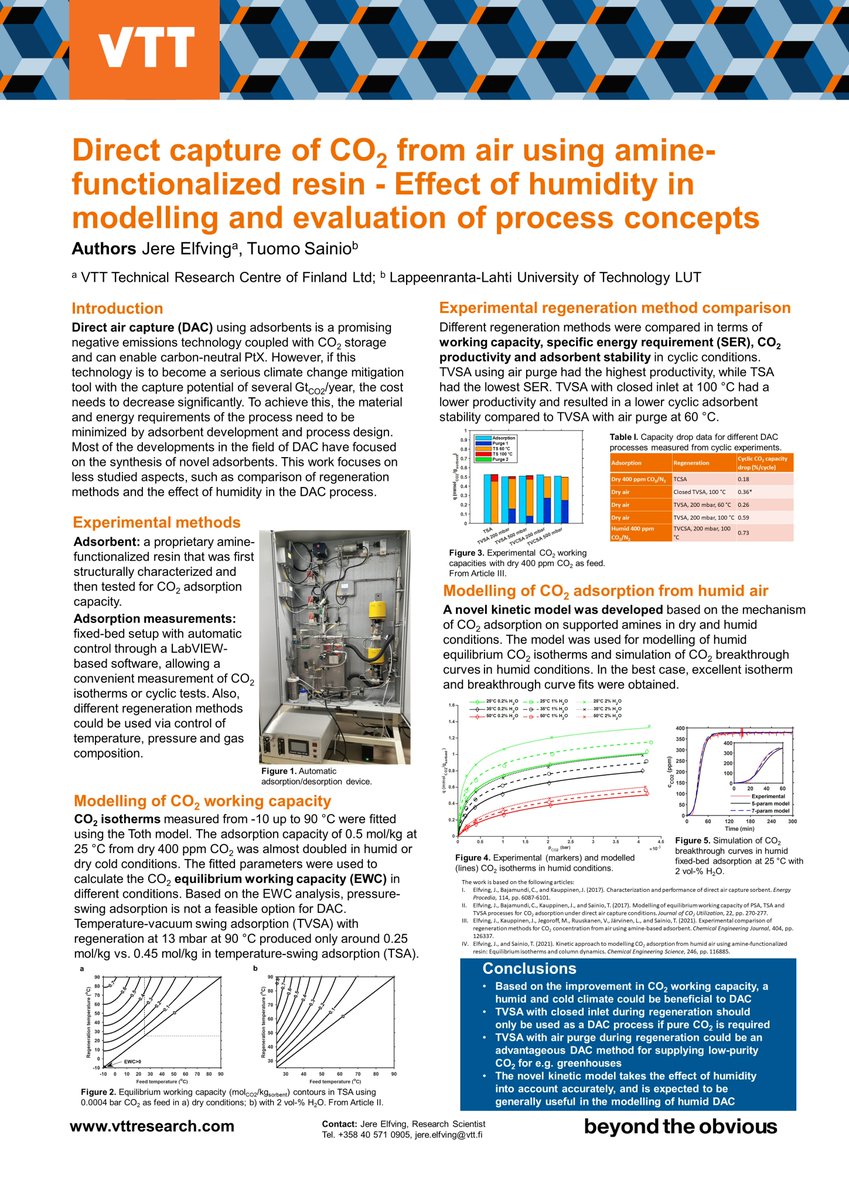
@JNA800389@IntAdsSoc The drop of CO2 capacity in most cases is probably related to amine degradation (loss of adsorption sites). However, it should also be studied whether chemical changes have occurred in the samples via, e.g., comparative ATR-FTIR analysis. This was not done in this work.
@BhubeshMurugapp@IntAdsSoc The sample has a low surface area (32 m^2/g) so N2 adsorption at room temperature and pressure can be assumed negligible. Check Article III (10.1016/j.cej.2020.126337) for cyclic TVSA/TSA results. The amount of sample was too low vs. device dead volume to produce a high purity.
@DavidDanaci@IntAdsSoc I used the same 2 hours as adsorption time for all the experiments in the first two articles. Desorption was typically 1.5 hours. At lower partial pressures the sample was not fully saturated at low temperature, so I used extrapolation in a few cases for "equilibrium capacity".
@CarstenWedler @IntAdsSoc To add: Yes, the water content was also measured continuously using humidity sensors. So both CO2 and H2O breakthrough profiles were measured and later simulated using a dynamic model.
@CarstenWedler @IntAdsSoc Hello. The CO2-containing feed was humidified using a humidity calibrator by passing the feed through an evaporator unit. The composition (CO2, H2O) of the feed was measured before initiating the adsorption phase. More details in: 10.1016/j.ces.2021.116885
@wilkins_ns@IntAdsSoc Hi. The detector is Vaisala GMP343 calibrated up to 5000 ppm. More info about the device in Article III: 10.1016/j.cej.2020.126337. There was heat generated, especially in humid conditions. You can find the temperature profiles in Article IV: 10.1016/j.ces.2021.116885
@lscottblank @IntAdsSoc Hi. The improvement in humid conditions is probably due to formation of bicarbonate and/or hydronium carbamate between CO2 and amines in humid conditions, resulting in a 1:1 ratio of CO2 and required amine groups (vs. ammonium carbamate with CO2/amine ratio 1:2).