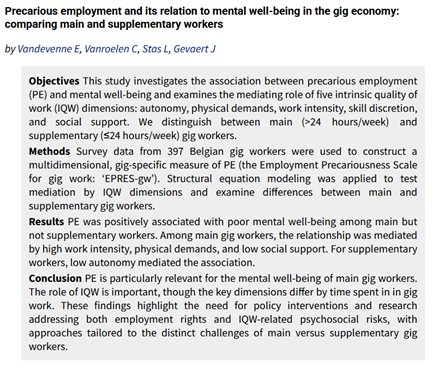
Policy responses focusing solely on employment status & labour rights are necessary but not sufficient. Occupational health strategies must address intrinsic quality of work & distinguish between main vs. supplementary gig workers.
📖 Full study: https://t.co/NPGHuXXfqL (8/8)
📢 Publication alert! Our new study (@SJWEH ) examines how precarious employment is associated with mental well-being in the gig economy — and why not all gig workers are affected the same way.
📌 Main takeaway:
Time spent in gig work shapes psychosocial risk. Traditional risk factors — especially lack of social support — remain highly relevant in platform-mediated work. (7/8)
Skill discretion does not mediate the PE–well-being link, but lower skill discretion is still associated with poorer mental well-being in both groups. (6/8)
🔎 Key finding 2: For main gig workers, this link is largely explained by low social support.
For supplementary workers, low autonomy is the key mediator. (5/8)
We examine the mediating role of five intrinsic quality of work dimensions:
Autonomy
Physical demands
Work intensity
Skill discretion
Social support (2/8)
Together with @ChristopheVanr3 , @stas_lara & @GevaertJessie , we analyse original survey data from 397 Belgian gig workers, including detailed measures of job quality. (1/8)
New Editor's Choice in WORK! 📖 "Measuring employment precariousness in gig jobs" delves into the lives of Brussels' food couriers. A must-read for understanding the gig economy's challenges and opportunities: https://t.co/EnZj44lbP4
#GigEconomy#EditorChoice 🚴♂️💼
BOEKEN - De kluseconomie (bespreking door @EliefV)
@TimChristiaens5 bestudeert de ingewanden van het platformkapitalisme en plaveit de weg naar ‘durfsocialisme’ en ‘platformcoöperativisme’.
https://t.co/WBOmnd2G45
The @ProjectSead consortium has launched a policy brief on occupational change in the Belgian labour market between 1986 and 2020. Interested in our findings? Go to https://t.co/Ep7C3BogAc to consult it.
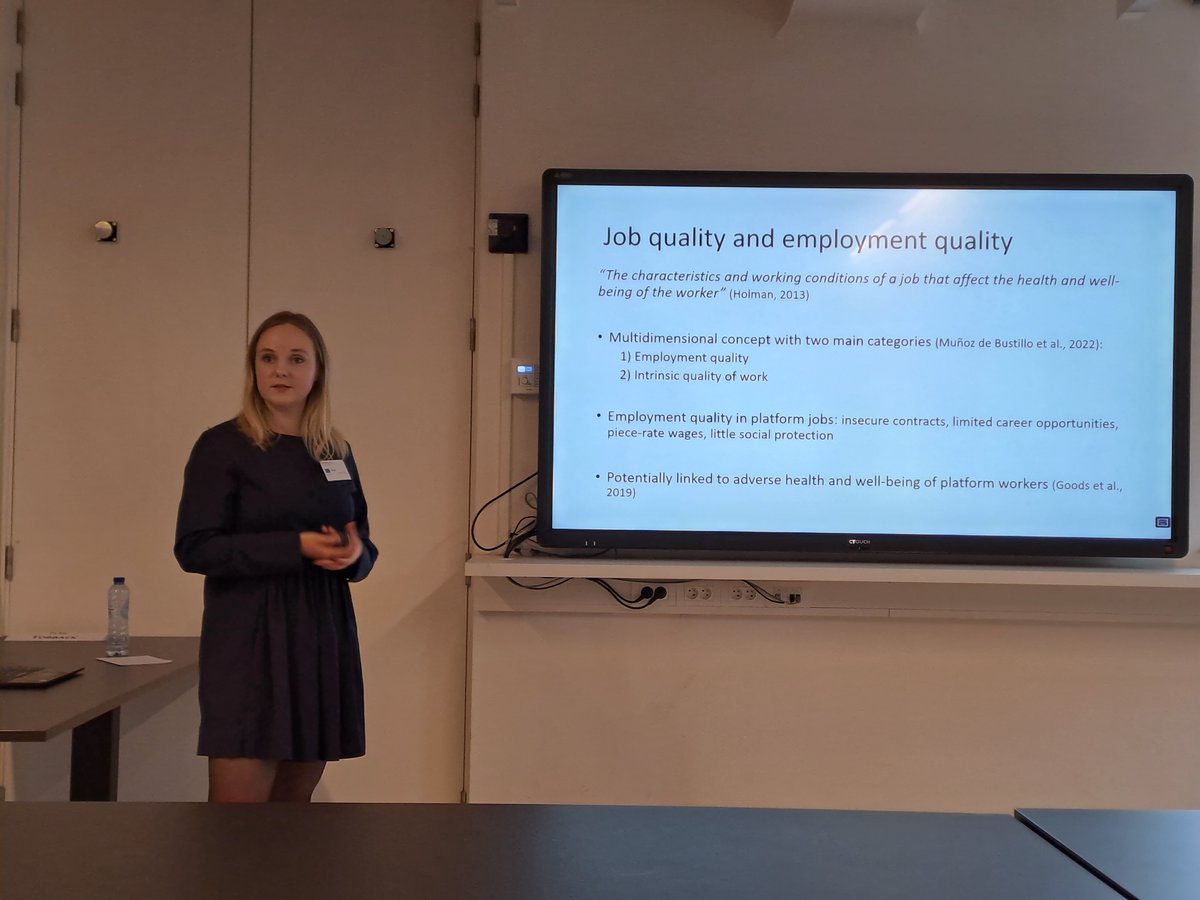
The UNTANGLED conference session on platform and flexible work featured presentations by Uma Rani (@ilo), @EliefV (@ID_VUB) and @RachelEScarfe (@EdinburghUni) on job quality, digitalisation's impact on platform work in developing countries and long-term trends in part-time work.
(6) Findings? The EPRES-gw showed sound reliability and correlated with well-being. We believe that it is a potentially successful instrument for studying employment precariousness in gig jobs.
New paper out in pre-press!🚩https://t.co/zygKk2Tdj6
In this pilot study, @ChristopheVanr3 and myself address the question of how to measure employment precariousness in gig jobs.
(5) Using fieldwork observations, we examine the different dimensions of precarity and adapt them to food couriers. We then quantitatively validate our adapted scale (EPRES-gw).
(3) We propose to address these challenges through the adaptation of an existing, theory-based, multidimensional instrument for measuring employment precariousness.
(2) The few existing measuring instruments that seek to capture precarity in the gig economy assess platforms as job providers, but not the situation of individual gig workers and do not account for different employment situations.